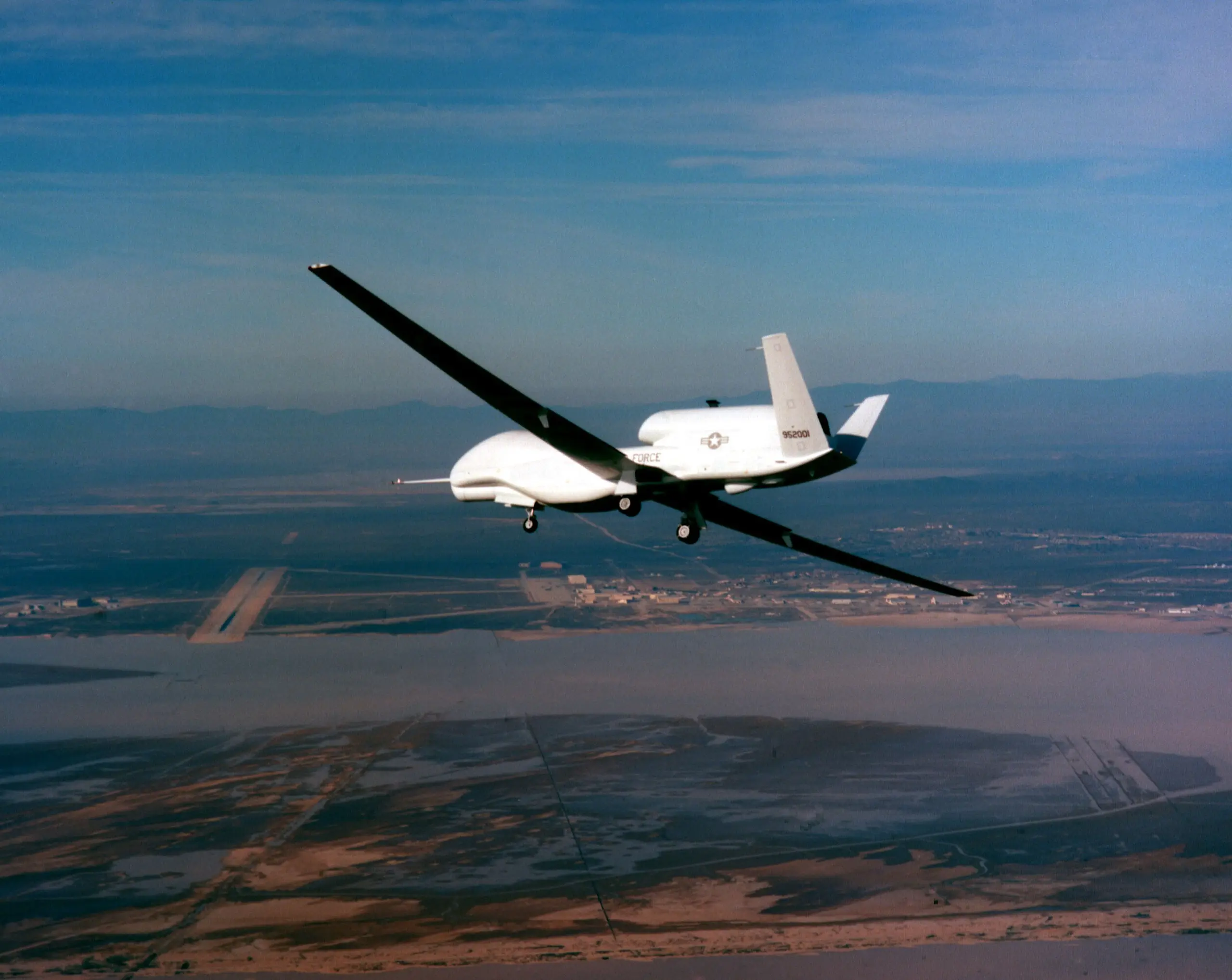
On its first flight, in February 1998, the Global Hawk looked like nothing else at Edwards: a long, thin wing as wide as a Boeing 737’s, a V-shaped tail, an engine perched on its back, and a smooth, windowless bulge where a cockpit would have been. That bulge holds a satellite dish, and the people flying the aircraft through it can be sitting on another continent.
A Global Hawk climbs to about 18,000 m, far above the airliners, and stays there for more than a day, looking down with cameras, infrared sensors, radar and radio receivers. A typical mission is a flight of nearly 2,000 km to the area of interest, a full day circling over it, and the flight home. In 2014 one stayed up for 34.3 hours, longer than any Air Force aircraft had ever flown without refuelling.
In April 2001 a Global Hawk renamed Southern Cross II flew nonstop from California to Australia, the first unmanned aircraft to cross the Pacific, and the record for distance it set that day still stands. Five months later the prototypes were at war, long before testing was finished, and one of them, nicknamed Grumpy, spent more than four thousand hours over Afghanistan and Iraq before it retired to a museum.
The Global Hawk was developed to do the job of the U-2 without a pilot, and for years the two flew the same kind of missions from the same base in California. It turned out to be useful well beyond spying. It photographed the wreckage of Japan’s tsunami and the damaged reactors at Fukushima, flew into hurricanes for NASA, and gave NATO a ground-surveillance fleet of its own.
The drone most people picture, the MQ-9 Reaper, hunts at medium altitude with missiles under its wings; the Global Hawk carries no weapons at all. Its job is to watch, from so high and for so long that it can cover an area the size of a small country in a single day.