Skip to content
Early preview The vault is just opening. New files are added regularly, and some sections are still being built.
VLTARIS
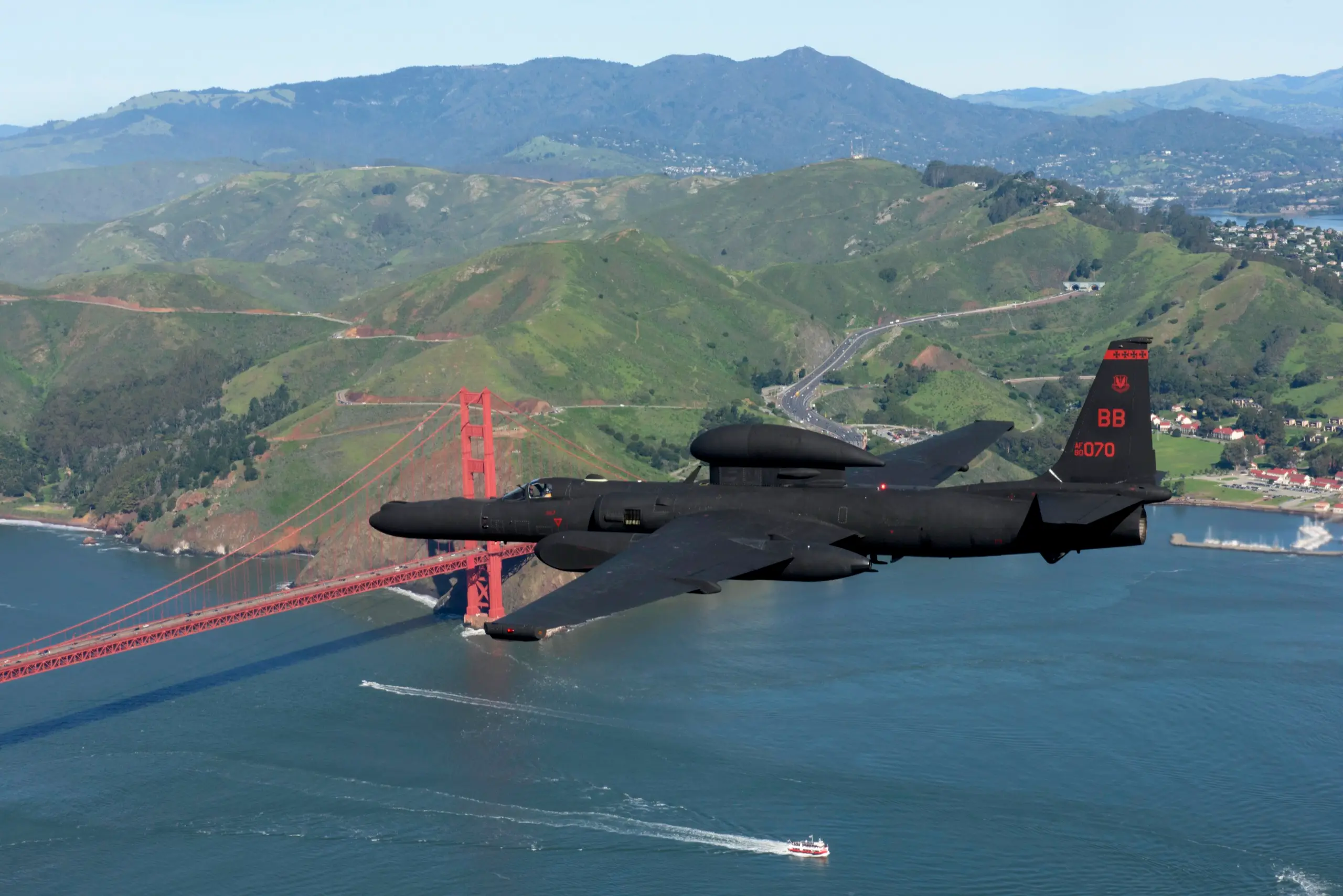
A black U-2 Dragon Lady in flight over the Golden Gate Bridge and the green hills north of San Francisco

Reconnaissance · Cold War · In service

U-2 Dragon Lady

The spy plane that outlived its replacements

Lockheed Skunk Works (now Lockheed Martin)

Where it works: higher than any airliner
21,000+m
Since its first flight, and still flying
71years
Height at which the pilot must let it stall onto the runway
~60cm
Pilots ever qualified to fly it
1,000+

The U-2 is a jet with a glider’s wings: 32 metres of span on a fuselage only 19 metres long, a single engine, and wheels arranged like a bicycle’s, one set up front and one under the tail. Those wings carry cameras and sensors to above 21,000 metres, higher than any airliner, and hold them there for hours. The pilot wears a spacesuit and can see the curve of the Earth. The aircraft has no guns and no missiles. For a few years in the 1950s it needed neither, because nothing on Earth could reach it.

Kelly Johnson’s Lockheed Skunk Works built it in secret for the CIA, which needed to see inside the Soviet Union before there were satellites to do it. Eight months passed between the go-ahead and the first flight. From 1956 the U-2 flew over Russia, and its photographs showed that the feared “bomber gap” and “missile gap” did not exist. Then, on May 1, 1960, a Soviet missile brought down Francis Gary Powers, and a secret aircraft became front-page news.

Two years later a U-2 found Soviet nuclear missiles in Cuba and set off the thirteen most dangerous days of the Cold War. Few airplanes have changed world politics once. This one did it twice, inside thirty months.

It never retired. Satellites were supposed to replace it. The SR-71 Blackbird came along, retired twice and is gone. The U-2s flying today are bigger descendants of the original, the last of them delivered in 1989, with modern engines and sensors, still cruising above 21,000 metres with a lone pilot in a pressure suit. They have watched over Korea, the Balkans, Afghanistan and Iraq, mapped floods and wildfires, and in 2023 one of them photographed a Chinese surveillance balloon from above.

The Air Force has tried again and again to retire the Dragon Lady, and Congress keeps answering “not yet”. In late 2025 the first one went to the boneyard in Arizona. In 2026 the Air Force asked to retire the last 23 by the end of fiscal 2027, and lawmakers are pushing back once more. Seventy years after it first floated off a Nevada lakebed by accident, the Dragon Lady still goes to work.

Thirteen days in October

On Sunday, October 14, 1962, Maj. Richard Heyser took off from Edwards Air Force Base in California, crossed a corridor of western Cuba at high altitude and landed in Florida. Nobody shot at him. Nobody came up to look. By Monday morning CIA photo interpreters were bent over a light table with his 928 photographs, and in a field near San Cristóbal they found what Washington had feared: launch sites being prepared for Soviet medium-range ballistic missiles. "If there was ever a time I want to be right in my life, this is it," said Arthur Lundahl, the man who ran the interpretation centre. On Tuesday morning, President Kennedy, still in his pajamas, was told: "Mr. President, there is now hard photographic evidence that the Russians have offensive missiles in Cuba."

In the days that followed, U-2s flew over Cuba several times a day. On Saturday, October 27, the day historians call Black Saturday, the crisis came closest to war. Maj. Rudolf Anderson Jr. took off from McCoy Air Force Base in Florida and was shot down by an SA-2 missile over eastern Cuba. He was killed. He was posthumously awarded the first Air Force Cross ever presented.

The same weekend, on the other side of the world, another U-2 got lost. Capt. Charles Maultsby, flying an unarmed air-sampling mission from Alaska towards the North Pole, made a navigation error and wandered over the Soviet Union's Chukotka Peninsula. Soviet fighters scrambled. He radioed for help on an open frequency and was guided home. Khrushchev was not amused. "Is it not a fact that an intruding American plane could be easily taken for a nuclear bomber, which might push us to a fateful step?" he wrote to Kennedy. Kennedy replied that the pilot had "made a serious navigational error" and promised that "every precaution" would be taken to stop it happening again.

The next morning Khrushchev agreed to take the missiles out of Cuba. U-2 photographs had started the crisis, and U-2 photographs closed it, confirming over the following weeks that the missiles really were leaving.

The hardest landing in the Air Force

On August 1, 1955, test pilot Tony LeVier was doing a fast taxi run on a Nevada lakebed when the wings lifted him off the ground. "It was at this point that I became aware of being airborne," he reported, "which left me with utter amazement, as I had no intentions whatsoever of flying." The U-2 had not officially flown yet, and its landing problem had already shown up. On the first planned flight three days later, Kelly Johnson told him to land on the front wheels. The U-2 bounced back into the air, and bounced again. Finally LeVier did it his own way, tail wheel first, and it stuck. Ten minutes later a thunderstorm flooded the lakebed.

Those long, thin wings are the whole point of the U-2: they lift heavy sensors into the stratosphere and keep them there for hours. Near the ground they work against it. The plane floats on a cushion of air and does not want to come down, and the pilot, sitting behind a long nose in a bulky pressure suit, can barely see the runway. The Air Force's own fact sheet says these quirks earn the U-2 "a widely accepted title as the most difficult aircraft in the world to fly."

So every landing has a co-pilot in a car. A second U-2 pilot, known as the mobile, chases the jet down the runway in a high-performance car (El Caminos and Mustangs in the old days, Camaros more recently), calling out the height over the radio. "We don't really have a landing procedure," one mobile explained. "You want to get the airplane down below 10 feet, and down to about two feet, and then the power's in idle, so you just want to wait for the airplane to run out of energy." Stall too high and you break the sensors. Touch down too fast and you may run off the runway.

The landing gear adds to it. The U-2 has bicycle wheels: one main set up front and a small set under the tail, all along the centreline, an arrangement that saved a lot of weight and bought extra altitude. To stop the wings scraping on takeoff, each wing has a pogo, a curved steel leg with two little solid rubber wheels. When the wings lift on the takeoff roll, the pogos fall away onto the runway. On landing, the pilot balances on the centreline wheels until the jet slows and tips gently onto a wingtip skid. Then the ground crew run out, push the pogos back in, and the Dragon Lady taxis home on training wheels.

A spy plane on an aircraft carrier

After Powers was shot down, asking allies for permission to fly U-2s from their bases got a lot harder. The Navy's answer was to bring the airfield along. In August 1963, off San Diego, a U-2 took off from the deck of the carrier USS Kitty Hawk without needing the catapult. Landing was harder. The plane bounced, hit a wingtip and only just got airborne again before the end of the deck.

Kelly Johnson went back to work. The carrier version, the U-2G, got a strengthened landing gear, an arresting hook and spoilers on the wings to kill the lift the moment it was over the deck. CIA pilots learned to land the most awkward airplane in the world on a moving ship, and the first clean landing came on March 2, 1964.

Two months later it was used for real. France was preparing to test nuclear weapons at Mururoa Atoll in the South Pacific, and the United States wanted to see the preparations without asking. In Operation Fish Hawk, a U-2G flew off the USS Ranger in May 1964, overflew the test site and landed back aboard, where the film was developed in the ship's own photo lab. The after-action report glowed: "From an operational and security standpoint, this was one of the most successful operations of this nature ever conducted by the United States."

It was also the last. A carrier needs a whole fleet around it and cannot move in secret, while a single U-2 can slip into a remote airfield overnight. The bigger U-2R was tested aboard the USS America in 1969, but no U-2 ever flew another operational mission from a ship.

Missions & Moments

May Day over Sverdlovsk

The plan was the first U-2 flight across the whole of the Soviet Union: take off from Peshawar, Pakistan, photograph the Tyuratam missile range, Sverdlovsk and Plesetsk, and keep going all the way to Bodø, Norway. The pilot was Francis Gary Powers, the most experienced man in the program, with 27 operational missions behind him. He was 30 years old.

Nothing about the morning went to plan. Bad weather had already postponed the flight three times, and the jet prepared for the mission was now due for maintenance, so Powers got a U-2 with a reputation for malfunctioning. He trusted it so little that, for the first time, he accepted the CIA's offer of a poison pin hidden in a silver dollar. Then, on May 1, 1960, he sat sealed in his suit at the end of the runway, sweating in the sun, waiting for a "go" that did not come. Radio conditions at sunrise were so bad that the message from Washington only got through when an operator in Peshawar picked a garbled Morse signal out of the static: "HBJGO HBJGO". HBJARGON, go. The detachment chief sprinted across the airfield to wave Powers off.

May Day turned out to be the wrong day to fly over Russia. The holiday had grounded most military flights, so Soviet radars had the sky almost to themselves, and they were tracking the U-2 before it crossed the border. Deep inside Russia the autopilot failed. Powers pressed on, flying by hand. Near Sverdlovsk he heard a dull thump, the aircraft lurched forward and a bright orange flash lit the sky: an SA-2 missile had exploded just behind him. The U-2 went out of control and spun down tail first, pinning him forward against the canopy, so that ejecting would probably have cost him both legs.

He climbed out instead. He released the canopy and his seat belt and was flung halfway out of the cockpit, still tethered by his oxygen hoses, his faceplate frosted over so that he could not see. He kicked until the hoses snapped. Then everything went quiet. The parachute had opened on its own. On the way down he watched a piece of his plane float past, and he tossed the silver dollar away and kept the pin. The Soviets, it later emerged, had fired a salvo of three missiles that day. One of them shot down a MiG-19 sent up to chase him, and killed its pilot.

Washington assumed nobody could survive a fall from above 21,000 metres, so it reached for the cover story: a NASA weather plane had strayed off course after its pilot reported oxygen trouble. Nikita Khrushchev let the Americans walk into it, releasing the news one piece at a time. "Our intention here was to confuse the government circles of the United States," he wrote later. "As long as the Americans thought the pilot was dead, they would keep putting out the story that perhaps the plane had accidentally strayed off course and been shot down in the mountains on the Soviet side of the border." Then he produced the pilot, alive, and much of his airplane with him. The Paris summit fell apart, and Eisenhower ended flights over the USSR.

Powers got a show trial, which opened on his 31st birthday, and a sentence of ten years. After 21 months, on February 10, 1962, he was walked onto the Glienicke Bridge in Berlin and exchanged for the Soviet spy Rudolf Abel. Before he crossed, a Soviet consular official had a parting word for him: "The next time you come to see us, come as a friend."

The crews

In seven decades, a little more than 1,000 pilots have qualified on the U-2. The first of them did not officially exist. President Eisenhower believed that military pilots over the USSR would look like an act of war, so U.S. Air Force Reserve fighter pilots resigned and went to work for the CIA, on paper as Lockheed employees. British RAF pilots flew in the program too. Today U-2 pilots are Air Force officers of the 9th Reconnaissance Wing at Beale Air Force Base, California, deploying around the world for missions that can last more than ten hours, with nobody else aboard.

The interview
Pilots come from every background: fighters, bombers, tankers, transports, even the Navy, Marines and Coast Guard. After an application and an interview at Beale, finalists fly three sorties in the two-seat trainer to see whether they can handle it. Only then does the training start.
Coffin corner
At altitude, early U-2s had to hold one very precise speed: a little slower and the wing stalled, a little faster and the airframe started to shake apart. The gap was only about 11 km/h. Pilots called it the coffin corner.
Why the spacesuit
Above 21,000 metres, an unprotected pilot would stay conscious for only a few seconds. U-2 pilot Lt. Col. Neal Hinson put it more vividly: “we wear a spacesuit for a reason, because if you’re exposed to it, your eyes pop out, your blood boils, and it gets really gross.”
An hour of pure oxygen
Before every flight the pilot is zipped into a full pressure suit and spends about an hour breathing pure oxygen to flush nitrogen from the blood and prevent the bends. Technicians walk them to the jet on a portable oxygen supply so the breathing never stops.
Pudding before landing
Meals come as tube food through a port in the helmet: peach cobbler, Key lime pie, even truffle macaroni and cheese. One popular choice is chocolate pudding loaded with caffeine: pilots often open a caffeinated tube shortly before landing, to be wide awake for the hardest part of the flight.

Names worth knowing

  • Tony LeVier Lockheed test pilot

    Flew the first U-2, first by accident on a taxi test, then for real in August 1955. At 42 he became the oldest pilot to complete the Air Force's partial-pressure suit training.

  • Hervey Stockman First overflight

    Flew the first U-2 mission over the Soviet Union on July 4, 1956. His aircraft, Article 347, is now on display at the Smithsonian in Washington, D.C.

  • Francis Gary Powers CIA pilot

    Shot down over the USSR in 1960 and exchanged in 1962. Cleared of all misconduct, he later flew U-2s as a Lockheed test pilot and died in 1977 flying a TV traffic helicopter in Los Angeles. The CIA posthumously awarded him its Director's Medal in 2000.

  • Richard S. Heyser Cuba, October 14, 1962

    One of only two Air Force pilots checked out on the CIA's modified U-2 at the time. His 928 photographs revealed the Soviet missiles in Cuba.

  • Rudolf Anderson Jr. Killed over Cuba

    Shot down by an SA-2 missile on October 27, 1962, at the height of the crisis. He was posthumously awarded the first Air Force Cross.

Did You Know?

The "U" stands for utility. The designation was chosen to mislead about the airplane's top-secret intelligence role.
Area 51 was born as the U-2's secret test site. To make the middle of nowhere sound more attractive to his workers, Kelly Johnson called it the Paradise Ranch.
After Powers was shot down, a U-2 was hastily painted in fake NASA markings with a made-up serial number and shown to reporters, to prop up the story that it was a weather plane.
Its nickname, "Dragon Lady", was borrowed from a comic-strip character of the 1930s.
NASA's U-2s helped collect volcanic dust from the stratosphere after Mount St. Helens erupted in 1980.
To mark 70 years in 2025, two U-2 pilots flew a two-seat TU-2S over all 48 contiguous U.S. states in one go: some 9,700 km in more than 14 hours, the longest flight the type has ever made.

Myth vs. fact

Myth

U-2 pilots were under orders to kill themselves if they were captured.

Fact

The CIA offered its pilots a poison pin, hidden in a silver dollar; it never ordered them to use it. Francis Gary Powers had always turned it down and took it for the first time on May 1, 1960, because he distrusted his airplane. Hanging under his parachute, he decided not to use it, threw the coin away and kept the pin in his pocket.

Myth

The wave of UFO sightings over America in the late 1950s must have been something unexplained.

Fact

Much of it was the U-2. Nobody believed a plane could fly above 18,000 metres, so when airline pilots at dusk saw a silver U-2 still lit by the sun far above them, it looked like a fiery object. According to the CIA's own history, U-2 and later OXCART flights accounted for more than half of all UFO reports in the late 1950s and most of the 1960s. Air Force investigators checked the reports against U-2 flight logs, but could never tell the public the real answer.

Timeline

  1. Aug 1955

    Lockheed test pilot Tony LeVier flies the first U-2 at a secret dry lakebed in Nevada, eight months after the CIA gave the go-ahead. Days earlier, it had taken off by accident during a taxi test.

  2. Jul 4, 1956

    The first U-2 overflight of the Soviet Union, flown by Hervey Stockman, brings back photos of Leningrad's shipyards.

  3. May 1, 1960

    CIA pilot Francis Gary Powers is shot down near Sverdlovsk. The Paris summit collapses two weeks later.

  4. Feb 10, 1962

    Powers is swapped for Soviet spy Rudolf Abel on the Glienicke Bridge in Berlin.

  5. Oct 14, 1962

    Maj. Richard Heyser's U-2 photographs Soviet missile sites in Cuba. The Cuban Missile Crisis begins.

  6. Oct 27, 1962

    Maj. Rudolf Anderson Jr. is shot down and killed over Cuba. He receives the first Air Force Cross.

  7. May 1964

    Operation Fish Hawk: a U-2 flies off the carrier USS Ranger to photograph France's nuclear test site in the Pacific.

  8. 1967

    The U-2R flies: 40 percent bigger than the original, and the ancestor of today's U-2S.

  9. Oct 1989

    The last new U-2 is delivered. Since the 1990s the whole fleet has been re-engined and upgraded as the U-2S.

  10. Feb 3, 2023

    A U-2 pilot photographs the Chinese surveillance balloon drifting over the central United States, from above.

  11. 2025–26

    A 14-hour flight over all 48 contiguous states marks the 70th anniversary. Months later the first U-2 goes to the boneyard, and the Air Force asks to retire the last 23. Congress pushes back again.

Who flies it

  • United States

    23

    US Air Force

    U-2S and two-seat TU-2S, all with the 9th Reconnaissance Wing at Beale. The Air Force wants to retire all of them by the end of fiscal 2027; a draft 2027 spending bill would allow only two.

  • United States

    2

    NASA

    ER-2 civilian versions, flown from Palmdale, California, for earth and atmospheric science.

Former operators: United States, United Kingdom, Taiwan

Fleet figures as of mid-2026; numbers change as aircraft are delivered and retired.

Where to see one today

The earliest U-2s are museum pieces now, including the airplane that made the first flight over the Soviet Union.

United States· 4

  • Smithsonian National Air and Space Museum

    Washington, D.C.

    The seventh U-2 built, which flew the first overflight of the Soviet Union on July 4, 1956.

    56-6680U-2C · indoors
  • Museum of Aviation

    Robins AFB, Georgia

    Its last job was with NASA. In April 1989 it set 16 altitude and time-to-climb records for its class, then was flown to the museum.

    U-2C
  • Strategic Air Command & Aerospace Museum

    Ashland, Nebraska

    Nicknamed “The Saint” while flying thunderstorm research. Also served with the CIA.

    56-6701U-2C
  • National Museum of the US Air Force

    Dayton, Ohio

    The last U-2A built. In the 1960s it made 285 flights studying high-altitude turbulence. In the Cold War Gallery.

    U-2A · indoors

Locations last checked October 2026. Airframes occasionally move, so check with the museum before you travel.

On screen

Where the U-2 Dragon Lady became a star outside the hangar.

  • Film · 2015

    Bridge of Spies

    Steven Spielberg's film shows Powers' U-2 being shot down over the USSR, and builds to his exchange for Rudolf Abel on the Glienicke Bridge.

  • Film · 2000

    Thirteen Days

    The Cuban Missile Crisis from inside the White House: U-2 photos start the crisis, and the loss of Maj. Rudolf Anderson's U-2 brings it to the brink.

Sources

Facts last reviewed October 2026

  1. 1. U.S. Air Force: U-2S/TU-2S fact sheet (specifications, mission, history)
  2. 2. National Museum of the U.S. Air Force: Lockheed U-2A, Dragon Lady: The U-2 and Early Cold War Reconnaissance, Origins of the U-2, U-2 Mission, The Powers Incident, Flying the U-2 and Cuban Missile Crisis
  3. 3. Gregory W. Pedlow & Donald E. Welzenbach, The Central Intelligence Agency and Overhead Reconnaissance: The U-2 and OXCART Programs, 1954–1974 (CIA History Staff, 1992)
  4. 4. CIA: “May Day Over Moscow: The Francis Gary Powers Story”
  5. 5. CIA: “Project Whale Tale: U-2 Flights off Aircraft Carriers”
  6. 6. CIA Museum: U-2 model used by Francis Gary Powers
  7. 7. Peter W. Merlin, Unlimited Horizons: Design and Development of the U-2 (NASA, 2015)
  8. 8. NASA Airborne Science Program: ER-2
  9. 9. Smithsonian National Air and Space Museum: Lockheed U-2C and Von Hardesty, “The Curious Story of a Cuban Missile Crisis Artifact” (2012)
  10. 10. U.S. Department of State, Office of the Historian: Khrushchev to Kennedy, October 28, 1962 and Kennedy to Khrushchev, October 28, 1962 (FRUS 1961–63, vol. VI)
  11. 11. Michael Dobbs, One Minute to Midnight: Kennedy, Khrushchev, and Castro on the Brink of Nuclear War (Knopf, 2008)
  12. 12. Air & Space Forces Magazine: “U-2 Chase Cars Guide Pilots and Plane to Safety” (2017), “Facing Retirement, U-2 Flies Record Mission to Celebrate 70 Years” (Aug 2025), 2027 budget report (Apr 2026) and “U-2 Would Avoid Chopping Block Under Draft Spending Bill” (Jun 2026)
  13. 13. Chris Pocock, “Congress limits divestment, but first U-2 is sent to the ‘boneyard’”, Dragon Lady Today (Jan 2026)
  14. 14. DVIDS: “99th ERS Airmen maintain U-2 flight suits” and “U-2 Pilot over Central Continental United States” (Department of Defense, 2023)
  15. 15. Lockheed Martin: U-2S Dragon Lady
  16. 16. SAC Aerospace Museum: U-2C “Dragon Lady”; Museum of Aviation: U-2C Dragon Lady
  17. 17. DreamWorks / Touchstone, Bridge of Spies (2015); Beacon Pictures / New Line, Thirteen Days (2000)
  18. 18. Gallery and hero photos via Wikimedia Commons and DVIDS (U.S. government works, public domain): U-2 over the Golden Gate Bridge, U-2 with fictitious NASA markings, U-2 landing on USS America