Skip to content
Early preview The vault is just opening. New files are added regularly, and some sections are still being built.
VLTARIS
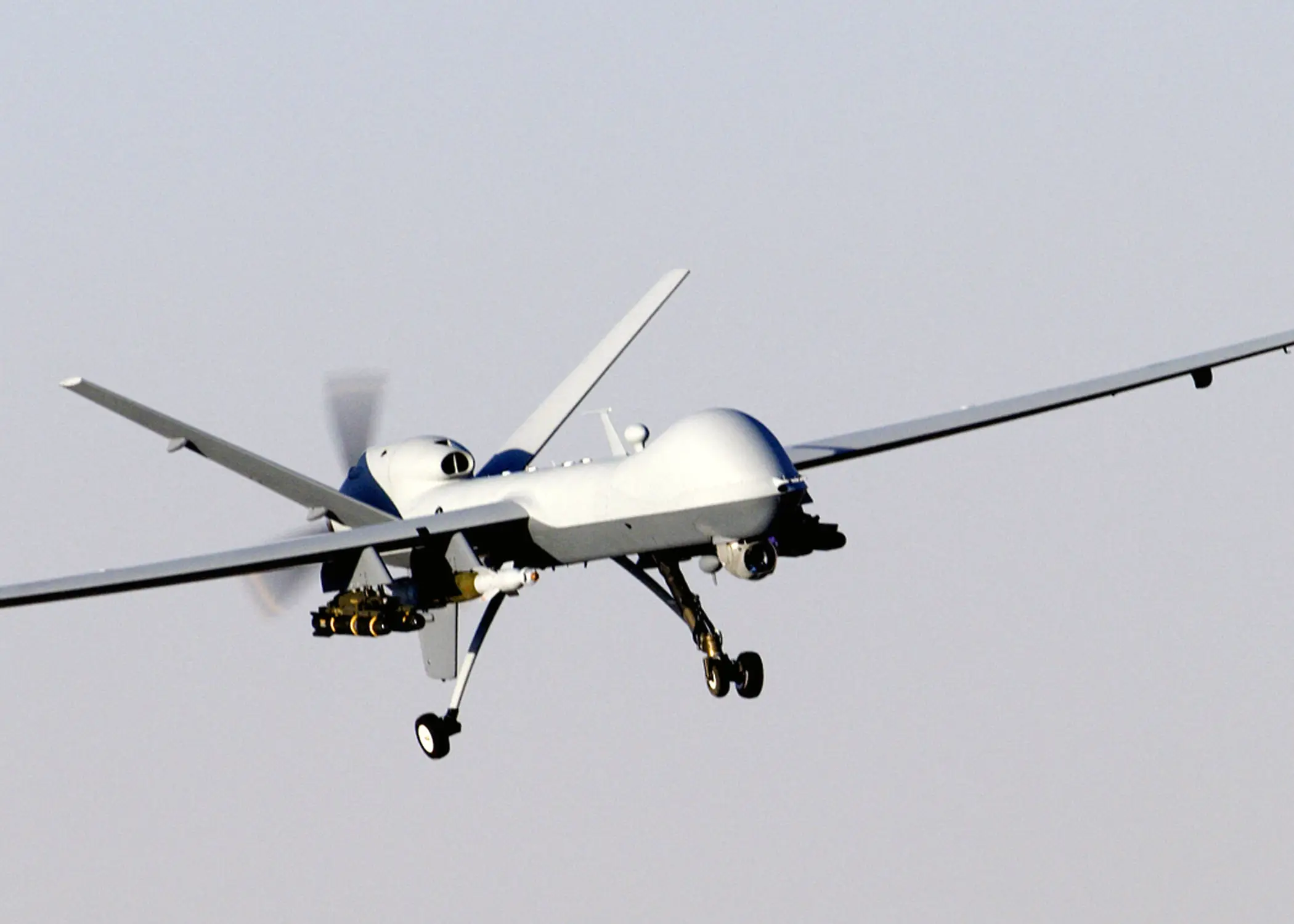
Early MQ-9 Reaper with its landing gear down, coming in to land against a pale sky

Drone · Modern · In service

MQ-9 Reaper

Twenty-seven hours aloft with nobody aboard

General Atomics Aeronautical Systems

Endurance on a single flight
27+hours
Crew, both on the ground
2
Service ceiling
15,240m
Combat hours flown by the museum's Reaper
3,266

A Reaper’s nose has no windows, because there is nobody inside to look out of them. The rest of the aircraft follows from that: a skinny grey body with a bulbous nose where a cockpit would be, wings far too long for the fuselage, and a propeller turning at the back. Parked on a ramp it looks almost gangly. It changed a rule of aviation that had held since 1903. The crew does not have to be in the aircraft.

A Reaper can stay up for more than a day. Its crew can’t, so they don’t try. A pilot and a sensor operator fly it from a ground control station, often at Creech Air Force Base in the Nevada desert, while the aircraft circles over a different continent. When their shift ends a fresh crew slides into the seats and the Reaper never notices. Then the airmen drive home. No other combat aircraft has asked so strange a thing of the people who fly it.

Its parent, the Predator, proved in the 1990s that a remotely piloted aircraft could watch a battlefield for hours on end. The Reaper took that idea, added a turboprop with nine times the power and room for far more weapons and sensors, and became the first US Air Force drone built from the start as a hunter-killer. It is a weapon, and its crews treat it as one. Since 2018 it has done the job alone: the Air Force flies Reapers and no more Predators.

Some of its best work has had nothing to do with war. NASA flew an unarmed version called Ikhana to map wildfires through the smoke. California’s Air National Guard sends its Reapers over the state’s fires nearly every summer, and in 2020 one helped helicopter crews find their way to more than 200 people trapped by flames. In March 2023 a Reaper’s own camera filmed the moment a Russian fighter flew into it over the Black Sea.

Nearly two decades in, the Reaper is still everywhere. It flies for the United States and five European air forces. Britain retired its Reapers in 2025 for the bigger MQ-9B Protector, and the US Air Force plans to keep about 140 of them flying into the mid-2030s. Their pilots will clock up another decade of combat hours without leaving the ground.

A cockpit on the other side of the world

The crew that takes a Reaper off is usually not the crew that flies its mission, and the two may be on different continents. The Air Force calls the arrangement remote split operations. A small launch and recovery team lives near the runway, wherever in the world that is. They have to be close, because they fly the takeoff over a direct radio link, and that only works in line of sight.

Once the Reaper has climbed away, it gets handed over the horizon by satellite. As Capt. Aileen Herrera described it at Kandahar Airfield in 2018: "once we get above a certain altitude, we release the controls to crews back stateside." Back stateside usually means Creech Air Force Base, in the Nevada desert, home of the 432nd Wing, where a pilot and a sensor operator pick up the aircraft from a ground control station. At the end of the sortie, the process runs in reverse, and the local team lands it.

The split shaped the lives of the crews. For years, Reaper airmen have flown a shift over another continent and then driven home to their families in Nevada. The Royal Air Force did the same: its crews flew Reapers from Creech, alongside the Americans, and later from RAF Waddington in Lincolnshire, home of XIII Squadron.

The next step is to do without the runway team altogether. In 2023, Creech's 489th Attack Squadron started proving Satellite Launch and Recovery, in which the takeoff and landing are flown over the satellite link as well. It puts fewer people forward and opens up some unusual airfields. In April 2023, during an exercise, a Reaper landed on Highway 287 in Wyoming.

The link is also the weak point. In September 2009, over Afghanistan, controllers lost "positive control" of a Reaper. When it stayed on a course that would take it out of Afghan airspace, a US Air Force manned aircraft brought it down in a remote area of northern Afghanistan, into the side of a mountain. Nobody on the ground was hurt.

From Predator to Reaper

In the mid-1990s General Atomics built the Predator, a slender, long-winged drone with a bulbous nose and a propeller at the back, and the Reaper still wears that shape. The unarmed RQ-1 version first deployed in July 1995, flying out of Albania. In October 2001, over Afghanistan, armed Predators flew their first missions, and a drone that could watch and strike stopped being a theory.

The Predator was small. In 2000, General Atomics started work on something bigger, partly funded by NASA, which wanted a civil version that could lift heavier science instruments, fly higher and stay up longer. The result, the Predator B, first flew in February 2001. In place of the Predator's piston engine it had a Honeywell turboprop, and General Atomics says the MQ-9 carries 500% more payload with nine times the horsepower.

The Air Force took it on. The design became the MQ-9 (the "M" for multi-role, the "Q" for unmanned, the "9" for its place in the series), and in 2006 it was named Reaper. The Air Force wanted a hunter-killer, faster and higher-flying than its parent and carrying far more weapons.

For a while, parent and child flew side by side, taxiing out of the same Nevada base at sunrise. Then, on 9 March 2018, a crew from the 489th Attack Squadron arrived at Creech at 4:45 a.m., took a Predator up for the last time, and the type retired from the Air Force. Since then the Reaper has carried the family name alone, and its own descendant, the MQ-9B, is already flying for the RAF as the Protector.

Fire watch: a Reaper over the flames

In California the Reaper has a second job, and it comes round with the fire season. An airframe that can stay up for a day and see in infrared makes a very good fire lookout.

NASA proved it first. In October 2006, its Altair, a civil Predator B, spent 16 hours over the Esperanza Fire, which killed five firefighters, mapping its edges for the crews below. Then came Ikhana, NASA's own Predator B (the name is a Choctaw word meaning intelligent, conscious or aware). In 2007 it imaged twenty wildfires across six Western states, and that October it flew over the Southern California firestorms too. A thermal scanner in a wing pod peered through the smoke, and within minutes the images were laid over Google Earth maps and passed to fire commanders in the field.

The California Air National Guard took the idea operational. Its 163d Attack Wing flew its Reapers over the Rim Fire near Yosemite in 2013, and now does it nearly every summer. During the Thomas Fire in December 2017, a Reaper remapped the fire's edges in about three hours and found it had spread kilometres further than anyone on the ground knew. "They were unaware that it has spread that far, that fast," said Capt. Michele Garcia, the mission intelligence coordinator. A Cal Fire officer, Jeremy Salizzoni, described what the live video meant to firefighters: "It was like being blind and then having vision."

In September 2020, at the Creek Fire, flames trapped more than 200 campers near Mammoth Pool Reservoir in the Sierra National Forest, with the only road cut off. A Guard Reaper crew circling overhead looked for somewhere helicopters could land; the aircraft's infrared sensor, as Capt. Eric Jeppsen put it, "cut through the smoke." Army National Guard Chinook and Black Hawk crews flew in on night-vision goggles through smoke so thick they had to rely on their instruments to land. In the end, 242 people and 16 dogs were flown out. The helicopter pilots received the Distinguished Flying Cross.

The same work has been done over water. In September 2024, when floods swept across Central Europe, airmen of the Texas Air National Guard's 147th Attack Wing ran a satellite dish at Ostrava, Czechia, so Reaper imagery could flow in real time to Czech emergency services.

Armament

Hellfire missiles
Laser-guided AGM-114 Hellfire missiles under the wings, used against small, fast-moving targets.
Guided bombs
Laser-guided GBU-12 Paveway II and satellite-guided GBU-38 JDAM bombs. The Reaper can lase its own targets with the sensor ball under its nose.
Room to carry
About 1,700 kg of payload, mixed and matched with sensor pods as "mission kits". General Atomics puts that at 500% more than the Predator could carry.
A Sidewinder, in tests
In November 2017, during a test, a Reaper fired a heat-seeking air-to-air missile at a manoeuvring target drone and scored a direct hit.

Missions & Moments

Forty-Two Seconds over the Black Sea

14 March 2023, early morning, high over the Black Sea. A US Air Force MQ-9 Reaper is flying slow circles in international airspace, watching. Its pilot and sensor operator are following it on screens from a long way off.

Somewhere between about 74 and 93 kilometres from land, two Russian Su-27 fighters intercept it. They are twin-tailed and far faster than anything the Reaper could outrun, and the encounter goes on for at least half an hour. According to US European Command, the Su-27s "dumped fuel on and flew in front of the MQ-9 in a reckless, environmentally unsound and unprofessional manner."

The Reaper's own camera, looking backwards at its tail, records what happens next. Two days later, European Command releases 42 seconds of that footage, along with a second-by-second description. A fighter slides in behind the drone and sprays a plume of fuel as it passes overhead, briefly scrambling the video. When the picture comes back the propeller is still turning, undamaged. On the second approach there is more fuel, and the jet passes closer.

At about 7:03 a.m. Central European Time, the Su-27 hits the Reaper. The camera feed goes dead for around a minute. When it returns, one blade of the propeller is visibly bent. "They collided with the aircraft, damaging the propeller, and essentially putting it in a situation where it was unflyable and uncontrollable, so we brought it down," explained Pentagon spokesman Brig. Gen. Patrick Ryder. The crew flew their crippled aircraft into the sea, in water more than 1,200 metres deep, and the US took steps to make sure anything sensitive on the wreck would be of no use to anyone.

Gen. James Hecker, commander of US Air Forces in Europe, put it bluntly: "Our MQ-9 aircraft was conducting routine operations in international airspace when it was intercepted and hit by a Russian aircraft, resulting in a crash and complete loss of the MQ-9." And then: "In fact, this unsafe and unprofessional act by the Russians nearly caused both aircraft to crash." Russia's Defence Ministry denied that its jets had struck the drone, saying it had crashed after sharp manoeuvring.

Intercepts over international waters are routine, and this one was not. As White House spokesman John Kirby noted, it was "the first time that an intercept resulted in the splashing of one of our drones." The Reaper's crew lost their aircraft and then walked out of the ground control station at the end of the shift, as they always do. When a Reaper goes badly wrong, the machine is the only thing that falls out of the sky.

The crews

Nobody flies in a Reaper. Its crew sits in a ground control station, a cockpit in a box, often thousands of kilometres from the aircraft. The basic team is two: a pilot, who flies the aircraft, and a sensor operator, who runs the cameras, the infrared sensor and the laser designator. Many missions add a mission intelligence coordinator to make sense of what they're seeing. A sortie can last close to a day, so crews swap seats in shifts while the aircraft stays on station.

The enlisted eye
Sensor operators are enlisted airmen, some as young as 20. They run the Reaper's Multi-Spectral Targeting System and lase targets for guided weapons. An enlisted crew member at the heart of the strike is unusual in the Air Force, and in 2018 one Reaper pilot called her sensor operator her copilot.
A school in the desert
New Reaper pilots and sensor operators learn the trade at Holloman Air Force Base, New Mexico, before joining operational squadrons such as those at Creech in Nevada.
First names only
Air Force stories about Creech crews name them by rank and first name only: "Lt. Col. David", "Senior Airman Than". Look for it in almost any official story about them.
Wanted overhead
Ground troops learned what a Reaper overhead was worth. "When we are not flying, the troops on the ground are calling to see how soon we can get back up there," Capt. Aileen Herrera said in Afghanistan in 2018.

A mission day

  1. 1

    Launch

    A launch and recovery crew near the runway does the walk-around, starts the turboprop and flies the takeoff over a line-of-sight radio link.

  2. 2

    Handover

    Once the Reaper is high enough, control passes by satellite to a mission crew, often at Creech in Nevada, half a world away.

  3. 3

    On station

    Hours of watching follow. Pilots and sensor operators rotate in shifts so there are always fresh eyes on the screens, while the aircraft keeps circling.

  4. 4

    Recovery

    The local team takes control back for the landing, unless the sortie uses the newer satellite launch and recovery, flown entirely from afar.

Did You Know?

In MQ-9, "M" means multi-role, "Q" means unmanned aircraft system, and "9" is its number in the series of purpose-built remotely piloted aircraft.
General Atomics started the Predator B in 2000 with partial funding from NASA, which wanted a high-flying, long-endurance science aircraft.
A Reaper can be taken apart and packed into a container, then flown anywhere in the world inside an Air Force transport such as a C-130.
It has scored an air-to-air kill, in a test. Col. Julian Cheater recalled that in November 2017, "we recently in November … launched an air-to-air missile against a maneuvering target that scored a direct hit."
In July 2018, its descendant the MQ-9B SkyGuardian flew from North Dakota to RAF Fairford in England in just over 24 hours, the first transatlantic flight by a medium-altitude, long-endurance drone.
In June 2018, NASA's Ikhana became the first aircraft to get FAA permission to fly a remotely piloted mission through US civil airspace with no chase plane and no ground observers, relying on its own detect-and-avoid system.

Myth vs. fact

Myth

A drone like the Reaper flies itself.

Fact

The Air Force calls it a remotely piloted aircraft, and the words are chosen with care. Every Reaper mission has a human pilot and a sensor operator at the controls, plus a launch and recovery crew, and people decide where it goes and what it does. The 2009 Afghanistan loss shows what happens when that human link breaks: with control lost, the Air Force sent a manned aircraft to bring it down.

Timeline

  1. Jul 1995

    The Reaper's ancestor, the unarmed RQ-1 Predator, first deploys, flying out of Albania.

  2. Feb 2001

    General Atomics' bigger, turboprop-powered Predator B makes its first flight. NASA had helped pay for its development.

  3. 2006

    The US Air Force gives the MQ-9 its official name: Reaper. In November, NASA takes delivery of its own unarmed version, Ikhana.

  4. Oct 2007

    The MQ-9 reaches initial operating capability with the US Air Force, weeks after the first Reapers began flying in Afghanistan.

  5. Oct 2007

    NASA's Ikhana images the Southern California wildfires through the smoke, sending maps to fire commanders within minutes.

  6. Jan 25, 2010

    The first Reaper to fly in Afghanistan goes on display at the National Museum of the U.S. Air Force.

  7. Aug 2013

    California Air National Guard Reapers fly over the Rim Fire near Yosemite: the start of a yearly fire-season job.

  8. Mar 9, 2018

    The last US Air Force MQ-1 Predator flies at Creech AFB, Nevada. The Air Force is now an all-Reaper force.

  9. Sep 2020

    During the Creek Fire, a Guard Reaper crew finds landing zones through the smoke for helicopters rescuing more than 200 trapped people.

  10. Mar 14, 2023

    Over the Black Sea, a Russian Su-27 strikes a Reaper's propeller and US controllers bring it down into the sea.

  11. Sep 30, 2025

    The Royal Air Force flies its last Reaper after 18 years, handing over to the MQ-9B Protector.

Who flies it

  • United States

    US Air Force

    Active duty, Air National Guard and Reserve. The Air Force plans to keep about 140 Reapers into the mid-2030s.

  • United States

    Department of Homeland Security

    Flies the Predator B for homeland security missions.

  • Italy

    Ordered two more MQ-9A Block 5s in September 2026, due by the end of 2027.

  • Poland

    Leased MQ-9As from 2022.

Also flown by: France · Spain · Netherlands

Former operators: United Kingdom, United States

Fleet figures as of 2026; numbers change as aircraft are delivered and retired.

Where to see one today

Almost every Reaper is still working, so museum examples are rare. The one below is the first Reaper that ever flew in Afghanistan.

United States· 1

  • National Museum of the U.S. Air Force

    Dayton, Ohio

    In the Modern Flight Gallery, near the Global Hawk. One of two pre-production Reapers sent to Afghanistan, it flew 3,266 combat hours before retiring. On display since January 2010.

    02-4002YMQ-9 (pre-production) · indoors

Locations last checked October 2026 (museum fact sheet listing). Airframes occasionally move, so check with the museum before you travel.

Sources

Facts last reviewed October 2026

  1. 1. U.S. Air Force: MQ-9 Reaper fact sheet and the 2008 edition (via GovInfo): specifications, designation, crew, weapons, initial operating capability
  2. 2. General Atomics Aeronautical Systems: MQ-9A Reaper (endurance, speed, payload, operators) and SkyGuardian completes first trans-Atlantic flight (2018)
  3. 3. General Atomics: New MQ-9 Reaper exhibit opens at National Museum of the US Air Force (2010) and GA-ASI to deliver MQ-9A Reapers to Poland (2022)
  4. 4. National Museum of the U.S. Air Force: General Atomics Aeronautical Systems YMQ-9 Reaper
  5. 5. Andreas Parsch, General Atomics MQ-9 Reaper (Predator B), Directory of U.S. Military Rockets and Missiles (first flight, designation, name)
  6. 6. U.S. Air Force / GlobalSecurity: Oct. 27 airpower summary: Reaper conducts first strike (2007)
  7. 7. U.S. Air Force / GlobalSecurity: Reaper crashes in Afghanistan (AFNS, 14 September 2009)
  8. 8. DVIDS: Sun setting the MQ-1 Predator: a history of innovation (2018)
  9. 9. DVIDS: MQ-9 Reaper keeps eyes on targets (Kandahar, 2018)
  10. 10. DVIDS: SLR: creating new legacy (satellite launch and recovery, 2023)
  11. 11. DVIDS: 163d blazes a DOMOPS trail with MQ-9 fire missions (Thomas Fire, 2017)
  12. 12. DVIDS photo captions: sensor operator, Creech (2016), Holloman training (2014), Wyoming highway landing (2023) and flood relief at Ostrava, Czechia (2024)
  13. 13. NASA: Ikhana fact sheet (FS-2019-04-097 AFRC) and Western States Fire Mission fact sheet (FS-2012-03-070 DFRC)
  14. 14. Senior Airman Crystal Housman (California National Guard), National Guard uses MQ-9 Reaper drone to improve firefighters' situational awareness, Wildfire Today, 2018
  15. 15. Air & Space Forces Magazine: How California Guard MQ-9s are helping with fire response (2020)
  16. 16. KQED: Escape from Mammoth Pool: a wildfire rescue that saved 242 people (and 16 dogs)
  17. 17. U.S. European Command / GlobalSecurity: Camera footage release from U.S. Air Force MQ-9 interaction with Russian Su-27 in Black Sea (16 March 2023)
  18. 18. Stars and Stripes: Russian jets force down US drone over the Black Sea (2023)
  19. 19. Air & Space Forces Magazine: Russian fighter collides with American MQ-9 over Black Sea and Video of Russian fighter crashing into US MQ-9 released (2023)
  20. 20. NPR via WFAE: The U.S. military releases footage of Black Sea drone crash with Russian jet (intercept duration, water depth, 2023)
  21. 21. U.S. Air Force map: Russian Su-27 collision with MQ-9 (2023)
  22. 22. The War Zone: Heat-seeking missile-armed MQ-9 Reaper shot down target drone (quoting Col. Julian Cheater to Military.com, 2018)
  23. 23. Stars and Stripes: UK's Reaper drones give way to new NATO-focused fleet of Protector aircraft (2025)
  24. 24. European Security & Defence: Italy orders two more MQ-9A Block 5 Reapers (2026)