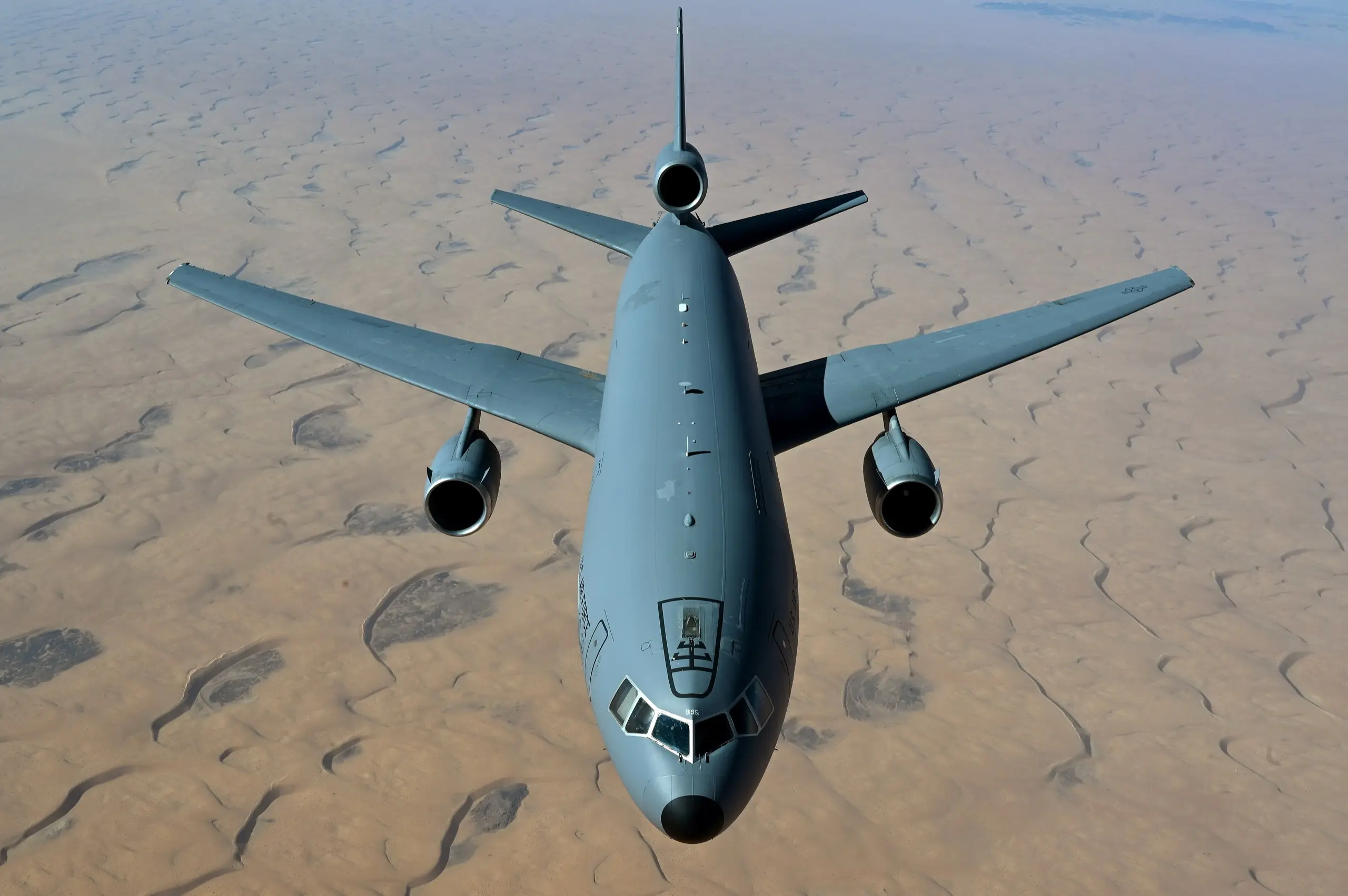
Under the cargo floor of a KC-10 sat three big fuel tanks that no DC-10 airliner ever carried. Most of the rest came from the wide-body airliner McDonnell Douglas built at Long Beach, and about 88 per cent of the systems stayed as they were. The Air Force added a refuelling boom and a hose reel in the tail, a pressurised station with a large rear window for the boom operator, and a receptacle above the cockpit so the tanker could be refuelled too. Above the floor it remained a freighter.
The Air Force wanted it because the 1960s and 1970s had shown how much rested on its tankers. Over Vietnam, KC-135 crews passed nearly 1.4 billion US gallons of fuel to other aircraft. In 1975 the Air Force asked for an aircraft that would be both tanker and cargo hauler. The DC-10 won, helped by its ability to use shorter runways than its rivals, and the first KC-10A flew on July 12, 1980.
The Air Force’s tanker until then was the KC-135 Stratotanker, which by the early 1990s, as a re-engined KC-135R, could carry about 90,000 kg of fuel. A KC-10 carried about 161,000 kg. It could refuel Air Force jets from its boom and Navy and allied jets from its hose on the same flight, and with a fighter squadron’s people and spare parts sitting on the deck above the fuel, it could take a whole unit across an ocean in one go.
Sixty were built, the last delivered in 1990, and the fleet went to war over Grenada, Libya, the Gulf in 1991 and three decades of operations in the Middle East and Afghanistan. Crews remember it fondly. Col. Jay Johnson, who commanded the 60th Air Mobility Wing at Travis, its last home, said of it: “that was a warrior.”
The Boeing KC-46 replaced it. On September 26, 2024, the last one, 79-1948, nicknamed Excalibur and flying as Gucci 10, took off from Travis Air Force Base in California, made a final pass with two F-15s on its wings and turned for the boneyard in Arizona, 44 years after the first one flew.


