Skip to content
Early preview The vault is just opening. New files are added regularly, and some sections are still being built.
VLTARIS
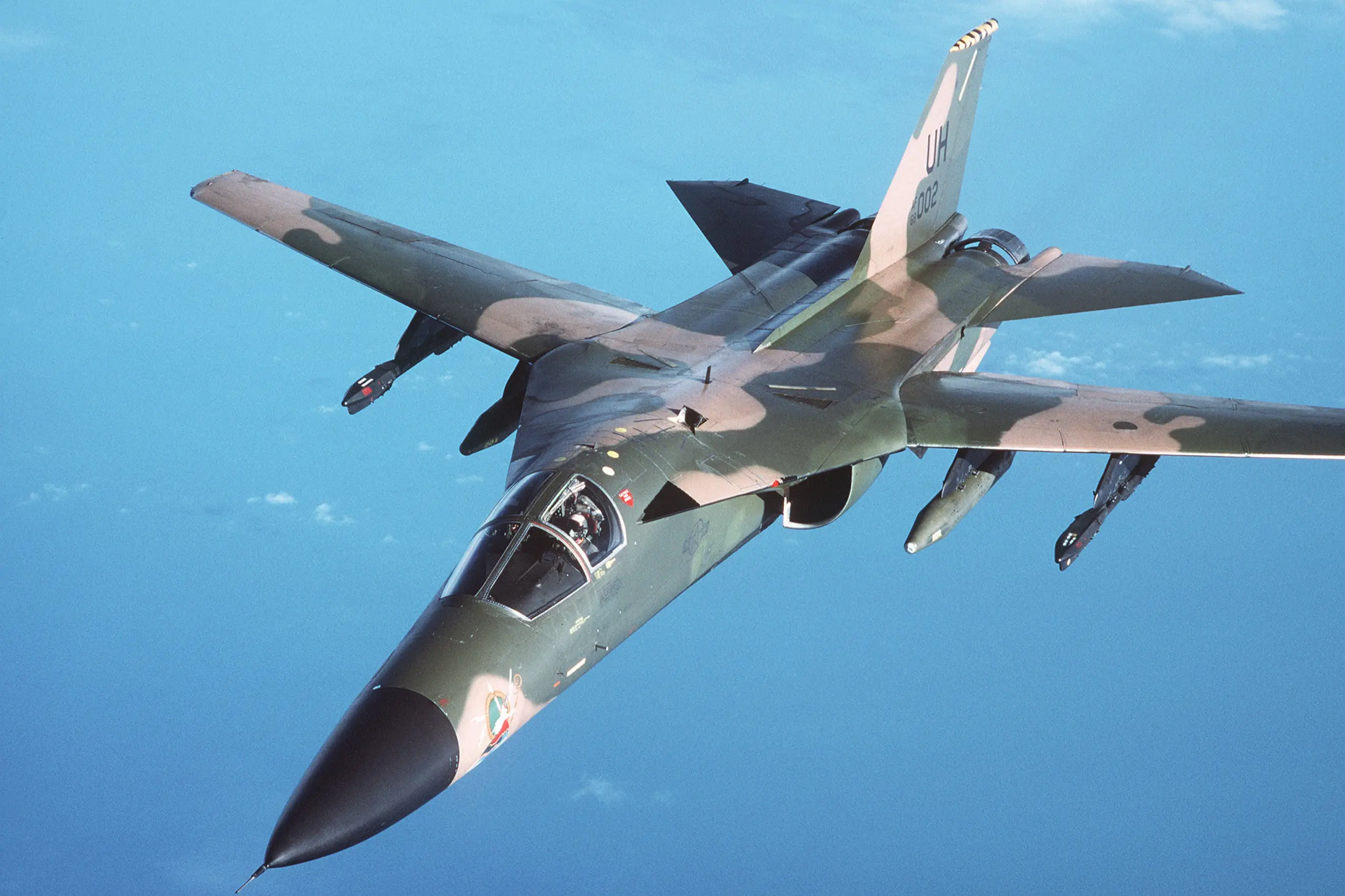
A camouflaged F-111 in flight over the North Sea, wings spread, seen from its left front

Attack · Cold War · Retired

F-111 Aardvark

An Aardvark for thirty years before it was official

General Dynamics

Built, all variants
563
Wing sweep, fully forward to fully back
16°–72.5°
Top speed at altitude (F-111F)
Mach 2.5
From first flight to Australia's last flight
46years

In an F-111 the pilot and the weapon systems officer sat side by side rather than one behind the other, close enough to share a glance, in a cockpit that could leave the aircraft as one piece. Behind them was a strike jet of up to 45 tonnes, built to reach a target at night and in any weather. Spread to 16 degrees, its wings let it land slower than the fighters of its day. Swept to 72.5 degrees, they let it pass Mach 1.2 at sea level and Mach 2.5 at altitude. The F-14 page explains how swing wings work; on the F-111 they served a bomber’s needs rather than a fighter’s.

In the early 1960s Defense Secretary Robert McNamara wanted the Air Force and the Navy to share one new aircraft, the TFX, and the F-111 was the result. The Navy’s heavier version never went to sea, the programme ran far over budget, and the press called the jet “McNamara’s Folly”. Its first combat tour, in Thailand in 1968, ended after three of the six jets were lost within a month, and a wing failure in 1969 grounded the fleet for seven months.

In 1972 the F-111s went back to Vietnam with crews who now knew the jet, and flew their first mission 33 hours after leaving Nevada. In 1986 they flew the long way round Europe to strike Tripoli. On the first night of the Gulf War more than a hundred of them went in, and by the end they were dropping a bunker buster that had been a pile of artillery barrels a month earlier. By then the jet once mocked as a folly had spent years as a backbone of NATO’s tactical nuclear forces in Europe.

Crews called it the Aardvark for decades, but the Air Force only made the name official in 1996, as it retired the last strike versions. Australians called theirs the Pig, flew them for 37 years, and gave the type its last flight in December 2010.

A cockpit that leaves as one piece

Production F-111s had no ejection seats. The pilot and the weapon systems officer sat in a sealed module, and in an emergency the whole module left the aircraft with both of them still strapped inside. The early pre-production jets had used ordinary ejection seats; the capsule arrived with the production aircraft, and it shielded the crew from the blast of an escape at supersonic speed.

Pulling the handle set off a sequence of small explosive charges. Harnesses pulled both crew back into their seats, a ten-minute emergency oxygen supply started and guillotines cut the cables and lines joining the cockpit to the rest of the jet. Then a rocket motor fired and threw the module clear, sensing the aircraft's speed and adjusting its thrust to suit. A brake chute slowed it, and a main parachute opened once it had come below about 4,500 metres and slowed enough. Airbags inflated underneath to soften the landing, and more on top kept the capsule upright if it came down at sea. It was watertight, so a crew that ditched could stay inside and use it as a small boat until rescue came.

The first time it saved anyone was on October 1, 1967, when two General Dynamics contractor pilots lost the hydraulics on F-111A 63-9780 over Texas and fired the capsule at about 8,500 metres. Neither was hurt. Six months later, over Thailand, Maj. Sandy Marquardt and Capt. Joe Hodges rode one out of a Combat Lancer jet whose tail controls had failed, and walked away unhurt.

It was not a gentle ride. Col. Rob Kyrouac, who left a burning F-111 from Cannon AFB, New Mexico, in 1993 after its engine blades failed, said he was sitting out of position when the rocket fired and his chin hit his chest at around 20 g. He and his crewmate came away bruised. One of these modules, a complete cockpit with its canopy, sits on display at the National Museum of the US Air Force in Dayton.

A bomb made from gun barrels

In early 1991 the planners of the Gulf War air campaign wanted a bomb that could reach Iraq's deepest command bunkers. Engineers built one from what they could find quickly: surplus barrels from 8-inch (203 mm) artillery guns, machined at the Army's Watervliet Arsenal in New York and the Air Force laboratories at Eglin AFB in Florida, then packed with explosive and fitted with a laser guidance kit.

Work started on February 1, two weeks before the formal go-ahead on the 14th. The first two bombs were delivered on February 16–17, the first test drop came on the 20th, and a contract followed only on the 22nd. On the 26th a rocket sled fired one into a concrete target; it went through more than 6 metres of concrete. An earlier test had seen one bury itself more than 30 metres into the earth. Each bomb body weighed about 2,100 kg and held about 290 kg of high explosive.

The finished weapon was named the GBU-28. The first two operational bombs reached the war zone on February 27, 1991, and that night, just hours before the ceasefire, two F-111Fs carried one each to a hardened command bunker at Al Taji, outside Baghdad. Only those two were dropped in the whole war. One hit its aim point exactly, and the video recorder in the jet showed smoke pouring from a bunker entrance about six seconds after impact.

Australia's Pig

Australia ordered 24 F-111Cs in 1963. Ten years passed before any arrived: the type's structural problems held the jets back, and the finished aircraft waited in storage at the General Dynamics factory in Fort Worth for about five years. The first, A8-134, was handed over in June 1973. Over the next decades the Royal Australian Air Force added four ex-USAF F-111As in 1980 and fifteen F-111Gs in 1993, and 43 F-111s flew in Australian colours in all. Their crews called the jet the Pig.

Australia's F-111s were built for long-range strike and reconnaissance, and from 1980 some were fitted with a camera bay in the belly as RF-111Cs. Their only operational missions came in November 1999, when RF-111Cs including A8-134 photographed military forces in East Timor ahead of its independence. They are better remembered for a display trick. The F-111's fuel dump vent sits between its two engine nozzles, so a pilot who dumps fuel with the afterburners lit trails a sheet of flame behind the jet. Australians called it the dump and burn, and at the closing ceremony of the Sydney 2000 Olympics, F-111s of No. 6 Squadron lit up the sky over the stadium with it.

The RAAF lost seven F-111Cs and one F-111G in crashes between 1977 and 1999, and ten aircrew were killed. Wing Commander Michael Gray, commanding No. 6 Squadron at the end, summed the jet up as "easy to fly but difficult to operate", and in 2004 Australia decided the costs and risks of being its only remaining operator were too high.

On December 3, 2010, at RAAF Amberley near Brisbane, the last F-111 landed. It was A8-125, the same aircraft that had been the first to land at Amberley on delivery in 1973. With it, the F-111 stopped flying anywhere in the world, 46 years after the first one left the runway in Texas.

Armament

Internal bomb bay and wing pylons
Conventional bombs such as 230 kg Mark 82s and M117s; the F-111A could carry up to 50 M117 bombs with its wings forward. The wing pylons alone could take about 11,300 kg.
Laser-guided bombs
GBU-10s on the 1986 Libya raid; GBU-15s and the first GBU-28 bunker busters in the Gulf War, aimed with the Pave Tack infrared pod that swung down from the F-111F's belly.
Nuclear weapons
B61, B43 and B57 bombs. The F-111 was a mainstay of NATO's tactical nuclear forces in Europe, and the bomber version, the FB-111A, could also carry six AGM-69 SRAM missiles for Strategic Air Command.
M61A1 Vulcan cannon
An optional 20 mm six-barrel gun with 2,000 rounds, fitted in the bomb bay of the F-111A.

Missions & Moments

Fourteen hours to Tripoli

On April 5, 1986, a bomb went off in La Belle, a West Berlin discotheque popular with American soldiers. It killed a Turkish woman and two US sergeants and injured about 230 people, and American intelligence tied it to Libya. At RAF Lakenheath in Suffolk, the F-111F crews of the 48th Tactical Fighter Wing had been planning for months. "Everybody knew this was coming," one squadron commander told the historian Robert F. Dorr years later.

France refused permission to cross its airspace, so the bombers had to take the long way round: out over the Atlantic, around the Iberian peninsula and east along the Mediterranean. A typical F-111F combat sortie lasted about three hours. This one would last about fourteen, and planners worried whether the airframes would take it. Most of the crews had never seen combat. Some had never refuelled from a KC-10, and none had done it at night in radio silence, which is what they were about to do again and again.

On the evening of April 14, twenty-four F-111Fs, six of them spares, took off from Lakenheath. Five EF-111A Ravens joined from RAF Upper Heyford to jam Libyan radar, and a fleet of KC-10 and KC-135 tankers went with them. Two of the spares took the places of other jets and the remaining four turned back, leaving three flights of six, callsigns Remit, Elton and Karma. Each jet in Remit and Elton carried four 900 kg laser-guided bombs for leadership targets in Tripoli, including the Bab al-Azizia barracks; Karma's jets carried 230 kg retarded bombs for the Libyan transport jets parked at Tripoli's airfield.

They arrived off the Libyan coast around two in the morning, low over the water. The strike lasted about twelve minutes. The bombing rules were strict: a crew had to see its target positively before releasing, and the Pave Tack infrared pod in each jet's belly was how they saw it. When the pod failed in one jet, Remit 33, its crew had only radar to go on. They judged the radar picture good enough and dropped.

Karma 52 never made it to the target. Inbound at low level, the jet flown by Capt. Fernando Ribas-Dominicci and Capt. Paul Lorence went into the sea. The leader of the strike, flying as Remit 31, saw it happen. "It was a smear across the water," he said. Whether a Libyan missile, a mechanical failure or the sea itself took them has never been settled. Libya returned Ribas-Dominicci's body in 1989; Lorence has never been found.

The rest came home the way they had gone, the long way round, refuelling in the dark. That evening in Washington, President Reagan said on television that Colonel Gaddafi had "counted on America to be passive. He counted wrong." Forty years later, in April 2026, the 48th Fighter Wing painted one of its F-15Es in the F-111's old tan and green and put the name Karma 52 on its nose.

Did You Know?

"Aardvark" was what crews called it for its whole career, but the US Air Force only made the name official in 1996, the year it retired the last strike versions.
The press nicknamed it "McNamara's Folly", after the Defense Secretary who insisted the Air Force and Navy share one design. The Navy's version proved too heavy for carriers and was cancelled, and the fighter that replaced it became the F-14.
On its first flight the pilots never moved the wings. A jammed flap held the jet below about 350 km/h and cut the flight short, but test pilot Dick Johnson still reported: "I felt I had power to spare."
On the first night of the Gulf War, an unarmed EF-111A Raven crewed by Capt. James Denton and Capt. Brent Brandon was chased low across the desert by an Iraqi Mirage F1, which was credited as crashing into the ground. Both men received the Distinguished Flying Cross, though Iraqi accounts dispute the kill.
More than 100 F-111s of different versions took part in the opening strikes of the Gulf War on January 17, 1991, as bombers and radar jammers. Later, F-111Fs used GBU-15 guided bombs on a daylight mission to seal an oil pipeline manifold Iraq had opened into the Gulf.
Australia's last F-111 to land, A8-125 in December 2010, was the same jet that had been the first to land at Amberley on delivery in 1973.

Timeline

  1. Dec 21, 1964

    Dick Johnson and Val Prahl fly the first F-111A from Carswell AFB, Texas. A flap fault cuts the flight to 21 minutes, and the wings stay at 26 degrees throughout.

  2. Jan 6, 1965

    On the second flight, the wings sweep through their full range, from 16 to 72.5 degrees.

  3. Oct 1, 1967

    Two General Dynamics pilots ride the crew escape module out of a crippled F-111A over Texas, the first time the capsule saves a crew. Neither is hurt.

  4. Mar 25, 1968

    Combat Lancer: six F-111As at Takhli, Thailand, fly their first mission over Vietnam. Within a month three of them are lost, and the detachment goes home in November.

  5. Dec 22, 1969

    A wing comes off an F-111A in flight. The whole fleet is grounded for seven months of structural tests and inspections.

  6. Sep 28, 1972

    Back to Vietnam: 48 F-111s of the 474th Tactical Fighter Wing reach Takhli, and the first mission flies 33 hours after they left Nevada.

  7. Jun 1973

    Australia accepts its first F-111Cs, ordered ten years earlier. A8-134 is handed over on June 8 and flies into RAAF Amberley in July.

  8. Apr 14–15, 1986

    Operation El Dorado Canyon: F-111Fs from RAF Lakenheath strike Tripoli after a flight of about 14 hours. One jet, Karma 52, and its crew are lost.

  9. Feb 27, 1991

    Hours before the Gulf War ceasefire, two F-111Fs drop the first GBU-28 bunker busters, built from artillery barrels in a matter of weeks.

  10. 1996–1998

    The US Air Force retires its last F-111s, making the name "Aardvark" official on the way out. The EF-111A Raven jammers go last, in 1998.

  11. Dec 3, 2010

    The Royal Australian Air Force flies its last F-111 at Amberley, ending the type's flying career after 37 years in Australian service.

Who flies it

    Former operators: United States, Australia

    Fleet figures as of October 2026; numbers change as aircraft are delivered and retired.

    Where to see one today

    No F-111 flies today, but the jet is on show in the United States, the United Kingdom and Australia. These are three we could confirm.

    United States· 1

    • National Museum of the US Air Force

      Dayton, Ohio

      The F-111A is in the Southeast Asia War Gallery; a complete escape capsule is in the Cold War Gallery.

      F-111A and crew escape module · indoors

    Australia· 1

    United Kingdom· 1

    Retired Australian F-111s also went to the RAAF Museum at Point Cook, the Aviation Heritage Centre at RAAF Amberley, the Australian War Memorial in Canberra, which holds RF-111C A8-134, and the Historical Aircraft Restoration Society at Albion Park. Check opening times and current displays before you visit.

    Locations last checked October 2026. Airframes occasionally move, so check with the museum before you travel.

    Sources

    Facts last reviewed October 2026

    1. 1. This Day in Aviation: F-111A first flight (21 December 1964) and FB-111A first flight (13 July 1968), with production figures and specifications
    2. 2. Federation of American Scientists, Military Analysis Network: F-111 (mirrors the US Air Force fact sheet)
    3. 3. Federation of American Scientists: GBU-28
    4. 4. Thomas Newdick, “The F-111 Aardvark's Crew Escape Module Ejected The Whole Cockpit”, The War Zone
    5. 5. Robert F. Dorr, “Operation El Dorado Canyon: Libya Under Air Attack in 1986”, Defense Media Network (2011)
    6. 6. The Aviationist, “On This Day in 1986: Operation El Dorado Canyon” (2020)
    7. 7. Vietnam Air Losses (after Chris Hobson): The F-111 and Combat Lancer (March 1968) and The Return of the F-111 (September 1972)
    8. 8. Aviation Safety Network: Combat Lancer losses, F-111A 66-0022 and 66-0024; F-111A 67-0049 (22 December 1969)
    9. 9. Australian Aviation, “F-111 flies into history” (December 2010)
    10. 10. Australian War Memorial: RF-111C A8-134 (AWM2019.549.1)
    11. 11. AIN Online, “Last hurrah for the ‘Pig’” (December 2010)
    12. 12. Royal Australian Air Force: Sydney Olympics (Our journey)
    13. 13. Air & Space / Smithsonian, “When Pigs Could Fly” (dump and burn)
    14. 14. RAF Museum: General Dynamics F-111F 74-0177 individual history (X003-6734)
    15. 15. Wikimedia Commons (public domain): US Air Force, NASA and National Museum of the US Air Force photographs credited in the gallery
    16. 16. Museum websites linked in “Where to see one today” (checked October 2026)