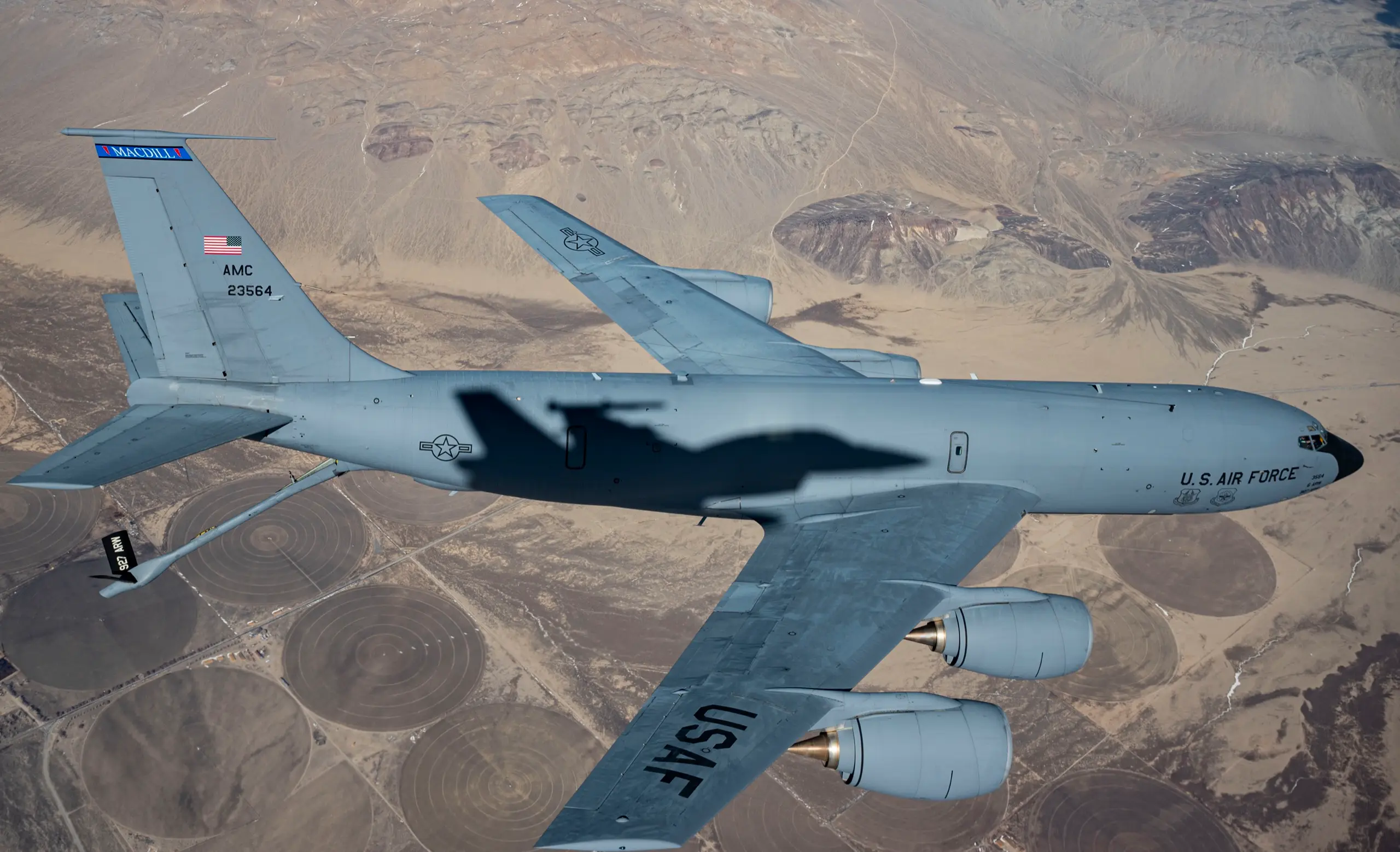
The boom swings down from under the KC-135’s tail, and behind it a fighter, a bomber or a transport creeps up until the two aircraft are flying a few metres apart. In the tail, lying on their stomach at a small window, the boom operator steers the nozzle into a receptacle on the receiver, and the fuel starts to flow. That is the whole job, and the KC-135 Stratotanker has been doing it for the US Air Force since 1957. It carries no weapons and nobody has ever called it glamorous, but without it the bombers cannot reach their targets, the fighters cannot stay on station, and a good many pilots would not have made it home.
In the early 1950s Strategic Air Command had new jet bombers and propeller-driven tankers that were too slow and too low to keep up with them. Boeing’s answer was a jet tanker, built from the same company-funded prototype that also became the 707 airliner. It first flew on August 31, 1956. Col. Phil Heseltine of the 22nd Air Refueling Wing has a shorter description of the result: “They’re built like a tank.”
The tanker refuelled B-52s over Vietnam and fighters over the Gulf of Tonkin, and some crews flew into enemy territory against orders to reach them. A special version carried the SR-71 Blackbird’s exotic fuel. Others became flying command posts, spy planes and NASA’s Vomit Comet. Re-engined, rewired and given new cockpits, the tankers went on to fuel almost every American air campaign since, from Linebacker II over Hanoi to El Dorado Canyon over Libya and the air war against ISIS.
Seventy years after that first flight, hundreds of KC-135s are still on duty, often flown by crews whose grandparents were not born when their airplane was built. The newer KC-46 is replacing them one by one, but the Air Force plans to keep the old Stratotanker flying until at least 2050. If it makes it, it will have served for almost a century.


