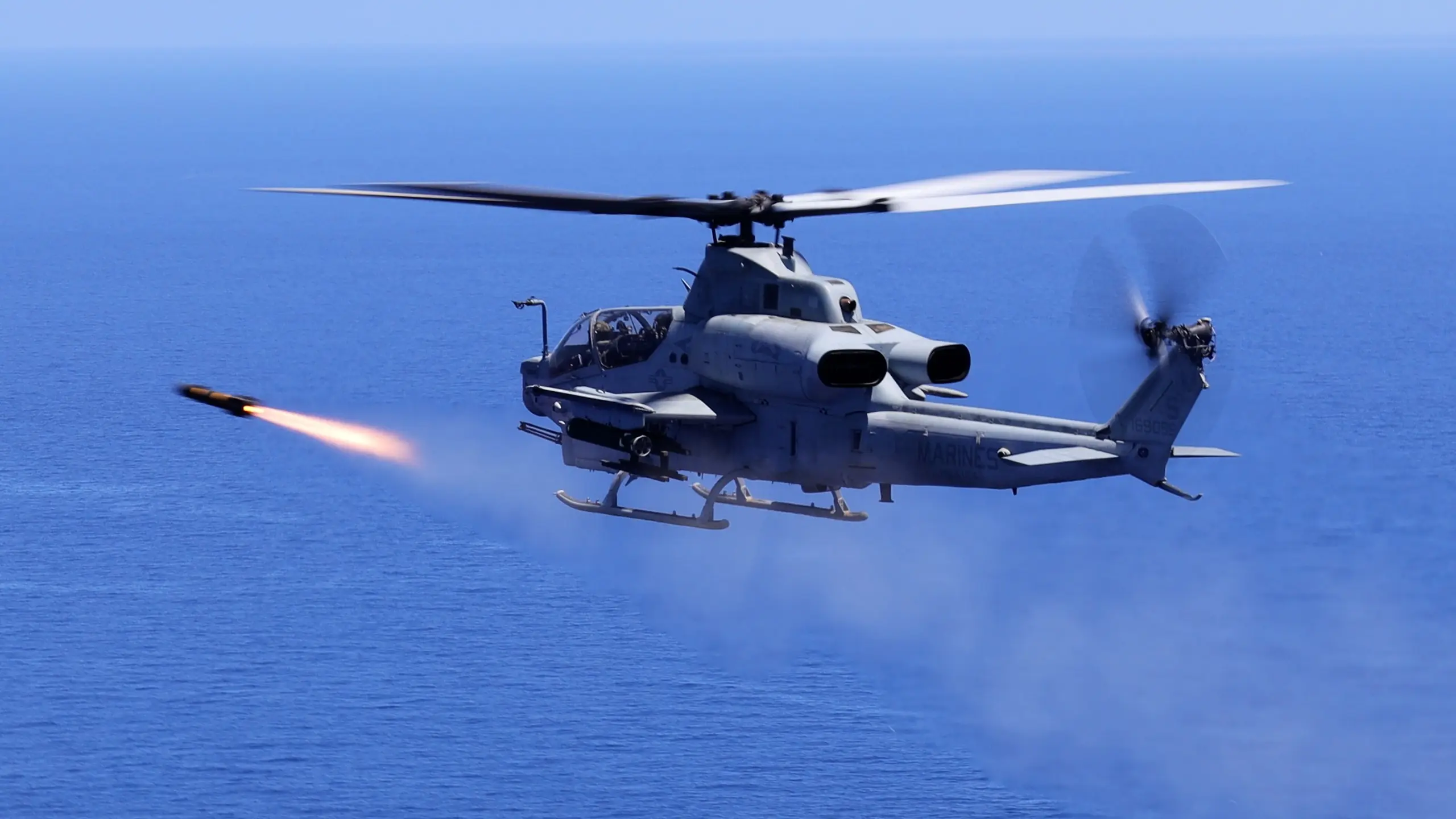
Bell rolled the Model 209 out at Fort Worth, Texas, on 2 September 1965, and five days later test pilot Bill Quinlan flew it for twelve minutes. Nobody had asked for it. Bell had built it with its own money in seven months, betting that the Army, already fighting in Vietnam with Hueys that had guns and rockets bolted on, would want a proper gunship long before its official one was ready. Bell was right, and the AH-1 Cobra became the first helicopter designed from the start to attack. More than sixty years later it is still flying.
Bell took the engine, transmission and rotor of its UH-1 Huey, threw away the cabin, and built a fuselage about 0.91 m wide around two pilots sitting one behind the other. From the front it was a sliver. It carried a gun turret under its chin and rockets on stub wings, and it arrived in Vietnam in August 1967, less than two years after that first flight.
The Army flew Cobras from 1967 until the AH-64 Apache took over its job, but the Marines kept going. They wanted two engines for flying over the sea, and got them in the AH-1J SeaCobra, then the AH-1T, then the AH-1W SuperCobra, which served for 34 years and flew in the Gulf War, over Mogadishu, and in Iraq and Afghanistan. Each generation carried new weapons and sensors, and each still looked unmistakably like the 1965 original.
Its hardest single morning came over Grenada in 1983, when two Marine Cobras went down within minutes of each other and a pilot gave his life to save the man he flew with. The story is told below, and it is more about the people in the cockpits than the machines.
Today’s model is the AH-1Z Viper, with a four-bladed rotor, a glass cockpit and helmet-mounted sights, and the figures in the specs panel are for this model. It shares most of its parts with the Marines’ UH-1Y utility helicopter and is still built for other countries. The Cheyenne, which the first Cobras were only meant to stand in for, was cancelled without ever entering service.