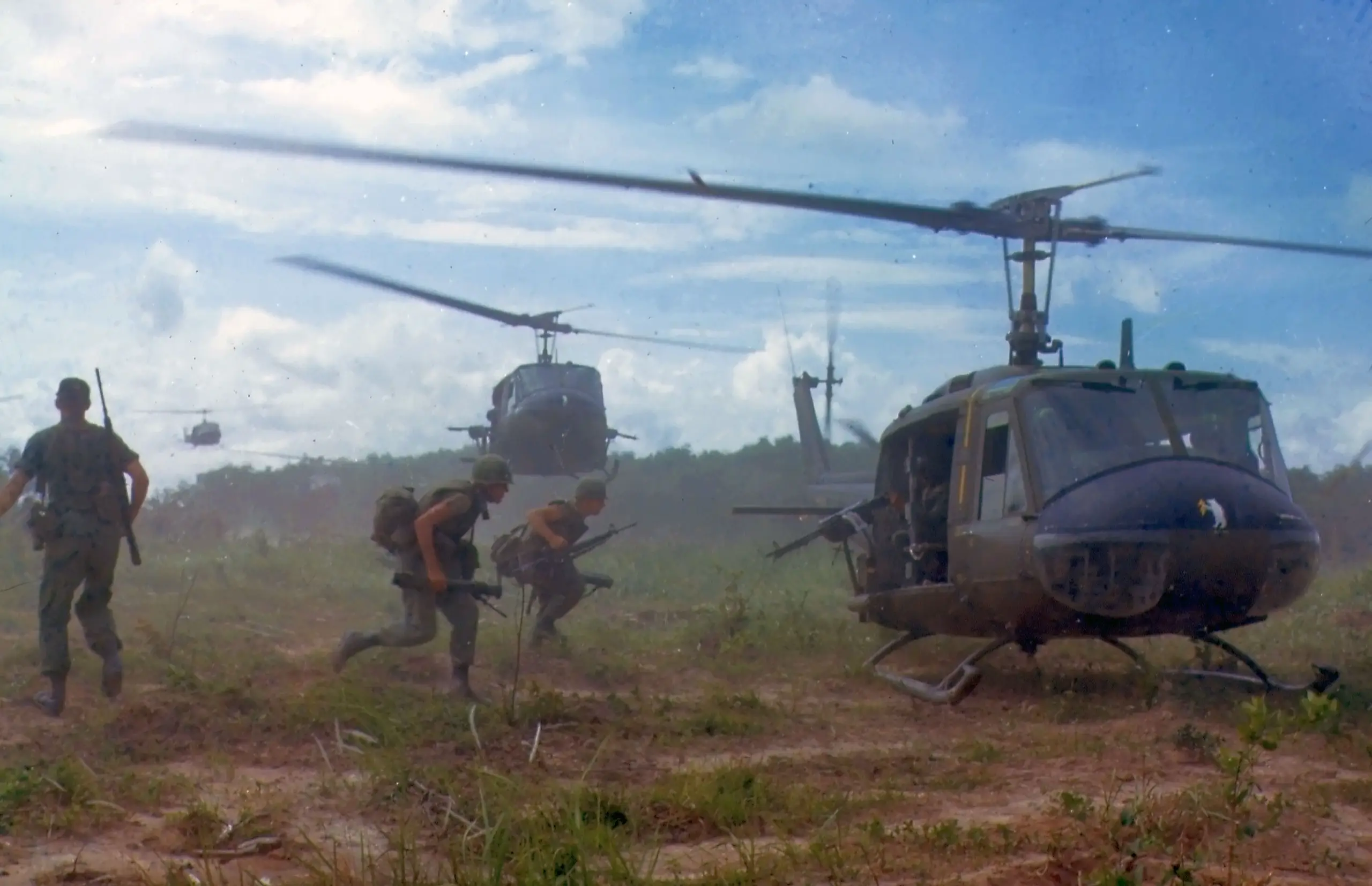
The first Hueys to reach Vietnam, in April 1962, were ambulances. They belonged to the 57th Medical Detachment, flew with American crews for the South Vietnamese army, and answered to the radio call sign Dustoff. Nobody had yet hung a machine gun in the doorway. The Army had asked Bell for a replacement for the piston-engined Bell 47 that had carried the wounded in Korea, and in 1956 Bell flew the XH-40, the first Army helicopter built around a gas turbine. The engine was lighter, smoother and far more reliable than a piston, and it left room in the cabin for stretchers, or a squad of soldiers, or whatever else needed moving. The production model was the HU-1A Iroquois. Crews read the letters as “Huey”, and the Army eventually gave up and let them.
Everyone in Vietnam knew the sound. Two rotor blades, each more than seven metres long, slapped through the air with a beat slow enough to count, and the whop-whop-whop crossed the paddies long before the olive-drab shape behind it came into view. The Smithsonian notes that people came to know the Huey by sound as much as by sight. Film-makers have been using that beat to mean the whole war ever since.
What turned an ambulance into the symbol of the war was an idea rather than a weapon. In 1962 General Hamilton Howze’s board tested moving infantry by helicopter instead of by truck, and the Army built a test division around the results. By 1965 that division was in Vietnam as the 1st Cavalry Division (Airmobile), and a battalion could be lifted into the middle of enemy country in an afternoon, resupplied by air, and lifted out again. The Hueys that carried the troops were “slicks”, armed Hueys flew alongside as gunships, and the Dustoff crews came in for the wounded. Nearly 900,000 people rode medevac helicopters in Vietnam, against 17,700 in Korea, and the Huey carried most of the combat casualties straight to a hospital.
The Vietnam Helicopter Pilots Association has tail numbers for about 7,000 Hueys that served in the war, and records more than 3,300 of them lost, with 1,151 pilots and 1,231 crew members killed in them. At the peak, in March 1970, the US military had more than 3,900 helicopters in Vietnam, and two out of three were Hueys. When Saigon fell in April 1975, South Vietnamese Hueys full of refugees landed on American carriers off the coast and were pushed over the side to make room for the next.
Bell and its licensees built more than 16,000 aircraft in the Huey family, which puts it second only to the B-24 Liberator among American military aircraft. The US Army flew its last one in December 2016. The Air Force still has 61 twin-engine UH-1Ns guarding its missile fields, and the Marine Corps flies the rebuilt, four-blade UH-1Y Venom from its amphibious ships. Seventy years after the first flight a helicopter called Huey is still on duty, and it still carries the wounded.
