Skip to content
Early preview The vault is just opening. New files are added regularly, and some sections are still being built.
VLTARIS
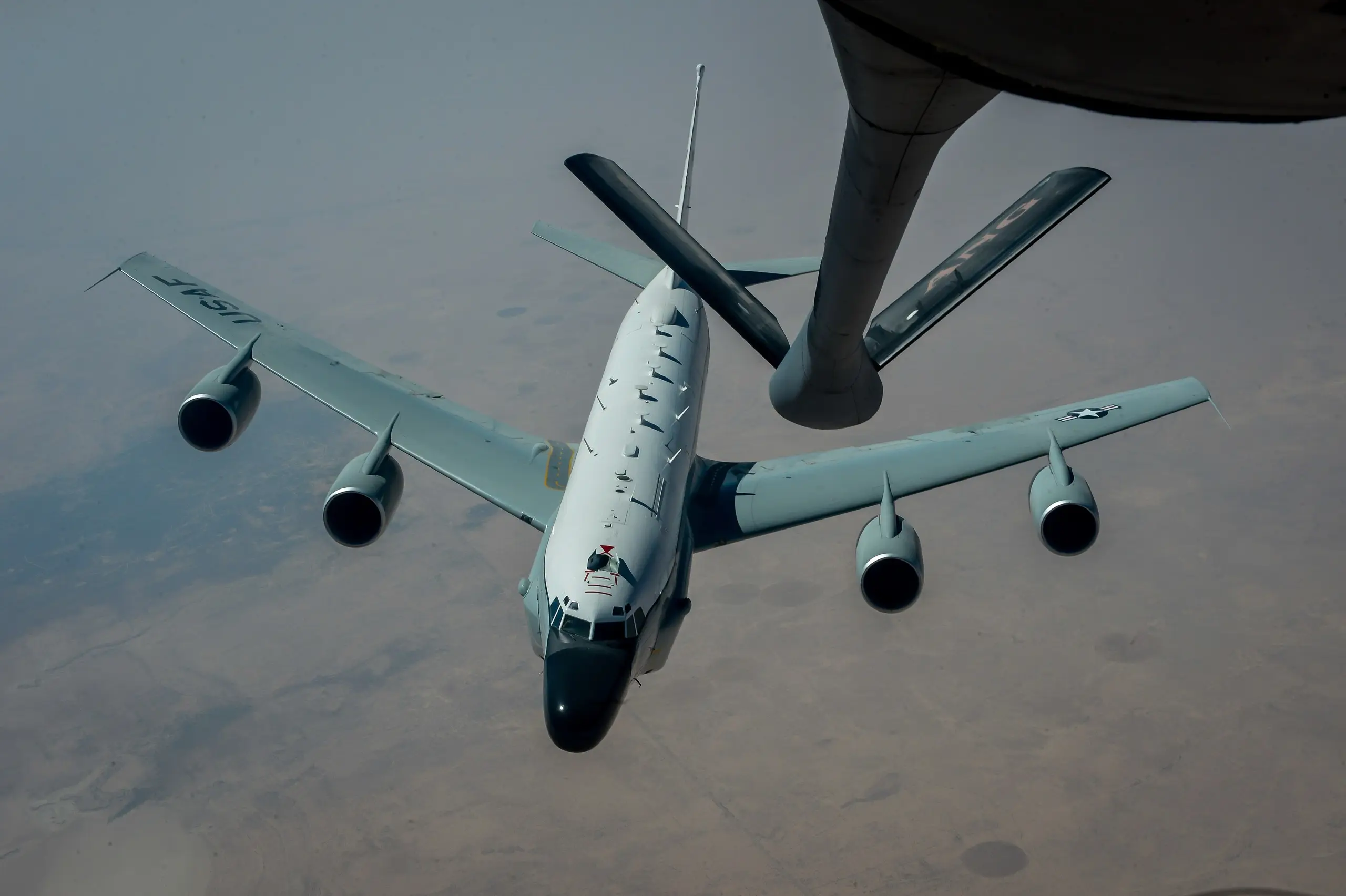
An RC-135V/W Rivet Joint seen from a tanker's boom position, its long dark nose and cheek antenna fairings visible as it pulls away over a hazy desert

Reconnaissance · Cold War · In service

RC-135 Rivet Joint

An old Boeing that flies to listen

Boeing (C-135 airframe); mission systems by L3Harris (formerly L-3 Communications)

Seats on board, most of them for the mission crew
32
Unbroken deployment to the Middle East, counted in 2015
25years
Flying hours on one airframe, 62-4132, by 2008
50,000
Shadowed by armed Su-27s over the Black Sea, 2022
~90min

Where an airliner would have rows of passenger seats, a Rivet Joint has rows of screens and headsets, and a crew of twenty or more sitting at them, most of them listening. Between them they detect, identify and locate signals right across the electromagnetic spectrum, from radars to radios, and pass what they learn to commanders while there is still time to act on it. The aircraft carries no weapons. From the outside it looks like a slightly odd Boeing 707, with a long, bulbous black nose, flat antenna fairings along both cheeks of the fuselage and hardly a window behind the cockpit.

The airframes are old. The first RC-135 conversions date from 1964, the three British aircraft began life as KC-135 tankers, and in 2012 most of the fleet was older than the crews flying it. The current RC-135V and RC-135W configurations appeared in 1981, and since then the fleet has been rebuilt in stages, with new engines, a glass cockpit and new mission equipment, while the basic aircraft stayed the same. One of them, 62-4132, flew over Vietnam and then over Afghanistan, and in 2008 it became the first C-135 of any kind to pass 50,000 flying hours.

What the Rivet Joint hears is almost entirely classified, and this page sticks to what the Air Force and the British government have said in public, which still covers a good deal. The fleet has taken part in every sizeable American conflict since the 1960s, from Vietnam and Libya to Grenada, Panama and the Gulf. In August 1990 a single aircraft flew to Saudi Arabia after Iraq invaded Kuwait, and the 55th Wing stayed in the region, without a break, for at least the next 25 years.

In 2010 Britain chose the Rivet Joint to replace its Nimrod R1s, and its crews learned the job by flying operations in American aircraft before their own arrived. The three RAF aircraft, called Airseeker, fly from RAF Waddington. In September 2022 one of them was on a routine patrol over the Black Sea when a Russian fighter released a missile in its direction, and for a few weeks the patrols stopped.

There are about twenty of them, counting the British three. They fly from Offutt in Nebraska and from bases in Japan, Britain and the Middle East, standing off at a distance from whatever they are listening to, often for ten hours or more at a time.

Twenty-five years in the desert

On 2 August 1990 Iraq invaded Kuwait. Six days later a crew of the 55th Strategic Reconnaissance Wing flew a Rivet Joint from Hellenikon Air Base in Greece to Riyadh, Saudi Arabia, and on 9 August it flew its first mission over the region. Two more aircraft followed, and from 11 August there was a Rivet Joint in the air around the clock.

The man sent to run the operation, Col. David "Tiny" Wolfe, flew out from Offutt on 8 August with about 65 maintainers and support staff. On arrival they found no provisions, no transport, nowhere to sleep and no way of talking to their own aircraft, which was out on its first mission and about ten hours from coming home. "To say the least it was a little stressful," Wolfe said later. "However, I'm proud to say our troops stepped up and carried the load."

Then they stayed. The war ended in 1991, and the wing kept flying for Operation Southern Watch over southern Iraq for more than ten years, moving from Riyadh to Prince Sultan Air Base in 1996. After 11 September 2001 came Afghanistan, then Iraq again in 2003, then the campaign against ISIS. By 9 August 2015 the 55th Wing had been deployed to the region without a break for 25 years, a stretch the Air Force believes is the longest single continuous deployment in its history.

For the people involved it became a way of life. The standard cycle was 3.1 deployments a year, roughly 60 days away and 60 at home, so an airman who spent a whole career with the wing could expect to be deployed for around 2,400 days. When the wing marked its 25th year, the head of Air Combat Command, Gen. Hawk Carlisle, pointed out that the average age of its airmen was the same as the number of years they had been deployed.

In March 1991 the Saudi commander at Riyadh Air Base, Brig. Gen. Rogi, gave the wing a sword inscribed "Fighting as a Team, Winning as a Team." It is now passed from hand to hand at the wing's anniversaries. At the 6,000-day ceremony at Offutt in December 2006 it went to the youngest airman back from deployment, and the very aircraft that had flown that first mission in August 1990 was parked outside for everyone to see.

Airseeker: the RAF learns on borrowed aircraft

For decades Britain's airborne signals intelligence came from the Nimrod R1, a version of the maritime patrol aircraft that had entered service in the 1960s. With the Nimrods due to retire in 2011, the Ministry of Defence signed an agreement with the US government on 19 March 2010 to buy three Rivet Joints and their ground systems. The British called the programme Airseeker. Defence Equipment and Support described it as the most complex combined Foreign Military Sales case and cooperative support arrangement the UK had undertaken with the US Air Force since the Second World War.

The aircraft themselves would take years to build, so the RAF did something unusual. From January 2011 the 55th Wing began training British crews from No. 51 Squadron at Offutt, and from June 2011 those crews flew real operations on American Rivet Joints, side by side with US airmen. By the time the first British aircraft arrived, UK crews had already flown more than 32,000 hours and 1,800 sorties in American aircraft. "We really do feel part of the team," said Air Chief Marshal Sir Simon Bryant after visiting the training at Offutt in 2011.

The three British aircraft were converted from KC-135 tankers by L-3 in Greenville, Texas, at a cost of around £650 million. The first was delivered on 12 November 2013, ahead of schedule, and in May 2014 an RC-135W with an RAF crew took off from RAF Waddington in Lincolnshire. By mid-2015 the first Airseeker was at work over Iraq and Syria against ISIS, and the second was due in September that year, seven months early.

The partnership did not end with the deliveries. Under the agreement, the British aircraft are supported, maintained and upgraded as part of one combined UK and US fleet.

The family: Rivet Card, Cobra Ball and Combat Sent

The Rivet Joint grew out of a whole family of reconnaissance -135s. During the Vietnam War, RC-135M aircraft flew signals intelligence missions from Kadena on Okinawa under the programme name Combat Apple, and in July 1967 a security squadron was set up at Kadena specifically to support them. The airframes from that war did not retire. Rivet Joint 62-4132, which passed 50,000 flying hours in 2008, counted Vietnam among its tours, alongside the patrols over Iraq in the 1990s and the wars in Iraq and Afghanistan.

Two cousins still fly from Offutt. The RC-135S Cobra Ball watches ballistic missiles, collecting optical and electronic data on them during boost and re-entry, and can deploy anywhere in the world within 24 hours. The Air Force has three, and they are easy to spot on the ramp: each has one black wing. The RC-135U Combat Sent, of which two remain, collects technical intelligence on radars. Its data goes into the design and programming of radar warning receivers, jammers, decoys and anti-radiation missiles, so its work ends up in what every other aircraft knows about the threats it faces.

The Rivet Joint is by far the largest of the three fleets. Like its siblings it stands off at a distance and collects. In wartime it works closely with the [E-3 Sentry](/aircraft/e-3-sentry/), and in the early 2000s US Strategic Command listed just two worldwide reconnaissance aircraft supporting its mission: the Rivet Joint and the [U-2](/aircraft/u-2-dragon-lady/).

Missions & Moments

Black Sea, 29 September 2022

Since 2019 the RAF had been flying its Rivet Joints on regular patrols over the Black Sea, in international airspace, along flight paths notified in advance. Russia invaded Ukraine in February 2022, and the patrols carried on. On 29 September an RAF RC-135W set out on another one. The aircraft was unarmed. Being shadowed was normal, and as Defence Secretary Ben Wallace later told the House of Commons, "this day was no different."

Two armed Russian Su-27 fighters came out to meet it. They stayed with the Rivet Joint for about 90 minutes. At some point during that time one of the Su-27s released a missile "in the vicinity of the RAF Rivet Joint aircraft beyond visual range." The missile did not hit. The British crew completed the patrol and flew home.

The UK said nothing publicly at first. Wallace wrote to the Russian defence minister, Sergei Shoigu, the Chief of the Defence Staff also made his concerns known, and the Black Sea patrols were suspended until Moscow replied. On 10 October the Russian Ministry of Defence did. It had investigated, it said, and the incident was "a technical malfunction of the Su-27 fighter." It also accepted that the Rivet Joint had been in international airspace.

On 20 October Wallace told Parliament what had happened. The patrols had resumed, he said, but now with fighter escorts. "We do not consider this incident to constitute a deliberate escalation on the part of the Russians, and our analysis concurs that it was due to a malfunction."

That was the official story for almost a year. In September 2023 the BBC, citing sources with knowledge of the incident, reported a different one. According to communications intercepted by the Rivet Joint itself, a Russian ground station had given the two pilots an ambiguous order, words, a Western defence source said, to the effect of "you have the target". One pilot took it as permission to fire. The other did not, and swore at his wingman when he did. The first missile failed to lock on. A second fell away from the wing, which suggested either a malfunction or an aborted launch.

The Ministry of Defence did not confirm the details and said Wallace had informed the Commons within three weeks. "This incident is a stark reminder of the potential consequences of Putin's barbaric invasion of Ukraine," it said. Downing Street added that there were "limitations on some of the operational detail that can be put into the public domain." If the BBC's sources were right, the aircraft had been listening in on the conversation about shooting it down.

The crews

A Rivet Joint carries five people on the flight deck, three pilots and two navigators, and behind them a mission crew of at least 21: three electronic warfare officers, fourteen intelligence operators and four airborne maintenance technicians, with more when the mission needs them. In 2012 only about 1,750 airmen were qualified to fly in one, and nearly all belonged to the 55th Wing at Offutt, Nebraska. Most of what they do is classified. What they can say is about the routine.

Ravens and ACEs
The electronic warfare officers are known as Ravens. The four airborne systems engineers, who keep the equipment running in flight, are the ACEs; one 2012 report called them the aircraft's "flight attendants".
Hardly a window
Inside, it looks like a passenger aircraft with most of the seats taken out and almost no side windows. A row of screens and headsets runs down one side, and the other is a maze of wiring and equipment racks.
Ten to thirteen hours
Crews in Afghanistan said a typical mission lasted 10 to 13 hours, with one or two air refuellings from a tanker such as the KC-135. Counting the briefing and the debrief, a flight day ran to about 20 hours.
Not even with each other
After landing, crews were not allowed to discuss what they had just done, even among themselves. So, they said, they talked about anything but the mission.
Years of training
Crew members train for at least two years before their first real mission. Because the training is so long and specialised, linguists and cryptologic operators often stay on the Rivet Joint for most of their careers.

A mission day

  1. 1

    Day one: fly

    An early wake-up, an intelligence briefing while the maintainers finish the aircraft, then a 10 to 13 hour mission. Afterwards, a debrief in a secure room.

  2. 2

    Day two: recover

    Gym, card games, studying for promotion, a video call home. One pilot watched his baby son crawl for the first time on a screen.

  3. 3

    Day three: prepare

    Breakfast together, then prepare an aircraft for another crew and sit through the next briefing. The day after, the cycle begins again.

Names worth knowing

  • Col. David "Tiny" Wolfe First Rivet Joint commander in Desert Shield

    Arrived in Riyadh in August 1990 with about 65 people and no transport, no beds and no radio link to his own aircraft, and started a deployment that lasted more than 25 years.

  • Lt. Col. Mike Kelley Crew member, August 1990

    Flew as a lieutenant on the second Rivet Joint mission of Desert Shield. Sixteen years later he handed the wing's Saudi sword to its youngest returning airman.

  • Brig. Gen. Donald Bacon 55th Wing commander

    Commanded the wing when it trained the first RAF crews. Of his own Rivet Joint crews he said: “If you or I went up there, we wouldn't know where to start. But (Rivet Joint crews) are so effective. They know right where to look.”

Did You Know?

Rivet Joint 62-4132 began flying in 1962, flew in Vietnam, and in 2008 became the first C-135 airframe of any kind to pass 50,000 flying hours.
When the 55th Wing marked 25 years of deployment to the Middle East in 2015, the average age of its airmen was the same as the number of years they had been deployed.
With 3.1 deployments a year, an airman who spent a whole career in the 55th Wing could expect to be deployed for around 2,400 days.
Before their own aircraft arrived, RAF crews flew more than 32,000 hours and 1,800 sorties in American Rivet Joints.
In 2012 there were only 17 Rivet Joints and about 1,750 airmen qualified to fly in them. “'Elite.' I like 'elite,'” said one airborne mission supervisor. “Stick with 'elite.'”
Crews compared the deployment routine to a film about a day that repeats forever. “It's like 'Groundhog Day,' kind of,” said one cryptologic operator.

Timeline

  1. 1962

    Aircraft 62-4132 begins flying. It will serve over Vietnam, become a Rivet Joint and still be at work more than forty years later.

  2. 1964

    The first RC-135 conversions begin. Every RC-135 flying today descends from this pool of modified -135 airframes.

  3. Jul 1967

    The 6990th Security Squadron is activated at Kadena, Okinawa. Its first mission is direct support of RC-135 flights in Southeast Asia under the name Combat Apple.

  4. 1981

    The RC-135V and RC-135W configurations, the aircraft known as Rivet Joint today, are deployed.

  5. Aug 9, 1990

    A week after Iraq invades Kuwait, a Rivet Joint flies its first mission over the Gulf from Riyadh. Two days later, with three aircraft in place, 24-hour coverage begins.

  6. Mar 12, 2008

    Rivet Joint 62-4132 passes 50,000 flying hours on a mission over Afghanistan, the first C-135 airframe of any kind to do so.

  7. Mar 19, 2010

    The UK signs an agreement with the US to buy three Rivet Joints, known in Britain as Airseeker, to replace the Nimrod R1.

  8. Jun 2011

    RAF crews of No. 51 Squadron begin flying operational missions on American Rivet Joints alongside the 55th Wing.

  9. Nov 12, 2013

    The first British RC-135W is delivered to the RAF, ahead of schedule.

  10. Aug 9, 2015

    The 55th Wing marks 25 years of continuous deployment to the Middle East, believed to be the longest in Air Force history.

  11. Sep 29, 2022

    An RAF RC-135W on patrol over the Black Sea is shadowed by two armed Russian Su-27s, and one of them releases a missile.

Who flies it

  • United States

    17

    US Air Force (55th Wing)

    Eight RC-135V and nine RC-135W, plus three TC-135W trainers. Home base is Offutt AFB, Nebraska, with forward locations including Kadena in Japan and RAF Mildenhall in the UK.

  • United Kingdom

    3

    Royal Air Force (No. 51 Squadron)

    RC-135W Airseeker, based at RAF Waddington, Lincolnshire. Converted from KC-135 tankers and supported as part of a combined fleet with the US.

Fleet figures as of 2026; numbers change as aircraft are delivered and retired.

Sources

Facts last reviewed October 2026

  1. 1. U.S. Air Force: RC-135V/W Rivet Joint fact sheet (archived editions of 2001 and 2004 via webharvest.gov: dimensions, crew, 1964 and 1981 dates, 32 seats)
  2. 2. Air & Space Forces Magazine: RC-135V/W Rivet Joint, RC-135S Cobra Ball and RC-135U Combat Sent (engines, ceiling, current inventory)
  3. 3. 55th Wing Public Affairs: 25 years on the hunt, Air Force News Service, August 2015
  4. 4. Dona Fair: 55th Wing marks 6,000 days in Southwest Asia, Air Force News Service, January 2007
  5. 5. 2nd Lt. Tania Bryan: RC-135 surpasses 50,000 flying-hour mark, Air Force Print News, March 2008
  6. 6. Offutt AFB: 390th Intelligence Squadron fact sheet (6990th Security Squadron and Combat Apple, 1967)
  7. 7. Omaha World-Herald: feature on a Rivet Joint crew in Afghanistan, February 2012 (crew life, mission length, quotes)
  8. 8. UK Parliament: Ukraine Update, Hansard, 20 October 2022 (Ben Wallace's statement on the Black Sea incident)
  9. 9. Associated Press via Military Times: Russian pilot tried to shoot down a British spy plane last fall: BBC, September 2023
  10. 10. Forces News: Russian pilot believed he had permission to shoot down RAF spy plane, September 2023 (reporting the BBC's account)
  11. 11. UK Ministry of Defence: Rivet Joint joins Future Force 2020 (2010), Commander-in-Chief visits new RAF intelligence aircraft training programme (2011), First Rivet Joint aircraft delivered to the UK (2013), RAF's new surveillance aircraft takes to the skies (2014) and New RAF intelligence aircraft to be delivered seven months early (2015)
  12. 12. U.S. Air Force photo captions on Wikimedia Commons (Cobra Ball's black wing; the Rivet Joint working with the E-3, 2000)
  13. 13. U.S. Strategic Command: RC-135V/W Rivet Joint fact file (2004)