Skip to content
Early preview The vault is just opening. New files are added regularly, and some sections are still being built.
VLTARIS
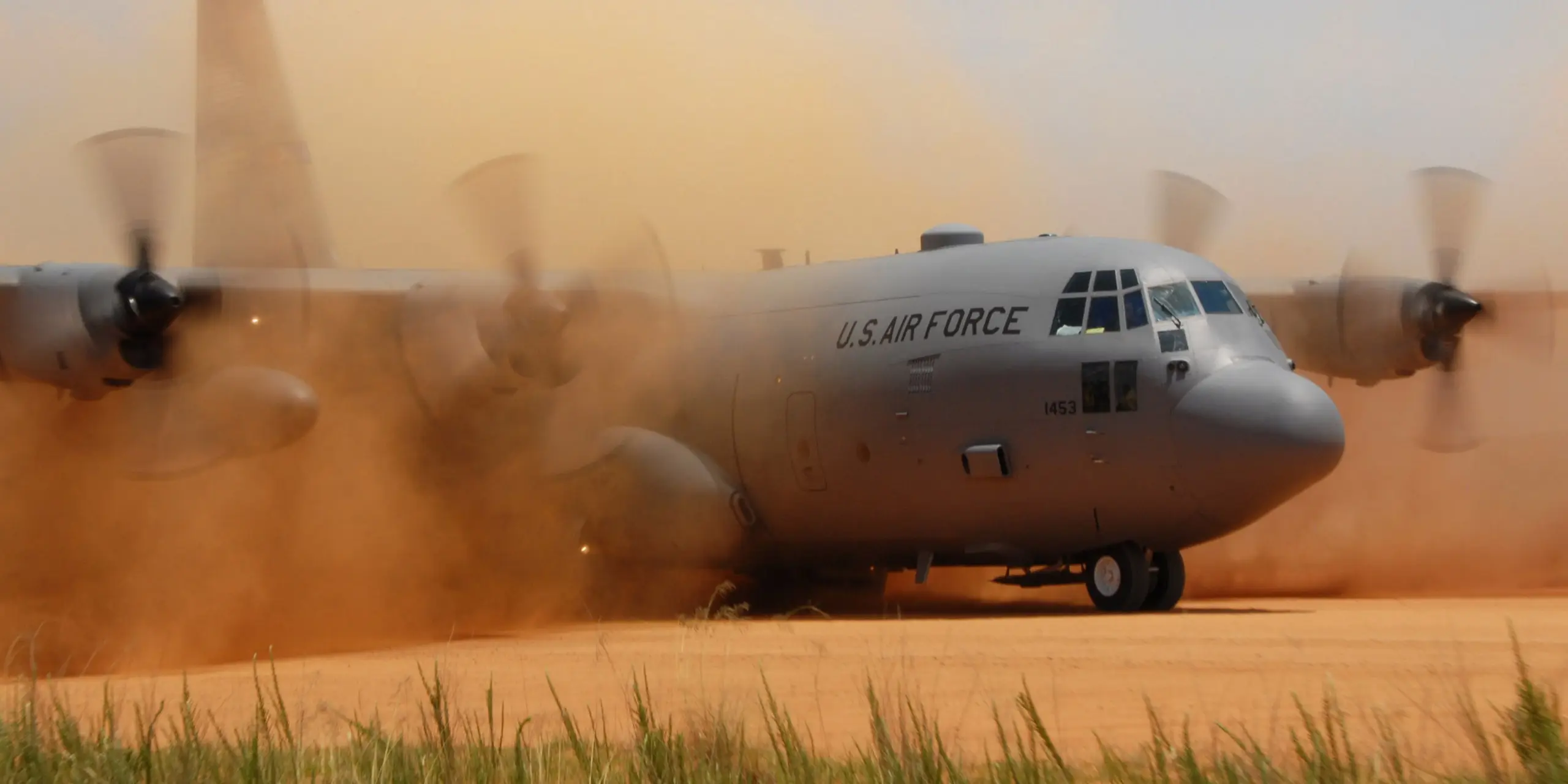
A grey C-130 Hercules rolling along a dirt landing strip in a huge cloud of orange dust, all four propellers spinning

Transport · Cold War · In service

C-130 Hercules

Dirt strips, polar ice and one carrier deck

Lockheed / Lockheed Martin

Years in continuous production
70+
Countries that fly it
70
People aboard one escape flight from Saigon
452
Full-stop landings on an aircraft carrier, without a hook
21

The prototype Hercules left the ground in about 260 metres on its first flight, on 23 August 1954, and flew from Burbank to Edwards Air Force Base in California. The design went back to 1951, when the Korean War had shown the US Air Force that its transports needed long, smooth runways the front line didn’t have. Lockheed’s answer was a tough box with wings: a high wing to keep the propellers out of the dust, a cargo floor set low to the ground with a ramp at the back, and sturdy tyres for rough fields. Since then it has landed on dirt strips and in jungle clearings, on the snow at the South Pole and, once, on the deck of an aircraft carrier.

Nobody has improved on the recipe since. The Hercules has been in production since the 1950s, longer than any other military aircraft in history, and it is still rolling out of the factory in Marietta, Georgia. About 70 countries fly it. Under the skin the newest C-130J is a different machine, with a glass cockpit, six-bladed composite propellers and a crew of three instead of five, but walk up the ramp of a 1950s A-model and then a brand-new J and you will recognise the same aircraft.

Much of what it does comes down to being a very good empty space. Pallets, jeeps, paratroopers, stretchers, fuel tanks, weather sensors, firefighting tanks, even guns: whatever fits through the back door, the Hercules can carry. So it has served as a tanker, a search-and-rescue plane, a hurricane hunter, a firefighter, an Antarctic ski plane, a flying hospital and, most famously, a gunship. Pilots call it the Herk. A former head of Air Mobility Command called it “the greatest airplane ever built.”

It also keeps turning up at the hinge points of history. It kept the Marines at Khe Sanh supplied in 1968, and it carried 452 people out of Saigon on the morning before the city fell. It has flown food aid into southern Sudan, dropped hay to stranded cattle in Colorado and flown into the eye of hurricanes on purpose. The Smithsonian’s Air & Space magazine put it this way: “Riding in the cargo hold of a C-130 is still a class below steerage, and, from the first A model to today’s spanking new J, from the first hour of flight to the 20 millionth, the airplane has been fun to fly.”

Fighters get the posters. The Hercules gets the job, and then the next one, and the one after that. Seventy years on, nobody has found one it can’t do.

The last flight out of Saigon

Saigon was about to fall. All night North Vietnamese mortars had pounded Tan Son Nhut air base, and by the morning of 29 April 1975 more than 100 aircraft, most of what was left of the South Vietnamese Air Force, lay twisted and burning across the airfield. Around 9 a.m. the shelling stopped. One aircraft was still in one piece: an old C-130A, serial 56-0518, a hand-me-down from the US Air Force.

The man who decided to fly it out was a South Vietnamese instructor pilot, a major remembered only by his family name, Phuong. Hundreds of people had the same idea. Tinh (Tim) Nguyen, then a 24-year-old in the South Vietnamese Air Force, had seconds to make up his mind: "It was either leave right then or stay and get killed. We saw a C-130A taxiing out so we ran as fast as we could." People poured into the cargo hold until they stood shoulder to shoulder, some of them on the ramp itself, so it could not close. The Air Force's account says Phuong taxied forward and stamped on the brakes, so that the crowd surged inside and the ramp could shut. Nguyen remembered it differently: "The pilot wasn't trying to pack people in, he was avoiding debris on the ramp."

Either way, the ramp finally closed. There were 452 people on board a transport built to carry about 90 troops, and more than thirty of them were crammed onto the flight deck alone. The Hercules thundered down the runway, past the end of it, and only just came unstuck. "He couldn't pull the nose up until he got to the end of the 1,000 foot overrun," Nguyen recalled. "We stayed in ground effect for twelve or fifteen miles before we started gaining altitude."

Phuong had no map. He pointed the nose toward Thailand, and after an hour and a half over the sea realised he was going the wrong way. The pilot of a smaller transport squeezed through the crowd into the copilot's seat with a map, and together they turned the aircraft around. A flight that should have taken about 90 minutes took three and a half hours. They landed safely at U-Tapao in Thailand, all 452 of them.

The old Hercules was not finished. The US Air Force took it back, and it flew for years with Air National Guard units before retiring in 1989. Today 56-0518 stands at the main gate of Little Rock Air Force Base, Arkansas. In 2019 an airman fixing C-130Js on that base turned out to be the son of one of its passengers: his mother had boarded that morning as a seven-year-old girl. Tim Nguyen made it to the United States and decided he wanted to work for the company that had built the plane that saved him. Lockheed hired him in 1983, and he spent his career building the defensive systems that protect transport crews from missiles.

Skis, storms and fire

The Air Force's own fact sheet lists Antarctic ice resupply, weather reconnaissance, aerial spraying, firefighting, hospital flights and disaster relief among the jobs of the Hercules. It can do all of them because it is a big, rugged, empty box with a ramp at the back. Almost anything can be bolted into it, and much of that special kit can be taken out again to turn it back into a cargo plane.

The LC-130 wears huge skis around its wheels, and it is the largest aircraft in the world that can land on snow and ice. Only one unit flies it today, the New York Air National Guard's 109th Airlift Wing, from Schenectady. Every southern summer its "Skibirds" fly from McMurdo Station to the South Pole and out to science camps on the open ice sheet, carrying scientists, fuel and cargo, and flying sick or injured people out to New Zealand. In the 2025–26 season alone the wing flew 63 missions to the South Pole. Its leaders call it the only heavy airlift in the world able to make tactical landings on snow and ice.

In 1943 Maj. Joe Duckworth flew a single-engine trainer into a hurricane on a bar-room dare, just to prove it could be done. The Hurricane Hunters trace their tradition to that flight. Today they are the Air Force Reserve's 53rd Weather Reconnaissance Squadron at Keesler Air Force Base, Mississippi, and they have flown the Hercules since 1965. A crew of five takes a WC-130J right into the storm and its eye. A flight meteorologist records the weather every 30 seconds, while the loadmaster drops parachute sensors called dropsondes that radio back data all the way down to the sea. Everything goes to the National Hurricane Center in Miami, and from there into the forecasts and warnings that people on the coast rely on.

When the US Forest Service runs out of civilian air tankers, it can call on C-130s fitted with MAFFS, the Modular Airborne Fire Fighting System. The kit is a set of tanks that rolls into an ordinary Hercules in about two hours, with a nozzle where the left rear paratroop door used to be. Flying about 45 metres above the flames, the crew can dump roughly 11,000 litres of retardant in less than five seconds and paint a red line about 400 metres long across the fire's path. Back at base the aircraft can be refilled and airborne again in under 20 minutes. The dye is red so that pilots can see where earlier loads landed, and the slurry doubles as fertiliser.

There are also tankers that refuel helicopters, long-range Coast Guard search planes and the most famous conversion of all, a Hercules with guns sticking out of its side: the AC-130 gunship, which has its own file.

Missions & Moments

Look Ma, No Hook

In the autumn of 1963 the Navy had a problem. A carrier deep in the Indian Ocean might need supplies in a hurry, and the little transport that resupplied carriers, the Grumman C-1 Trader, could not fly far enough or carry anything bulky, such as a spare jet engine. Someone at the Naval Air Test Center in Maryland suggested a Hercules. It had the range and it had the room. It also had a wingspan of more than 40 metres, four engines and no tailhook.

The job went to a brand-new test pilot, Lt. James Flatley III. "Either I was in the right part of the line or the other pilots said, 'Give this one to Flatley. It isn't going to go anywhere,'" he said later. With copilot Lt. Cmdr. W. W. "Smokey" Stovall, flight engineers Ed Brennan and Al Sieve and Lockheed test pilot Ted Limmer, he borrowed a Marine Corps KC-130F tanker, number 149798, and spent some fifty-five flying hours practising short landings. The changes to the aircraft were small: better brakes, a precise airspeed indicator, a softer nose gear. Someone at the test centre painted a message under the copilot's window. It read "Look Ma, No Hook."

On 30 October the crew found the carrier USS Forrestal in foul weather. "It was a blustery, squally day with a forty-knot wind gusting to sixty knots and huge ocean swells. The deck was heaving twenty feet up and down," Flatley remembered. It took 42 approaches to make 19 touch-and-go landings. The numbers surprised the engineers. The big transport was touching down more gently than the fighters that normally landed there.

On 8 November they stopped for real. Flatley came over the stern at just 79 knots, chopped the power, threw the propellers into reverse, and he and Stovall stood on the brakes. The Hercules stopped in about 84 metres, short of where the arresting wires would normally lie. "We stopped so short it kind of startled me," said Brennan. "It was like landing on a normal runway, but that big metal island on the side of the ship just beyond the wingtip was a bit scary." Instead of waiting for a tractor to tow them back for takeoff, they simply reversed, using the propellers. "You should have seen the looks on the faces of the deck hands," said Flatley.

Taking off had its own problem. The wingtip cleared the carrier's island by about four and a half metres, and the crew had orders not to lift the nose until the wing had passed it. "Otherwise we could have been looking down on the captain on his bridge when we took off." Landing by landing, they added fuel to make the aircraft heavier, up to 54,900 kg, still the record for the largest and heaviest aircraft ever landed on a US Navy carrier. Even at that weight it needed only about 140 metres to stop. By the end the crew didn't bother backing up. They took off from wherever they had stopped.

It worked, and the Navy never did it again. A carrier with all its fighters cleared off the deck is a carrier that can't fight, and Brennan saw what that meant on the bridge: "A carrier with no tactical aircraft on deck makes a skipper antsy." The Forrestal's captain gave them two hours each trip, to the minute, and then sent them home. The Navy bought the smaller C-2 Greyhound instead, and the project was kept quiet for a year.

Flatley received the Distinguished Flying Cross and went on to become a rear admiral. His Hercules went on to a long Marine Corps career, and in November 2001 it was the first aircraft to land at Rhino, the Marines' desert airstrip in Afghanistan. Today 149798 is at the National Naval Aviation Museum in Pensacola, repainted in 2025 in the colours it wore on the Forrestal. Flatley saw photographs of it before he died in December 2025, aged 91. More than sixty years on, nobody has landed anything bigger on a US Navy carrier. "This has always captured people's attention," he once said. "There are still folks who don't believe it."

Did You Know?

From 1960 to 1986, Air Force C-130 crews caught spy-satellite film in mid-air, snagging the capsules as they dangled from parachutes over the Pacific.
In 1980, after the failed attempt to rescue the hostages in Iran, the Air Force secretly built rocket-boosted Hercules for a second try, meant to land and take off inside a soccer stadium in Tehran. The hostages were freed in January 1981 and the mission was never flown.
In the late 1950s four C-130 transports flew together as an aerobatic display team, the Four Horsemen.
The Blue Angels' support aircraft, Fat Albert, has been a C-130 since 1970. For years it opened each show by blasting off the runway on rocket bottles, to show how fast a Herc can get out of a short, rough strip.
Fill it with stretchers and the Hercules becomes a flying hospital ward for 72 patients, with two flight nurses and three medical technicians joining the crew.
Its designer, Willis Hawkins, explained the brief: “It was designed to be used in a tactical situation where there weren’t any nice, clean places to take care of it.” So it got its own built-in power unit, and doesn't even need a ground cart to start.

Timeline

  1. Aug 23, 1954

    The YC-130 prototype flies for the first time, from Burbank to Edwards Air Force Base, California. It needs only about 260 m of runway to get airborne.

  2. Dec 1956

    Deliveries of the first production model, the C-130A, begin to the US Air Force.

  3. Oct–Nov 1963

    A Marine Corps KC-130F makes 29 touch-and-goes and 21 full-stop landings and takeoffs on the carrier USS Forrestal, with no hook and no catapult.

  4. 1965

    The Hercules becomes the aircraft of choice for the Air Force's Hurricane Hunters. They still fly it.

  5. 1967

    In Vietnam, C-130s drop hundreds of paratroopers in Operation Junction City.

  6. 1968

    C-130s land or air-drop much of the supplies that keep the besieged Marines at Khe Sanh alive.

  7. Apr 29, 1975

    C-130A 56-0518, the last flyable Hercules at Tan Son Nhut, escapes Saigon with 452 people on board.

  8. 1988

    The New York Air National Guard's 109th Airlift Wing begins flying its ski-equipped LC-130s in support of science in Antarctica.

  9. Feb 1999

    The C-130J Super Hercules, with glass cockpit, new engines and six-bladed propellers, enters the US Air Force inventory.

  10. Nov 2001

    KC-130F 149798, the very aircraft that landed on the Forrestal, is the first aircraft to land at Rhino, the Marines' desert airstrip in Afghanistan.

  11. Aug 2024

    Seventy years since the first flight. The Hercules is still in production in Marietta, Georgia, the longest continuous production run of any military aircraft.

Who flies it

  • United States

    US Air Force

    Active duty, Air National Guard and Air Force Reserve, including the LC-130 Skibirds, WC-130J Hurricane Hunters and firefighting MAFFS crews.

  • United States

    US Marine Corps

    KC-130J tankers, plus Fat Albert, the Blue Angels' support aircraft since 1970 and a C-130J since 2020.

  • United States

    US Coast Guard

    HC-130J long-range search and rescue.

  • Canada

    Royal Canadian Air Force

    CC-130J, based at Trenton, Ontario.

  • Mexico

    Added a second C-130J-30 in 2026.

Former operators: United Kingdom

Fleet figures as of 2026; numbers change as aircraft are delivered and retired.

Where to see one today

Hundreds of Herks are still flying. A few with stories worth the trip have been put out to pasture where you can see them.

United States· 3

  • Pima Air & Space Museum

    Tucson, Arizona

    An early A-model, the first production version. It last served with the Tennessee Air National Guard.

    57-0457C-130A
  • Little Rock Air Force Base

    Jacksonville, Arkansas

    The last flight out of Saigon, with 452 people aboard. It stands at the base's main gate, where it has been since 1989. Check base access before planning a visit.

    56-0518C-130A
  • National Naval Aviation Museum

    NAS Pensacola, Florida

    The Forrestal carrier-landing aircraft of 1963, repainted in 2025 in its original colours. The museum is on an active Navy base: US citizens need a REAL ID or passport, and foreign visitors must be escorted by a US citizen.

    149798KC-130F

Several gunship conversions of the Hercules, including the very first C-130 ever built, are on display too. They're listed in our AC-130 file.

Locations last checked October 2026. Airframes occasionally move, so check with the museum before you travel.

On screen

Where the C-130 Hercules became a star outside the hangar.

  • TV · 2004

    JAG

    In one episode, Harmon Rabb makes an emergency landing in a C-130 on a carrier. As the credits roll, the show plays the real 1963 film of Flatley's Forrestal landings.

Sources

Facts last reviewed October 2026

  1. 1. U.S. Air Force: C-130 Hercules fact sheet (specifications, models, roles, aeromedical crew)
  2. 2. Jeff Rhodes, “C-130 Carrier Landing Trials”, Code One (Lockheed Martin), 2014
  3. 3. Jeff Rhodes, “Tim Nguyen's Story”, Code One (Lockheed Martin), 2014
  4. 4. Naval Historical Foundation: Landing a Cargo Plane on a Postage Stamp (2019)
  5. 5. National Naval Aviation Museum: Museum's historic C-130 Hercules gets a facelift (2025) and Plan your visit
  6. 6. David Roza, “Workhorse of the Air: C-130 Celebrates 70 Years Since First Flight”, Air & Space Forces Magazine, 23 August 2024
  7. 7. Lockheed Martin: The C-130 Hercules: Made in America (2024)
  8. 8. Lockheed Martin: Mexico expands C-130J Super Hercules fleet with second aircraft (2026), and product pages for the KC-130J and Coast Guard HC-130J
  9. 9. Little Rock Air Force Base: April 29, 1975: Last C-130 out of Vietnam
  10. 10. Senior Airman Kristine Gruwell, “Herk Heritage: C-130 Vietnam rescue linked to 19th AMXS Airman”, DVIDS, 10 December 2019
  11. 11. U.S. Air Force: NY Guard's 109th Airlift Wing supports Antarctic research (largest ski-equipped aircraft)
  12. 12. Staff Sgt. Jocelyn Tuller, “109th Airlift Wing completes 38th year of Antarctic support during Operation Deep Freeze”, DVIDS, March 2026
  13. 13. 403rd Wing: 53rd Weather Reconnaissance Squadron "Hurricane Hunters" fact sheet
  14. 14. U.S. Air Force: Modular Airborne Fire Fighting System fact sheet
  15. 15. Angela Woolen, “Iranian Hostage Crisis: part of '80s history sits at Robins”, Robins Air Force Base, 17 June 2016
  16. 16. U.S. Navy Blue Angels: History (Fat Albert since 1970, C-130J since 2020)
  17. 17. Royal Canadian Air Force: CC-130J Hercules
  18. 18. Royal Air Force: The C-130J Hercules completed its farewell flypast (15 June 2023)
  19. 19. Pima Air & Space Museum: Lockheed C-130A Hercules
  20. 20. Photo captions of U.S. Air Force and U.S. Navy public-domain images (LAPES, Khe Sanh, Fat Albert's rocket-assisted takeoff), via Wikimedia Commons