Skip to content
Early preview The vault is just opening. New files are added regularly, and some sections are still being built.
VLTARIS
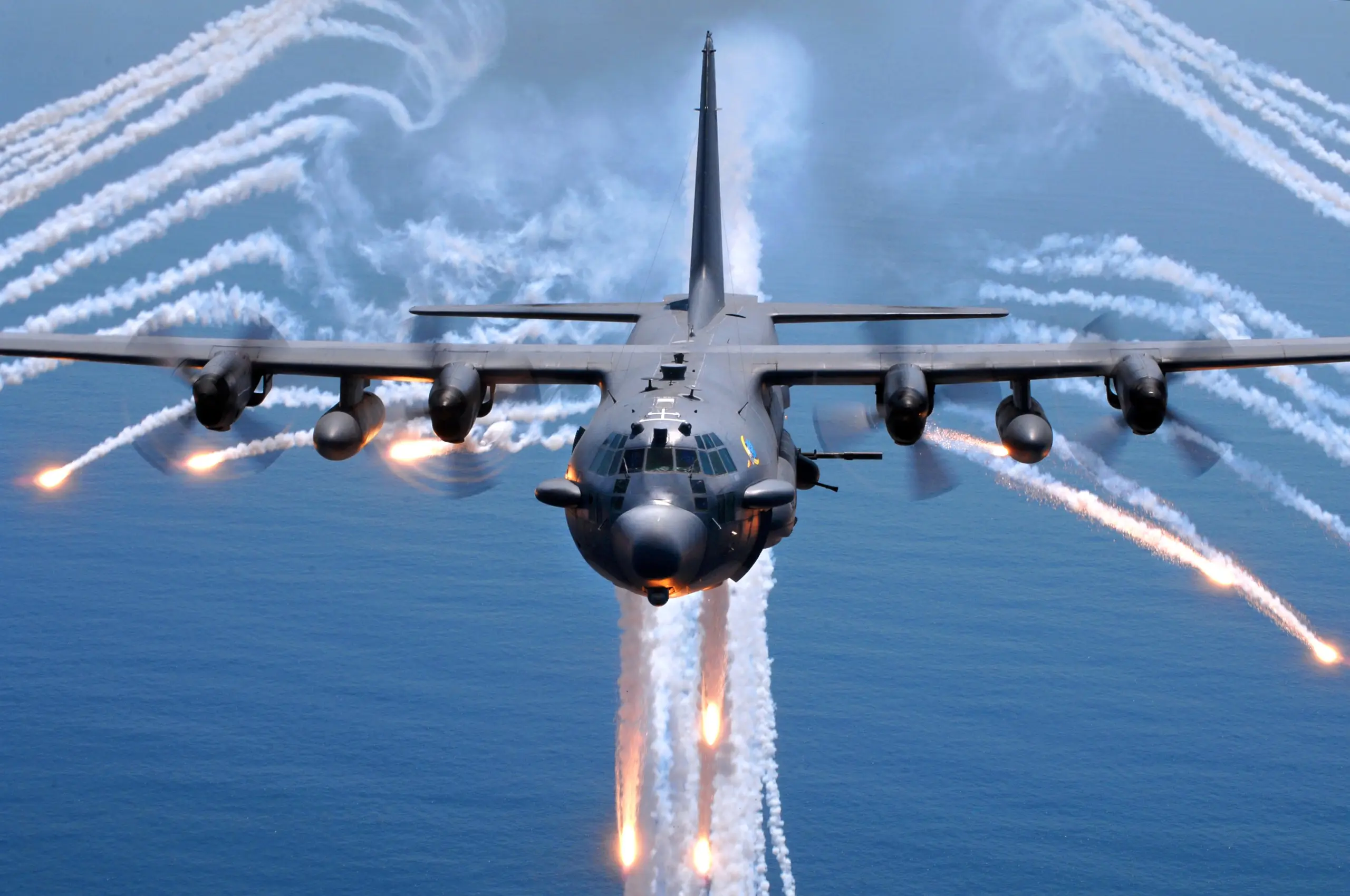
An AC-130H Spectre gunship flying head-on over the sea while dropping curving trails of burning flares on both sides

Attack · Cold War · In service

AC-130 Gunship

Artillery that flies in circles

Lockheed / Lockheed Martin (C-130 airframe), converted for the US Air Force

Trucks destroyed by gunships in Vietnam
10,000+
A howitzer-sized gun in the cargo hold
105mm
In combat, from 1967 to today
59years
Enemy helicopter shot down (1969)
1

The guns of an AC-130 point out of the side of the fuselage, so the aircraft attacks by turning. The pilot banks into a slow, steady left-hand circle around the target and holds it there, and for as long as the aircraft keeps turning the guns stay on the same patch of ground. The target sits at the centre like the point of a compass. A fighter has to dive, fire, pull away and come round again. The gunship stays. The Air Force has flown that circle, in one gunship or another, for nearly sixty years.

Underneath the guns it is a cargo plane. The C-130 Hercules was designed in the 1950s to haul troops and supplies into rough airstrips, and the Air Force took that big, patient, high-winged airlifter and filled its hold with miniguns, cannons, night-vision sensors and, in the end, a 105 mm howitzer. What came out is closer to artillery than to a fighter, artillery that can stay overhead for hours.

Its ancestor was a World War II transport, the AC-47, which became known in Vietnam as “Puff the Magic Dragon” for the way its tracers came down out of the night sky, and for the relief that sight brought to the men below. The AC-130 took over in 1967 and became the Air Force’s most successful truck-killer on the Ho Chi Minh Trail. Gunships destroyed more than 10,000 trucks in that war.

Since then it has turned up wherever special forces have gone: Grenada, Panama, Desert Storm, Somalia, the Balkans, Iraq and Afghanistan. It has also paid a price. At dawn on 31 January 1991 the AC-130H Spirit 03 was shot down over Khafji with fourteen men on board, and the lessons of that morning have shaped the way every gunship crew has flown since.

The current model is the AC-130J Ghostrider, built on a C-130J with a digital cockpit. It carries a 30 mm cannon that one commander compared to a sniper rifle, guided bombs and missiles, and the 105 mm gun. It is the fifth generation of an idea first tried from a biplane in the 1920s. The aircraft has changed every time. The turn has not.

The pylon turn: a missionary, a fencepost and a grease pencil

Pilots call the manoeuvre a pylon turn, a name borrowed from the air races of early aviation. The guns point sideways, the aircraft flies a steady, banked circle around the target, and because it pivots around that one spot the guns stay aimed at it the whole way round. A fighter has to dive, fire, pull away and come back for another pass, and over thick jungle it often loses the target in between. A gunship never lets go.

The idea is far older than the AC-130. In 1926–27, 1st Lt. Fred Nelson bolted a side-firing machine gun into a DH-4 biplane at Brooks Field, Texas, flew a pylon turn and peppered a target marked on the ground with lime. Then it was forgotten. In 1942, a young anti-aircraft officer named Gilmour MacDonald suggested it for hunting submarines: "it is proposed that a fixed machine gun be mounted transversely in the aircraft so that by flying a continually banked circle the pilot may keep the underseacraft under continuous fire if necessary." Nothing came of it. He tried again in 1945, and again in 1961. Still nothing.

The man who finally got it moving was Ralph Flexman, an engineer at Bell Aerosystems, and he got there from an odd direction. He had read about Nate Saint, a missionary pilot in South America who flew pylon turns with a long rope hanging from his plane and used it to lower mail and other small items to remote villages, accurately, without landing. Flexman also remembered his own days as a flight instructor, pivoting his plane around a fencepost while holding it in view at the wingtip. If you could keep a fencepost in sight, he reasoned, you could keep a target in your gunsight.

Official review boards rejected the concept as technically unsound. Capt. John Simons, a research psychologist at Wright-Patterson AFB who had become a believer, tested it himself in June 1963, more or less under the table. His gunsight was a line drawn in grease pencil on the side window of a T-28 trainer. With it he held targets for ten minutes at a time, including a truck as it turned a corner. On a later flight in a C-131 transport, the crew practised on silos, barns, moving horses and, according to the Air Force's official history, "even fighting geese." Simons offered to "bet anyone a case of beer it will be much larger than 'lateral firing' as its only use." He would have won.

The last push came from Capt. Ronald Terry, a test pilot who flew a side-firing C-47 in 1964 and talked his way up the chain of command. On 2 November 1964 he briefed the Air Force Chief of Staff, Gen. Curtis LeMay, who liked it and sent a team to Vietnam to test it in combat. Years later LeMay grumbled that gunships were "not a very good platform and you can't carry the load." By then the gunship had been at war for years, and he was the man who had sent it.

Puff the Magic Dragon

Terry's team landed at Bien Hoa, near Saigon, on 2 December 1964. Their equipment arrived a week later, and within days two World War II-era C-47 transports had become gunships, with rapid-fire miniguns pointing out of the left side and a gunsight made from a converted 16 mm camera viewfinder. For want of a better name they were called FC-47s.

On the night of 28 December 1964, Terry flew one to Ngai Giao, a district capital under Viet Cong attack. The defenders had marked each corner of their small triangular fort with pots of fire and laid out an arrow of fire. The gunship dropped flares and swept the perimeter for more than an hour. An Army general flew along to watch, and wrote: "At the end of the mission the personnel at the post reported that due to the air support the VC attack had been broken off and they were extremely grateful for this support."

The nickname came quickly. At night the tracers poured down out of a black sky like tongues of flame, with a sound nobody forgot, and the aircraft became "Puff, the Magic Dragon". Terry believed the name came from a mix of 1964 being the Chinese Year of the Dragon, prisoners' stories about fire from the sky, and the fairy tale; others point to the popular song. Redesignated the AC-47, it became better known by its radio call sign, Spooky, and more than 50 were converted for Vietnam.

Its most famous night belongs to a 23-year-old loadmaster. On 24 February 1969, AC-47 Spooky 71 was circling the Army base at Long Binh when an enemy mortar round exploded in its right wing. Shrapnel tore through the cargo hold and wounded all four men working there. Airman 1st Class John Levitow, hit by about forty fragments, dragged a stunned gunner away from the open door, then saw smoke. An armed magnesium flare was rolling around the floor among the ammunition, seconds from igniting. Three times it slid out of his grip. He threw himself on it, hugged it to his body, crawled to the door dragging his wounded legs, and pushed it out. It ignited just outside the aircraft.

"I'll never know how Levitow managed to get to the flare and throw it out," said his pilot, Maj. Kenneth Carpenter. "In my experience, I have never seen such a courageous act performed under such adverse conditions." Levitow received the Medal of Honor on 14 May 1970, the first enlisted airman of the independent Air Force to be awarded it. He shrugged it off as luck, or "temporary insanity."

Puff had proved the idea, and shown its limits. The C-47's low wings got in the way of the guns, and it could not carry much. The Air Force went looking for a bigger airlifter with a high wing, room for heavier guns and far more ammunition, and settled on the C-130 Hercules.

The big gun

By 1971 the enemy's defences along the Ho Chi Minh Trail were getting deadlier, and gunships had to fly higher to survive. The engineers' answer was an Army howitzer in the back. A 105 mm shell carried roughly nine times the explosive of the 40 mm rounds the gunships were already firing, it reached further, so the aircraft could stay higher, and each burst left a clear mark on the ground for the escorting fighters. A team from the Air Force Academy checked the stresses on the airframe and decided the plane could take it. The project was called Pave Aegis. The first gun arrived in February 1972, and on 1 March 1972 it fired in combat.

Weeks later North Vietnamese tanks were rolling south. On 23 April 1972, near Tan Canh, Capt. Russell T. Olson flew a Pave Aegis gunship through anti-aircraft fire to break up a column of tanks heading for friendly positions. Back at Pleiku there was no spare aircraft, so the same crew turned around in the same aeroplane and were over the battlefield again by dawn, descending through thick cloud. The gunship drew the fire of two tanks onto itself and away from a helicopter that was lifting out eleven US Army advisors, then guided newly arrived fighters onto targets they couldn't find in the smoke and haze. Low on fuel, it didn't leave until the rescue was done. The Seventh Air Force credited it with putting at least seven tanks out of action.

Ground troops learned the difference fast. When a Spectre checked in overhead, they wanted to know whether it had "the big gun". The 105 mm gunships made up only an eighth of the fleet, but accounted for more than half of all the tanks the gunships damaged or destroyed.

The big gun never left. The AC-130H carried it, the AC-130U carried it, and when the Air Force designed the AC-130J around precision missiles and bombs, the head of Air Force Special Operations Command, Lt. Gen. Bradley Heithold, insisted on a 105 mm too. As a gunship fired its cannons over Hurlburt Field, the 1st Special Operations Wing commander, Col. Tom Palenske, summed up the effect: "That's the sound America makes when she's angry."

Armament

105 mm cannon
An Army howitzer adapted to fire sideways out of a cargo plane. It first fired in combat in 1972, and every gunship generation since has kept one. On the AC-130J it is trainable, so it can swivel to track a target.
30 mm GAU-23/A cannon
The AC-130J's precision gun. A wing commander described it as “almost like a sniper rifle … it’s that precise, it can pretty much hit first shot, first kill.”
Guided weapons
The AC-130J adds standoff precision munitions: GBU-39 Small Diameter Bombs, the GBU-69 Small Glide Munition, AGM-114 Hellfire and AGM-176 Griffin missiles.
The ancestors' guns
The AC-47 carried three 7.62 mm miniguns. The first AC-130As added 20 mm Vulcan cannons, later 40 mm guns, and the AC-130U carried a 25 mm Gatling gun, a 40 mm and a 105 mm. Each generation hit harder, from higher up.

Missions & Moments

Spirit 03: the last gunship over Khafji

Late January 1991. The air war over Iraq and Kuwait is almost two weeks old. Then, on 29 January, Iraqi forces surge south across the border into Saudi Arabia and attack the border town of Khafji: about 40 tanks and 500 troops, by one veteran's count. Coalition troops are pushed back. Two small teams of US Marine reconnaissance troops are left behind inside the town.

Over the next nights, four AC-130H Spectre crews of the 16th Special Operations Squadron fly to Khafji to support the Marines and special operations forces. They work under heavy anti-aircraft fire, and they wreck Iraqi vehicles and armour on the roads into town. On the night of 30–31 January, two gunships, Spirit 01 and Spirit 02, are hammering Iraqi columns. A third, Spirit 03, arrives a few hours later and circles for hours waiting for tasking.

As the flak grows heavier, Spirit 01 and 02 head home, and advise Spirit 03 to do the same. Spirit 03 stays. It keeps taking targets from a Marine forward air controller, shooting up a border post that Iraqi soldiers are using for cover. By 6 a.m. the crew has declared "bingo" fuel: just enough left to get home. Dawn is coming. Then the Marine controller passes on a suspicion: an Iraqi FROG rocket launcher may be somewhere nearby, a threat to the Marines. Spirit 03 goes looking for it.

Nobody on board sees the missile. A shoulder-fired SA-7 streaks up, hits the left wing and starts a fire near the external fuel tank. The pilots hold the big gunship steady at first, but the burning fuel eats through the structure, and 14 seconds after the explosion the left wing fails. The AC-130 spins out of control and crashes into the shallow waters of the Persian Gulf. All 14 airmen on board are killed. It is the largest single loss suffered by any Air Force unit in Desert Storm.

It takes a month to find the wreck, and in that silence stories grow. Years later, the former gunship pilot Maj. Gen. Mark Hicks explained what probably happened: "the sun was breaking over the horizon to their east, likely preventing visual acquisition of the inbound MANPADS missile." Two other AC-130 crews had beaten these missiles earlier in the war by spotting them in time, manoeuvring and firing flares. "Unfortunately, nobody saw it coming." In the battle itself the three Spirit gunships proved decisive. They stopped Iraqi reinforcements before they reached the town.

The loss changed how gunships fly. After Desert Storm, every AC-130 received a missile warning system that spots a launch and fires flares automatically, with no crew action needed. Crews learned to fly higher, in looser and less predictable orbits, breathing through oxygen masks in the unpressurised cabin. And the story of that morning went into the training syllabus. "The lessons passed on to crews trained since that fateful day are the true legacy of Spirit 03," Hicks said. Thirty years later, no AC-130 had been lost in combat since.

The crews

The AC-130J flies with eight people: two pilots, two combat systems officers who run the sensors and weapons, and four special mission aviators. The AC-130U it replaced needed thirteen, including five officers and four aerial gunners. Up front the pilots fly the orbit, round and round, for as long as the fuel lasts. In the back the crew keeps the guns fed.

A gunsight in the side window
In the first gunships the pilot did the aiming. The sight was mounted at the left cockpit window, so he steered the whole aircraft until the target sat in the crosshairs, then fired.
Shovel duty
When an AC-130's 20 mm guns fired, hundreds of empty casings rained onto the floor. Gunners shovelled them into bags.
Loaded by hand
The 105 mm gun is fed by its gunners, one heavy round at a time, in a dark, noisy cargo hold while the aircraft banks around the target.
Spirit 03 is in the syllabus
The events that led to the loss of Spirit 03 in 1991 have been studied at length and are part of AC-130 crew training. As one former gunship pilot put it: “The fundamental lesson learned is to always expect to be fired upon when firing.”

Names worth knowing

  • Capt. Ronald Terry Father of the gunship

    Test pilot who flew a side-firing C-47 in 1964, briefed Gen. Curtis LeMay, then led the team that took the first gunships into combat in Vietnam.

  • A1C John Levitow Loadmaster, Spooky 71

    Badly wounded, he smothered a live flare with his body and threw it out of his burning AC-47 in 1969. He received the Medal of Honor, and later spent 22 years serving fellow veterans in Connecticut.

  • Capt. Russell T. Olson Pave Aegis pilot, 1972

    Flew a 105 mm gunship against tanks at Tan Canh, turned straight round for a dawn mission, and drew tank fire away from a helicopter rescuing eleven US advisors.

  • Brig. Gen. Brenda Cartier Spooky pilot

    Joined the AC-130U community in 1997 and, as AFSOC's director of operations, personally flew the last armed AC-130U to retirement in 2019. “It’s very bittersweet.”

Did You Know?

Some AC-130As carried a sensor called Black Crow that could find and track vehicles by the electrical impulses of their spark plugs.
The AC-130's low-light TV camera amplified existing light 60,000 times, producing images at night “as clearly as if it were noon.”
The C-130 chosen as the first AC-130 had been in three major accidents before the project got it. At one point it had been nicknamed "sick-two-six".
The very first C-130 ever built became an AC-130A gunship. Nicknamed The First Lady, it kept flying until 1995.
On 8 May 1969 an AC-130 shot down an enemy helicopter. It earned the nickname "fabulous four engine fighter", to the chagrin of fighter pilots who had few chances for air-to-air kills.
From December 1968, F-4 Phantoms flew escort for the AC-130s to protect them from ground fire, which made the gunship a cargo plane with its own fighter cover.

Myth vs. fact

Myth

Spirit 03 was lost because its crew knowingly stayed out in daylight, in a heroic last stand to save Marines who were about to be overrun.

Fact

Maj. Gen. Mark Hicks, a career gunship pilot who studied the loss, wrote that this story and another about an overeager pilot “contain partial facts, but are somewhat misleading.” He found no sign of reckless heroism, and no special urgency to the final target. Staying in a sky lit by the rising sun was a tactical error, but old sensors, a useless flare system and gaps in training and tactics played their part too. “The fact remains that Spirit 03 was shot down by an enemy weapons system while doing what we asked them to do and exactly as we had trained them to do.”

Timeline

  1. 1926–27

    At Brooks Field, Texas, 1st Lt. Fred Nelson flies a DH-4 with a side-firing machine gun in a pylon turn and hits a target marked with lime. The idea is then forgotten for decades.

  2. Dec 1964

    Capt. Ronald Terry's team converts two C-47s at Bien Hoa, South Vietnam. The FC-47, soon the AC-47 "Puff", flies its first combat missions.

  3. Feb 26, 1967

    C-130A 54-1626 is picked to become the prototype "Gunship II", the first AC-130.

  4. Sep 1967

    The prototype arrives at Nha Trang, South Vietnam, for its combat evaluation. The AC-130 goes to war.

  5. May 8, 1969

    An AC-130 shoots down an enemy helicopter and earns the nickname "fabulous four engine fighter".

  6. Mar 1, 1972

    A 105 mm howitzer fires from an AC-130 in combat for the first time.

  7. Dec 1989

    Gunships open the invasion of Panama by attacking the Panamanian Defense Force headquarters. The crews win the Mackay Trophy.

  8. Jan 31, 1991

    AC-130H Spirit 03 is shot down at dawn during the Battle of Khafji. All 14 crew are killed.

  9. Jan 31, 2014

    The AC-130J, converted from an MC-130J special operations transport, flies for the first time as a gunship at Eglin AFB, Florida.

  10. Jul 2019

    The AC-130J Ghostrider deploys for the first time. In August the last armed AC-130U flies to the boneyard in Arizona.

  11. Nov 2022

    The last AC-130J is delivered to Air Force Special Operations Command.

Where to see one today

The newer gunships are still flying, but the pioneers have retired to museums, several of them combat veterans with names painted on their noses.

United States· 4

  • Air Force Armament Museum

    Eglin AFB, Florida

    The first C-130 off the production line, in 1953. It became a gunship and flew until 1995. Open for walk-through tours on the third Friday of each month.

    53-3129AC-130A "The First Lady"
  • Hurlburt Field Memorial Air Park

    Hurlburt Field, Florida

    Survived 37 mm and 57 mm hits over Vietnam, then flew in Panama and Desert Storm. It shares the park with an AC-130H and an AC-130U. Open to the public around the clock since April 2024.

    56-0509AC-130A "Ultimate End" · outdoors
  • Museum of Aviation

    Robins AFB, Georgia

    Flew combat in Southeast Asia from 1971 to 1975, then again in Desert Storm, before retiring to the museum in 1995.

    55-0014AC-130A Spectre · outdoors
  • National Museum of the US Air Force

    Dayton, Ohio

    In the Cold War Gallery. Named after the angel of death, it attacked Iraqi convoys fleeing Kuwait on 26 February 1991 through surface-to-air missiles and radar-guided flak.

    54-1630AC-130A "Azrael" · indoors

The Gunship II prototype, 54-1626 (once nicknamed "sick-two-six"), belongs to the National Museum of the US Air Force but is no longer on public display. The Hurlburt Field air park also has an AC-47D Spooky, so you can see the whole family line in one walk.

Locations last checked October 2026. Airframes occasionally move, so check with the museum before you travel.

On screen

Where the AC-130 Gunship became a star outside the hangar.

  • Game · 2007

    Call of Duty 4: Modern Warfare

    The mission Death From Above puts you in an AC-130 as the gunner, watching your own squad as white dots on a thermal screen while the crew chatters over the radio. GamesRadar calls it one of the most memorable missions in the series' long history.

Sources

Facts last reviewed October 2026

  1. 1. U.S. Air Force: AC-130J Ghostrider fact sheet (January 2025) and 919th Special Operations Wing version (speed, ceiling)
  2. 2. U.S. Air Force: AC-130U fact sheet (2016) and AC-130W Stinger II fact sheet
  3. 3. Jack S. Ballard, Development and Employment of Fixed-Wing Gunships 1962–1972 (Office of Air Force History, 1982)
  4. 4. Air Force Historical Research Agency: Flashback: Puff the Magic Dragon (2023)
  5. 5. Tinker AFB: Air Force history: John Levitow and Spooky 71
  6. 6. Hurlburt Field: AC-130A Spectre "Ultimate End" fact sheet (gunship history, helicopter kill, 105 mm dates)
  7. 7. Hurlburt Field: Hurlburt honors Spirit 03 crew for 25th anniversary (2016)
  8. 8. David Roza, Spirit 03 article, Task & Purpose, February 2021 (drawing on Maj. Gen. Mark Hicks and CMSgt. Bill Walter in Air Commando Journal)
  9. 9. Joint Aircraft Survivability Program: 'Spirit' of Survivability, Aircraft Survivability, Summer 2021
  10. 10. Special Operations Warrior Foundation: Spirit 03, Battle of Khafji
  11. 11. National Museum of the US Air Force: Lockheed AC-130A Spectre (Azrael), Lockheed AC-130A Hercules (prototype) and Gunship II: Spectre
  12. 12. U.S. Air Force: New AC-130J completes first test flight (2014)
  13. 13. Davis-Monthan AFB via DVIDS: AC-130U Spooky gunship rolls into retirement (2019)
  14. 14. Jared Keller, “That's the sound America makes when she's angry”, Task & Purpose (quoting Col. Tom Palenske to Military.com)
  15. 15. Air Force Armament Museum: AC-130 "The First Lady"
  16. 16. Museum of Aviation: AC-130A Spectre
  17. 17. Hurlburt Field: Memorial Air Park and DVIDS: Hurlburt Field reopens memorial air park to the public (2024)
  18. 18. GamesRadar+: Modern Warfare's Death From Above mission