Skip to content
Early preview The vault is just opening. New files are added regularly, and some sections are still being built.
VLTARIS
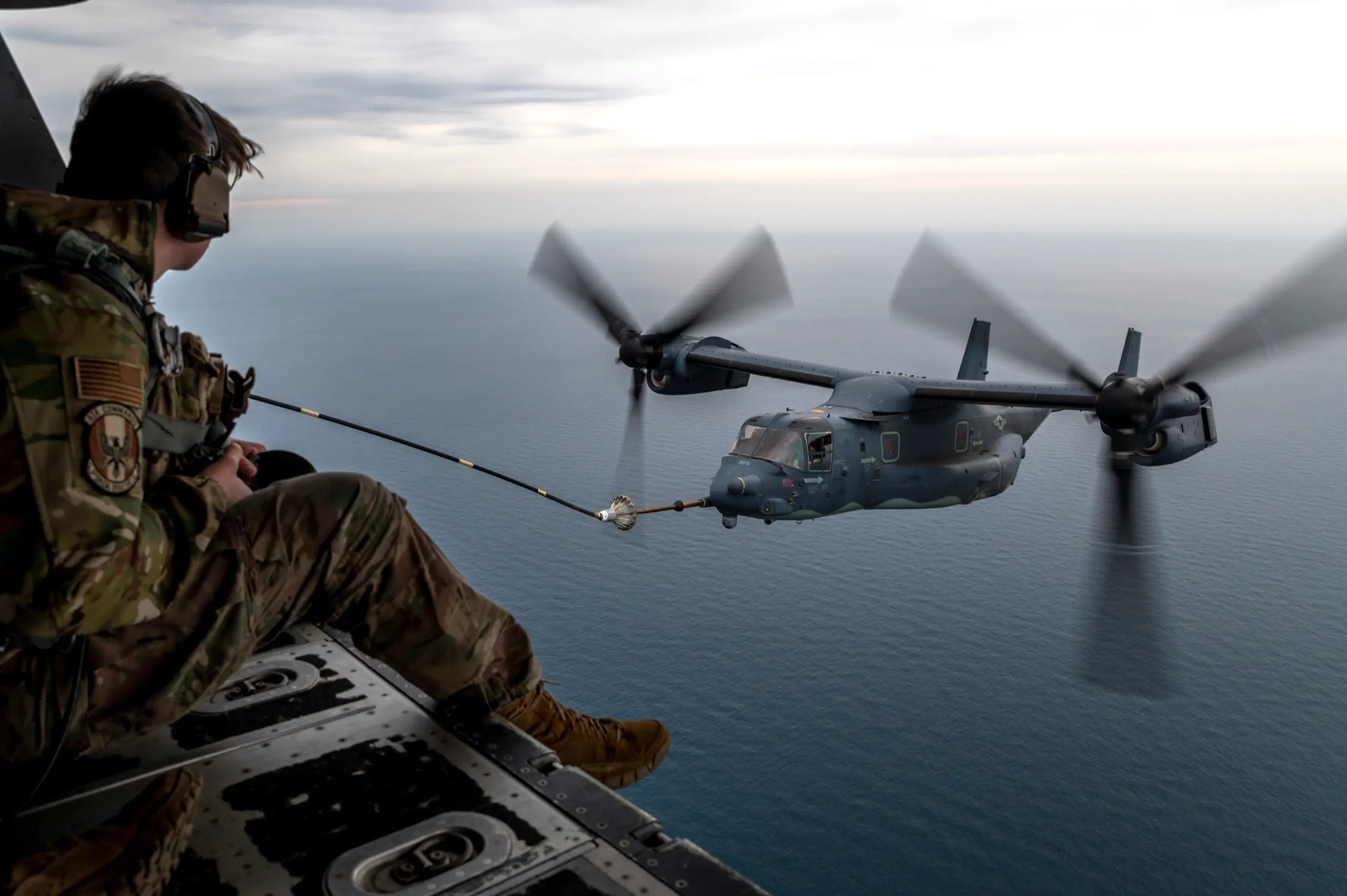
A CV-22 Osprey with its rotors tilted forward, trailing a refuelling hose from an MC-130J over the Sea of Japan, seen past an airman sitting in the tanker's open ramp

Helicopter · Modern · In service

V-22 Osprey

Lands like a helicopter, leaves like an aeroplane

Bell Boeing

Cruise speed with the rotors tilted forward
493km/h
Troops in the cabin
24
Fleet flight hours
750,000+
Lives lost in Osprey mishaps, 1991 to July 2025
65

On 19 March 1989, at Arlington, Texas, the first Osprey rose straight up off the ground on two 11.6 m rotors, hovered, and set itself back down. On 14 September it took off again, swung those rotors forward and flew away as an aeroplane. One machine had done both, which no aircraft in military service had managed before. The V-22 is a tiltrotor, a helicopter when it needs to be and a twin turboprop the rest of the time, and it is still the only one ever built in numbers.

The Marines wanted it because a helicopter is slow and an aeroplane needs a runway. An Osprey leaves an assault ship vertically, cruises at 493 km/h and lands on a road, a ridge or a patch of desert hundreds of kilometres away. That reach sent it into Iraq in 2007, Afghanistan in 2009, and off USS Kearsarge one night in 2011 to pick up an Air Force pilot hiding in a Libyan creek bed. The Air Force flies its own version for special operations, the Navy uses one to carry mail and engine parts out to aircraft carriers, and twelve green ones fly the President’s staff and press corps around the world.

It took twenty-six years to get there. The programme nearly died in Congress in 1989, lost seven people in a prototype crash in 1992, and in 2000 killed twenty-three Marines in two accidents eight months apart, one of them at Marana, Arizona, when a pilot descending too fast at night flew into a rotor stall nobody had fully understood. The fleet was grounded, a squadron commander admitted faking maintenance records, and a panel of outsiders ordered the whole thing rebuilt. That history is told here in full.

The accidents did not end when it entered service. In November 2023 a CV-22 called Gundam 22 went into the sea off Japan after a gearbox gear fractured, eight airmen died, and every Osprey in the US fleet was grounded. Three years on, the aircraft still flies with limits while stronger gears and clutches are fitted, and 65 people have died in Osprey mishaps since 1991.

Set beside that are the nights the design earned its keep: a downed pilot picked up 47 minutes after the Ospreys left the ship, and three shot-up CV-22s that flew 90 minutes to Uganda with four wounded men and not a single death. The Marines have taken delivery of their last new Osprey and intend to fly it until 2055, and the Army’s next tiltrotor is already being built on what this one taught.

Neither helicopter nor aeroplane

On the deck of an assault ship an Osprey waits with both of its 11.6 m rotors pointing at the sky. It lifts straight up, like a helicopter. Then the two nacelles on the wingtips, each holding an engine and a gearbox, swing forward through 90 degrees until the rotors face the way the aircraft is going. From that moment the rotors are propellers, the wing carries the weight and the Osprey is a twin turboprop cruising at 493 km/h. Boeing puts that at nearly twice the speed of most helicopters. At the far end the nacelles swing back up and it lands in a clearing, on a ship, or on a road.

What the trick buys is distance. Marine officers say the Osprey expanded their logistics reach about 3.5 times over the helicopters it replaced. When the first squadron went to sea in 2009, the Government Accountability Office noted that it finished its amphibious assault mission with half the aircraft, in less time, over twice the distance of the old way. A probe on the nose lets it take fuel from a tanker, so a CV-22 can fly for five hours or more and cross oceans on its own.

The tiltrotor idea was not new in 1989. Bell had flown the experimental XV-3 and, with NASA, the XV-15 research aircraft from 1977. The Osprey was the first one built in numbers for a military customer, and the Navy calls it the world's first production tiltrotor.

Ships are tight on space, so the Osprey folds. The three blades on each rotor fold back, then the whole wing rotates to lie along the fuselage. An aircraft that is 25.8 m wide with the rotors turning becomes a 5.6 m wide package.

The price of all this lives in the nacelles. Each one holds an engine, a clutch and the proprotor gearbox, and the two are joined by a driveshaft through the wing so that either engine can turn both rotors. Bell said in 2021 that 60 per cent of the Osprey's maintenance hours go into nacelle work. The Army's new tiltrotor, the Bell MV-75, keeps the engines fixed and tilts only the rotors, a design shaped partly by what the Osprey taught.

Twenty-six years from drawing board to war

The programme began in December 1981, and for most of the next twenty years it was fighting for its life. The Army, which led it, dropped out the following year over cost. Bell and Boeing, the only bidders, won the design contract in April 1983, and full-scale development started in 1986.

A month after the first flight in March 1989, the Secretary of Defense stopped requesting money for it. In December 1989 the Pentagon ordered the Navy to terminate every V-22 contract, arguing that helicopters could do the job for less. Congress disagreed and kept writing cheques, year after year, through 1992. The Marine Corps wanted the aircraft badly, and in Washington that counted.

The prototypes were another matter. In June 1991 one crashed without loss of life because of a wiring error in the flight controls. On 20 July 1992 the fourth prototype caught fire on approach to Quantico after hydraulic failures inside a nacelle, and seven people died. The fleet stayed on the ground until August 1993.

The year 2000 was the worst. On the night of 8 April, two MV-22s on an exercise simulating an evacuation flew into the airport at Marana, Arizona. "Both aircraft arrived at the airport 2,000 feet higher than planned," Lieutenant General Fred McCorkle, the head of Marine aviation, told reporters. The investigation found that both crews descended far too fast rather than go around, and that the second aircraft, slowing to about 40 knots with a tailwind behind it while sliding into position behind its leader, fell into vortex ring state, a stall of the rotor that every helicopter can suffer. All four crew and fifteen Marine passengers died. McCorkle again: "In the Marine tradition of getting the mission accomplished, rather than go around, the Marines decided to accomplish the mission." Then, on 11 December, an Osprey crashed near Jacksonville, North Carolina, killing four more Marines, among them Lieutenant Colonel Keith Sweeney, the most experienced Osprey pilot in the Corps.

Within weeks an anonymous letter and a tape reached the press: the commander of the Osprey squadron had told his mechanics to falsify maintenance records until the production decision was made. He admitted it in January 2001 and was relieved of command. A Blue Ribbon panel reported in April 2001 that there was nothing inherently flawed in tiltrotor technology, but a great deal wrong with the programme, and the Osprey was rebuilt almost from scratch: nacelles redesigned so that lines could no longer chafe, a software laboratory, a research effort into vortex ring state, and a slower production line until the Secretary of Defense could certify the aircraft safe. Full-rate production was finally approved in September 2005. The Marines declared the MV-22 ready in June 2007 and sent ten of them to Iraq that September.

Rooster 73: ninety minutes to Entebbe

South Sudan, the world's newest country, fell into civil war in December 2013. American citizens were stranded at a United Nations compound at Bor, which was surrounded by thousands of rebel fighters and some 14,000 refugees. Rebel leaders were told that US aircraft would come for the Americans, and on 21 December three CV-22s of the 8th Special Operations Squadron, call signs Rooster 73, 74 and 75, left Djibouti with a security team, pararescuemen and medics aboard. The flight crossed three countries and about 1,460 km (790 nautical miles), refuelling from MC-130s on the way.

The crews had been told to expect a permissive landing zone. As the lead Osprey rotated its nacelles up to land beside the compound, the ground opened fire with machine guns, rocket-propelled grenades and rifles. "It just erupted," flight engineer David Shea said later. "They lit us up pretty good." A round hit Shea square in the chest plate and threw him across the cargo bay. When he got up, everyone behind him was on the floor and he assumed they were dead. The three aircraft took 119 hits between them. Four special operations soldiers were wounded, three of them critically.

Fuel was pouring from the one point in the lines that cannot be isolated, the fumes were so thick the crew could barely breathe, and a hydraulic system was gone. Landing was out of the question, so the formation turned for Entebbe, Uganda, about 640 km away. Rooster 73 could not reach it without a tanker. With the hydraulics dead, flight engineer Christopher Nin extended the refuelling probe by hand crank, something no crew had done on a real mission before. The leak was so fast the aircraft needed a second hook-up, so Nin cranked it out again: around 300 turns in all.

In the back, medics put tourniquets on the wounded, worked out their blood groups and drew blood from everyone else on all three aircraft, so transfusions would be ready the moment they landed. Shea kept one hand pressed on a team leader's arterial bleed for the entire flight and held an IV bag with the other. At Entebbe the crew blew the landing gear down with emergency nitrogen, hover-taxied in without brakes or nose-wheel steering, and wedged ammunition cans under the tyres because there were no chocks. A C-17 that happened to be passing through, carrying an Army medical team, became the ambulance to Nairobi. Nobody died.

Pilot Benjamin Fingarson, commanding the third Osprey, met one of the soldiers months later. "He told me, as he heard the rounds hitting the aircraft, he felt me maneuver the Osprey in ways he didn't know were possible. He told me I saved his life." The three crews received the 2013 Mackay Trophy for the most meritorious flight of the year, and Bell-Boeing engineers spent months at Entebbe putting the aircraft back together.

Gundam 22 and the grounding

On 29 November 2023 a CV-22 of the 21st Special Operations Squadron, call sign Gundam 22, was flying from Yokota Air Base in a joint exercise with Japanese forces. The crew received a series of chip warnings, the Osprey's way of saying that metal flakes had been caught in a gearbox's oil, and disregarded some of them. When the aircraft announced "Land as Soon as Possible", they aborted the mission and diverted to the airport on Yakushima island. On final approach to the runway the recorder captured a cascade of failures. The aircraft rolled left and went into the sea about 800 m off the coast. All eight airmen died.

The Air Force released its accident investigation on 1 August 2024. The left-hand proprotor gearbox had failed catastrophically: one of its five high-speed pinion gears had fractured, and the fragments set off a chain of failures through the drive system until one rotor lost lift and the other did not, a condition the board called "unrecoverable by the mishap crew". The board also found the crew's decision-making causal: pressing on through the warnings had prolonged the sequence and taken an earlier landing off the table. The head of Air Force Special Operations Command, Lieutenant General Michael Conley, said afterwards that the rules had changed: "Our criteria prior was three-chip [warnings] was a 'land as soon as practical'. We've changed that to one, and then two becomes a 'land as soon as possible'. At the end of the day, there will always be aircraft commander and crew discretion."

It was the second drive-system crash in eighteen months. On 8 June 2022 an MV-22 training near El Centro, California, suffered a double "hard clutch engagement", in which a worn clutch slips and slams back in, overloading the drive, and five Marines died. The programme had logged 19 such events, and the admiral running Naval Air Systems Command ordered every clutch with more than 800 hours replaced.

In December 2023 the Navy grounded every Osprey in the US fleet. The grounding was lifted in March 2024 on condition that aircraft stay within 30 minutes of a place to land. After a near-crash in New Mexico in November 2024 the fleet was briefly grounded again. The fixes are mechanical and slow: gearbox gears made from a cleaner "triple-melt" alloy, new plating on the gearbox mast, a redesigned clutch, vibration monitoring that can estimate a gearbox's remaining life, and rebuilt nacelles that Bell said in April 2026 had cut maintenance hours by 75 per cent on the first CV-22s to get them.

As of this file's review in October 2026, the latest authoritative account we could find is the Congressional Research Service report of September 2025. It says the Navy and Air Force fleets were still under the 30-minute rule, that the programme office aimed to return the Osprey to full operations in 2026, and that the Marines planned to fly theirs until 2055. We could not confirm from official sources whether the restriction had been lifted by October 2026, so treat the Osprey as active but still flying with limits until a service says otherwise.

Armament

Ramp gun
A machine gun on the open rear ramp, worked by the crew chief. In Afghanistan the Marines swapped the standard 7.62 mm gun for a .50-calibre one.
Belly turret
Some Ospreys carry a retractable 7.62 mm gun under the belly that can fire in any direction. It takes up cabin space when stowed, so it is fitted only when the mission calls for it.

Missions & Moments

Forty-seven minutes

Late on 21 March 2011, the third night of the air campaign over Libya, an F-15E Strike Eagle called Bolar 34 dropped a bomb on an air defence site, rolled into a hard right turn at about 9,000 m and fell into a spin it could not recover from. Major Kenneth Harney and his back-seater, Captain Tyler Stark, ejected at about 1,700 m and landed in open fields near Bu Mariem, east of Benghazi. Stark was found almost at once by local people who, luckily, were on the rebels' side. Harney shed his gear, grabbed his survival kit and ran.

The nearest Air Force rescue helicopters were in Europe, hundreds of kilometres away. The nearest help of any kind was the amphibious assault ship USS Kearsarge, about 160 km off the coast, with the 26th Marine Expeditionary Unit aboard. Every MEU keeps a team trained for exactly this, a TRAP, Tactical Recovery of Aircraft and Personnel. In the wardroom, Osprey pilot Captain Erik Kolle was drinking coffee when his executive officer yelled his call sign: "Brillo, get your butt in the ready room. We've had a jet go down."

Two AV-8B Harriers launched first, then two MV-22s with 15 reconnaissance Marines each, then two CH-53E helicopters carrying 35 more as a backup. The package was airborne within the hour. On the way in, Harrier pilot Major Eric Grunke switched to the downed pilot's frequency and heard a man whispering into his radio with the wind rustling around him. "At that point it all became real to me," he said. "This is no longer North Carolina, this is no longer practice. That's really a guy down there scared for his life." Air Force F-16s circling above were steering Harney through the dark with their targeting pods. Kolle, inbound in the second Osprey, heard it on the radio: "There's a ditch 50 yards to your east. Go there, now."

Harney could see vehicles with searchlights and hear dogs and gunfire. Grunke put his targeting pod on one of them. "I tell the pilot, 'Okay, I can see the guys … I've got two 500-pound bombs, do you need them?' He says, 'Yes, yes I do.'" As Grunke set up the attack, Harney came back on the radio, crying: "Tell my wife I love her." Grunke answered, "Don't worry, I'm going to have a bomb on the deck in one minute," guided the bomb for about fifty seconds onto the ground between Harney and the vehicle, and dropped a second in front of another. Then he found a road beside the creek bed where the pilot was hiding and passed its coordinates to the Ospreys. It was learned afterwards that the vehicles had belonged to rebel sympathisers looking for the airman to help him.

The two Ospreys, led by Major B. J. Debardeleben, closed at 300 knots and went in low, about 60 m above the ground, because Gaddafi's radar and missiles were still alive. On short final the lead aircraft asked for a laser "sparkle" on the pilot's position, and the crews could also see the strobe on his survival vest. The leader passed straight over Harney with too much speed to land. Kolle had deliberately held back in case the leader kicked up a brownout, and from his trailing position he set down about 45 m from the pilot, on a patch of irrigated green in the brown desert. "Leave it to an Air Force pilot to find the one area that looked like a golf course," he said.

The recon Marines ran down the ramp and spread out. Harney put his hands in the air so that nobody would mistake him for anything else. "As that back door opened, I see a group of young marine recon units jump out, and that was probably the best feeling I've ever felt in my entire life." Seconds later crew chief Sergeant Daniel Howington came up on the intercom: "Hey, we got him." Kolle replied, "Roger that, we're getting out of here," then had Howington count the Marines back aboard, and count again. The Ospreys were back on Kearsarge 47 minutes after they had left it. The helicopters never had to land.

Grunke shook Harney's hand on the ship. The accident board later cleared Harney of error and blamed the jet's lopsided load and an ambiguous flight manual. Kolle, Potter and Howington received Air Medals, Grunke was named Marine Aviator of the Year, and the Osprey, four years into service, had done the thing it was built to do better than anything else, which is to reach a man a long way off, fast, and land next to him.

The crews

The two pilots sit side by side, with the controls between them. A Marine Osprey flies with two pilots and a crew chief; the Air Force CV-22 carries two flight engineers. The cabin behind them seats 24 troops, and the ramp at the back stays open for the gunner when it matters.

Chip lights
Each proprotor gearbox has magnetic plugs and three detectors that warn the crew when metal debris turns up in the oil. Since the 2023 crash one warning means land as soon as practical, and a second means land as soon as possible.
Brownout
Landing in the desert, the downwash throws up a blinding cloud of dust. In Libya in 2011 the second Osprey hung back on purpose to see whether the leader would brown out. A planned cockpit upgrade, VeCToR, is meant to help the flight controls through it.
Three hundred cranks
If the auxiliary hydraulics fail, the refuelling probe can be wound out by hand. Over South Sudan in 2013 flight engineer Christopher Nin did it twice, about 300 turns, to keep a leaking CV-22 drinking from its tanker.
Folding for the ship
The rotor blades fold and the wing turns to lie along the fuselage so the Osprey fits a hangar deck. Crew chiefs learn the blade-fold mechanism early.

Names worth knowing

  • Maj. Tom Currie First Air Force CV-22 pilot

    Flew the first flight of the CV-22 test aircraft in 1997. In 2025, as Bell's head of flight operations, he flew the last company flight of the final CV-22 built for the Air Force.

  • Capt. Erik "Brillo" Kolle Libya, 2011

    Landed his MV-22 about 45 m from a downed F-15E pilot in the Libyan desert. He and his crew chiefs, Staff Sgt. David Potter and Sgt. Daniel Howington, received the Air Medal with combat "V".

  • TSgt. David Shea Rooster 73 flight engineer

    Took a round in his chest plate over Bor, South Sudan, then spent the flight to Uganda holding pressure on a wounded soldier's artery with one hand and an IV bag in the other.

  • Lt. Col. Keith Sweeney Test and squadron pilot

    The most experienced Osprey pilot in the Marine Corps, in line to command its first squadron. He died with three other Marines near Jacksonville, North Carolina, on 11 December 2000, and the fleet was grounded.

Did You Know?

An Osprey with its rotors turning is 25.8 m wide. Fold the blades, swing the wing round to lie along the fuselage, and it is 5.6 m wide, narrow enough to park in a ship's hangar.
The test aircraft now outside the Patuxent River Naval Air Museum, known to its engineers as Eight-ball, once reached 354 knots, about 655 km/h, during envelope-expansion flying.
Twelve green Ospreys fly with HMX-1, the squadron that carries the President. They carry his staff and the travelling press. The President himself flies in a helicopter, never in the Osprey.
When the programme was rebuilt in 2001, the requirement that the Osprey be able to land in helicopter mode with both engines dead was dropped. The aircraft relies on two engines and a cross-shaft instead.
The Navy's CMV-22B has redesigned sponsons and extra wing tanks that hold 25 per cent more fuel than a Marine Osprey, enough to carry a 2,700 kg load about 2,130 km out to a carrier.
In 2009 Marine Ospreys supported the operation that freed Captain Richard Phillips of the Maersk Alabama from Somali pirates, providing rapid transport for the special operations forces.

Myth vs. fact

Myth

If an engine quits, an Osprey falls out of the sky, because it can't autorotate.

Fact

The two engines are linked by a driveshaft through the wing, so either one can turn both rotors; the Navy lists redundant drive and electrical systems among its safety features. What is true is that the requirement for an engine-out landing in helicopter mode (autorotation) was dropped when the programme was restructured in 2001, so the Osprey relies on that redundancy rather than gliding down on its rotors. The 2022 El Centro crash showed the limit: a double hard clutch engagement defeated the cross-shaft and left the crew with a single engine and a failing drive system.

Myth

The Osprey is the most dangerous aircraft in the US military.

Fact

It depends which Osprey. The Congressional Research Service puts the Marine MV-22's serious mishap rate at 2.56 per 100,000 flight hours for 2015 to 2024, slightly below the Marine Corps average of 2.67 for all its aircraft. The Air Force CV-22, flown hard at low level and in dust, had 11.55 against an Air Force average of 1.65, and the Navy's CMV-22 had none at all. Sixty-five people have died in Osprey mishaps since 1991, thirty of them before it entered service.

Timeline

  1. Dec 1981

    The Pentagon starts a joint-service tiltrotor programme, led at first by the Army. In April 1983 the only bidders, Bell and Boeing, win the design contract; the aircraft is named Osprey in January 1985.

  2. Mar 19, 1989

    The first prototype flies in helicopter mode at Arlington, Texas. On 14 September it flies as an aeroplane for the first time.

  3. Dec 1989

    The Pentagon orders the Navy to cancel every V-22 contract as unaffordable. Congress refuses, and keeps refusing through 1992.

  4. Jul 20, 1992

    The fourth prototype catches fire and crashes while landing at Quantico, Virginia, killing seven people. Flying resumes in August 1993 after changes to the prototypes.

  5. Apr 8, 2000

    An MV-22 on a night evacuation exercise descends too fast into Marana, Arizona, loses lift and crashes. Nineteen Marines die.

  6. Dec 11, 2000

    A second Osprey crashes near Jacksonville, North Carolina, killing its four crew. The fleet is grounded, and a Blue Ribbon panel orders the programme rebuilt.

  7. Jun 2007

    The MV-22 is declared ready for service. In September, ten Ospreys deploy to Al Anbar province, Iraq. The Air Force's CV-22 follows in March 2009.

  8. Dec 21, 2013

    Three CV-22s are shot up over Bor, South Sudan, and fly 90 minutes to Uganda with four wounded aboard. The crews win the Mackay Trophy.

  9. Jul 2020

    The first Osprey for Japan is delivered. The Navy's carrier-delivery CMV-22B is declared operational in February 2022.

  10. Nov 29, 2023

    A CV-22 call sign Gundam 22 crashes off Yakushima, Japan, after a gearbox fails; eight airmen die. Every Osprey is grounded until March 2024.

  11. Jul 29, 2026

    Bell and Boeing mark the 359th and last MV-22 for the Marine Corps. The Marines plan to fly the Osprey until 2055.

Who flies it

  • United States

    306

    US Marine Corps

    MV-22B. The Marines' inventory in June 2024; the 359th and last MV-22 for the Corps was delivered in July 2026. Also 12 with HMX-1 for presidential support flights.

  • United States

    51

    US Air Force Special Operations Command

    CV-22B, for long-range special operations. Some have been put into storage so that the rest can be better maintained.

  • United States

    37

    US Navy

    CMV-22B, replacing the C-2 Greyhound for carrier deliveries. Still in production; 53 are planned.

  • Japan

    17

    Japan Ground Self-Defense Force

    The only export customer. First delivered in July 2020.

Fleet figures as of September 2025 (CRS report); Marine total updated July 2026; numbers change as aircraft are delivered and retired.

Where to see one today

Only two Ospreys have retired to museums so far, and both spent their lives as test aircraft.

United States· 2

  • Patuxent River Naval Air Museum

    Lexington Park, Maryland

    The eighth Osprey built, instrumented with 1,300 sensors for 20 years of flight testing. It once reached 354 knots. On loan from the National Museum of the Marine Corps since 2019.

    164940MV-22B "Eight-ball" · outdoors
  • National Museum of the U.S. Air Force

    Dayton, Ohio

    The Air Force's oldest CV-22. Built for the Navy, it flew more than 600 test missions at Edwards and Hurlburt before landing at the museum on 12 December 2013. Shown in the Cold War Gallery.

    99-0021CV-22B · indoors

The Air Force museum also keeps the experimental Bell XV-3 in its Research and Development Gallery: the tiltrotor idea, decades before it worked.

Locations last checked October 2026. Airframes occasionally move, so check with the museum before you travel.

On screen

Where the V-22 Osprey became a star outside the hangar.

  • Film · 2007

    Transformers

    A CV-22 from Kirtland Air Force Base joined the F-117s at Holloman for Michael Bay's shoot in May 2006. The Air Force called it the Osprey's feature film debut.

  • Film · 2025

    Mission: Impossible – The Final Reckoning

    Bell's own newsroom invites fans to spot the Osprey in action in the newest Mission: Impossible film.

Sources

Facts last reviewed October 2026

  1. 1. Congressional Research Service, V-22 Osprey Aircraft: Background and Issues for Congress (R48703, 12 September 2025): fleet sizes, specifications, mishap statistics, the 2022 and 2023 accident findings, the grounding, restrictions and upgrade plans
  2. 2. Congressional Research Service, V-22 Osprey Tilt-Rotor Aircraft Program (RL31384, 2005–2012): programme history, the 1991, 1992 and 2000 crashes, the falsified records, the Blue Ribbon panel, early deployments
  3. 3. Boeing: V-22 Osprey (specifications: engines, width, rotor diameter, length, height, weights)
  4. 4. Boeing: 22 fast facts on the Bell Boeing V-22 Osprey (June 2023)
  5. 5. Bell: Bell Boeing V-22 (performance, fleet size, flight hours, milestones)
  6. 6. Bell Newsroom: U.S. Marine Corps MV-22 Program of Record Reaches Milestone (29 July 2026)
  7. 7. Bell Newsroom: Nacelle Improvement Elevates Bell Boeing V-22 Readiness (20 April 2026) and A Full-Circle Moment for a CV-22 Pilot (25 July 2025)
  8. 8. U.S. Navy fact file: V-22B Osprey Tilt Rotor Aircraft (updated December 2020)
  9. 9. U.S. Air Force fact sheet: CV-22 Osprey
  10. 10. Air Force Special Operations Command: CV-22 accident investigation report released (1 August 2024)
  11. 11. American Forces Press Service: Chain of Errors Caused Fatal Osprey Crash (28 July 2000) and Headquarters Marine Corps: MV-22 accident investigators focus on loss of lift (9 May 2000)
  12. 12. Cpl. Brian Adam Jones, Marine aviator of the year recalls historic mission in Libya, II Marine Expeditionary Force via DVIDS (24 April 2012)
  13. 13. Otto Kreisher, Strike Eagle Rescue, Air Force Magazine (March 2013)
  14. 14. Aaron M. U. Church, Blood Over Bor, Air Force Magazine (September 2015)
  15. 15. U.S. Air Force: Mackay Trophy returns to AFSOC (14 November 2014) and Hurlburt Field: CV-22 crews save lives (30 July 2014)
  16. 16. NAVAIR: Osprey debuts at Marine Helicopter Squadron (HMX) 1 (6 May 2013)
  17. 17. National Museum of the U.S. Air Force via DVIDS: CV-22 Osprey arrives at National Museum of the U.S. Air Force (12 December 2013)
  18. 18. Patuxent River Naval Air Museum, historical marker Bell-Boeing MV-22B Osprey Test Aircraft No. 8 ("Eight-ball") (2019, via the Historical Marker Database)
  19. 19. U.S. Air Force: From Holloman to Hollywood, Transformers make movie magic (2 August 2006)
  20. 20. Bell Newsroom listing: Soaring Through Cinema: The Legacy of Bell Aircraft in Hollywood Films (28 May 2025)