Skip to content
Early preview The vault is just opening. New files are added regularly, and some sections are still being built.
VLTARIS
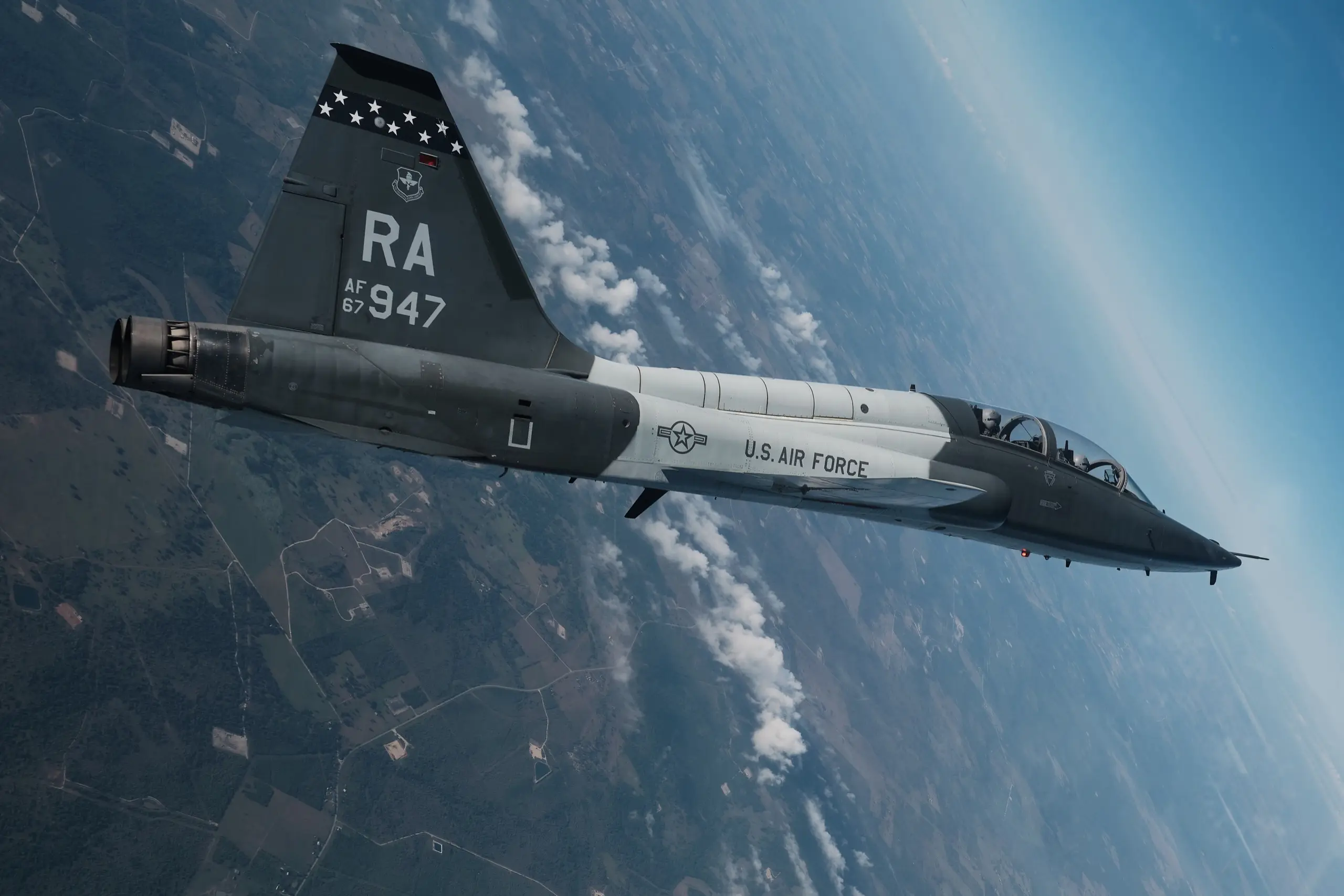
A black-tailed T-38C Talon banking over East Texas, seen from a second jet in close formation, with the curve of the clouds and farmland far below

Trainer · Cold War · In service

T-38 Talon

The supersonic classroom

Northrop Corporation

In Air Force service, from March 1961 to today
65years
Reached from sea level in one minute
~9,100m
Delivered to the Air Force, 1961–72
1,100+
T-38s in NASA's astronaut fleet (2025)
20

Student pilots in Texas, Oklahoma and Mississippi still strap into the T-38 Talon for the last stage of pilot training before fighters and bombers, sixty-five years after it entered Air Force service in March 1961 as the world’s first supersonic trainer. The jet is older than most of the instructors who teach in it. It is small, white or dark grey, with a needle nose and stubby wings, and it climbs from the runway to about 9,100 m in a minute.

Northrop designed it around a pair of small General Electric J85 engines, each weighing less than 270 kg, after the Air Force asked in 1955 for a supersonic trainer. The same design became a lightweight fighter, the F-5, sold around the world. The T-38 itself was cheaper to run than the jet it beat for the contract, easier to maintain, and safer with two engines. More than 1,100 went to the Air Force before production ended in 1972, and the fleet has been rebuilt, rewired and given a glass cockpit to keep it flying.

Its second career began almost at once. In the early 1960s NASA’s first astronauts, all military test pilots, began flying T-38s out of Ellington Field in Houston, and the agency has never stopped. Mercury and Gemini astronauts kept their skills sharp in them, Skylab and shuttle crews flew to their launches in them, and the Artemis II crew trained in them. For astronauts who are not pilots, the back seat is where they learn to think quickly with the g-forces on and the radio talking. The T-38 has also flown with the Thunderbirds and set world records with Jacqueline Cochran. In 1966 a NASA T-38 crashed in snow and fog at St. Louis, killing the first crew of Gemini IX.

The jets are wearing out. The Air Force’s replacement, the Boeing T-7A Red Hawk, was approved for production in 2026, months after the first one was delivered to Joint Base San Antonio-Randolph in December 2025. The Air Force plans to buy 351 and expects them to begin replacing the T-38 in 2027. NASA will need a successor too. Until then the little white jets keep flying out of Ellington, as they did when Wally Schirra posed beside one on the ramp in 1963.

The astronauts' jet

The first American astronauts were military test pilots, and NASA gave them T-38s to keep their flying sharp between missions. The jets were based at Ellington Field in Houston, and they are still there. Wally Schirra posed beside one in 1963. In November 1973 the three-man crew of the last Skylab mission stood in front of one at Ellington before heading to Florida for launch, and in June 1983 Sally Ride climbed into the back seat of another, with her commander Robert Crippen at the controls, and flew to Kennedy Space Center, days before she became the first American woman in space.

As the astronaut corps filled up with scientists, doctors and engineers who had never flown a jet, the T-38's job changed. NASA calls it Space Flight Readiness Training. A mission specialist in the back seat wears a flight suit and an oxygen mask, pulls g, and has to work as a crew member while the aircraft keeps moving. David Johnson, deputy chief of NASA's Aircraft Operations Division, quotes a colleague, Ann McLean: "flying in an aircraft is no different than space flight. It's just in a different medium." His own version is shorter: "it's the opportunity for some of those folks to get comfortable feeling uncomfortable."

The hours are not optional. Pilot astronauts aim for 180 hours a year, with a minimum of 100; astronauts qualified for the rear cockpit aim for 120, with a minimum of 80. The jets also carry astronauts to launches and around the country, which takes some planning, because a T-38 has almost no room for luggage. For an overnight trip a small pod is strapped underneath for the bags.

In 2025 NASA had 20 T-38s, many of them about sixty years old, and finding parts is getting harder. Johnson, a retired Air Force pilot who also flies the WB-57 and Gulfstream V, still calls the Talon his favourite: "it looks like a little sports car, it flies like a little sports car, and it is, it is just a joy to fly." In February 2026 two of the Artemis II crew, Christina Koch and Jeremy Hansen, took off from Ellington in one under a crescent Moon.

The Speed Queen's trainer

In the summer of 1961, months after the T-38 entered service, the Air Force lent one to a 55-year-old civilian. Jacqueline Cochran had earned her pilot's licence in the early 1930s. She won the Bendix Trophy in 1938, led the Women Airforce Service Pilots in the Second World War, and in 1953 became the first woman to break the sound barrier. Her nickname was the Speed Queen.

She flew the same T-38 for almost six weeks, through a bout of flu, while Chuck Yeager flew chase in an F-100 Super Sabre to document each attempt. By mid-October she had eight records for speed, distance and altitude. The fastest came on 24 August 1961: 1,358.6 km/h around a 15 km closed course. Cochran described flying beyond the speed of sound like this: "Up there things come into proportion. The people on earth have disappeared." And then: "You have left them behind you and are on your own, impressed with the immensity of space."

The Air Force handed her aircraft to the Smithsonian in 2004, and it sat in storage for more than a decade until the museum's director, Ellen Stofan, spotted it in 2018. Restored, with her records painted below the canopy, it is now on display in the National Air and Space Museum on the National Mall. Behind it a screen repeats the headline a 1961 magazine gave the new trainer: "GO, GO, GO!"

The Air Force set records of its own. In February 1962, at Edwards Air Force Base, Maj. Walter F. Daniel flew T-38A 61-0849 to four time-to-climb records. That aircraft is now displayed by the Air Force Flight Test Museum at Edwards, restored in 2013 as an Eagle Scout project.

Missions & Moments

NASA 901: the morning Gemini IX lost its crew

At 7:41 on the morning of 28 February 1966, two NASA T-38s took off from Ellington Field in Houston and turned north for St. Louis. In the lead jet, NASA 901, were Elliot See and Charles Bassett, the prime crew for Gemini IX. Behind them, in NASA 907, were their backups, Tom Stafford and Gene Cernan. It was a routine trip. McDonnell Aircraft built the Gemini spacecraft at Lambert Field, and the four men were going to spend two weeks there in the simulator, next to the capsule they would fly.

About forty minutes out, the weather report from St. Louis turned bad: low overcast, a ceiling of about 180 m, visibility around 3 km, rain and fog. By the time the two jets arrived it was worse, with thick cloud, poor visibility, rain and snow flurries. At 8:55 both jets were over the runway, too low and too fast to land.

Stafford, flying on See's right wing, pushed the power up to go around for another approach, expecting the lead jet to do the same. See did not. He made a tight turn to try to get back to the runway. From the second jet Stafford watched the lead aircraft disappear. "Goddammit, where's he going?" It was the last time anyone in NASA 907 saw them.

See seems to have realised too late that he was heading straight for Building 101, McDonnell's assembly hall, where their own spacecraft was being built. He lit the afterburners, rolled right and pulled. About three seconds later, at 8:58, the T-38 struck the roof of the building, lost its right wing, cartwheeled into the car park and exploded. Debris fell through the roof onto the workers below, and about a dozen were hurt. Both astronauts were killed, about 150 m from the Gemini IX spacecraft, which was undamaged.

Stafford, by then very short of fuel, brought NASA 907 round and landed. The tower asked him an odd question: "Who was in NASA 901?" He answered: "See and Bassett." When he opened his canopy, James McDonnell himself was waiting to tell them both men were dead. Stafford later wrote that, a little further along, the crash would have "wiped out the whole Gemini program."

A board chaired by Alan Shepard found nothing wrong with the aircraft and nothing wrong with either pilot's health. The weather had contributed, but the finding was pilot error. Two days after the crash Stafford and Cernan became the prime crew, and on 3 June 1966 they launched in the same spacecraft as Gemini IX-A. Jim Lovell and Buzz Aldrin moved up to be their backups, which put them in line for Gemini XII, the last flight of the programme. NASA kept its T-38s, and its astronauts kept flying them, as they still do.

The crews

The T-38 seats two in tandem on rocket-powered ejection seats: the student in front, the instructor behind. For an Air Force pilot it is the last step of undergraduate pilot training before fighters or bombers, flown in aerobatics, formation, night, instrument and cross-country sorties. Test pilots learn in it at Edwards, and student pilots from most NATO countries fly it at Sheppard Air Force Base, Texas. At NASA the back seat belongs, more often than not, to an astronaut.

The fighter school
The T-38C prepares Air Force pilots for the F-15E, F-16, F-22, A-10 and B-1B. Its glass cockpit and head-up display, added from 2001, look much more like the jets the students will fly next.
Hours in the logbook
NASA pilot astronauts aim for 180 hours a year in the T-38 and must fly at least 100. Astronauts qualified for the rear cockpit aim for 120 and must fly at least 80.
Short runway, steep climb
A T-38 needs as little as about 700 m of runway to take off, and can climb from sea level to nearly 9,100 m in one minute.
Goodbye, steam gauges
Around 2008 NASA began fitting its T-38s with glass cockpits to match the displays astronauts used on the space shuttle. As one NASA research pilot put it: “Instead of having round dials -- what we call steam gauges -- we are now converting our T-38s with these new types of displays.”

Names worth knowing

  • Jacqueline Cochran Record-setter, 1961

    At 55, she flew one T-38 for almost six weeks and set eight speed, distance and altitude records. Her aircraft is now at the National Air and Space Museum.

  • Maj. Walter F. Daniel Air Force test pilot

    Set four time-to-climb records in T-38A 61-0849 at Edwards in February 1962.

  • Sally Ride Astronaut, STS-7

    Flew from Houston to Kennedy Space Center in the back seat of a NASA T-38 in June 1983, with her commander Robert Crippen flying, days before her first spaceflight.

  • Tom Stafford Gemini IX backup commander

    Flying the second jet into St. Louis on 28 February 1966, he aborted the landing in bad weather and landed safely. He and Gene Cernan then flew the mission themselves.

Did You Know?

The T-38 was the world's first supersonic trainer. Northrop's N-156 design behind it also produced a fighter, the F-5 Freedom Fighter and Tiger II.
One of its pilots, Lt. Howard Morland, said of the T-38: “It looked like a comic book superhero.”
A T-38 has almost no luggage space. When NASA astronauts fly one somewhere overnight, a small pod is strapped underneath for their bags.
In 1974 the Thunderbirds gave up the F-4 Phantom for the T-38, because the little trainer burned less fuel and cost less to maintain.
Each T-38 cost the Air Force $756,000 in 1961 dollars.
The T-38A at the Pima Air & Space Museum spent 1977–78 training pilots in Taiwan, then came home and was declared surplus in 1981.

Timeline

  1. 1954–55

    General Electric shows Northrop its small J85 engine in July 1954. The Navy drops its lightweight fighter requirement, but in 1955 the Air Force asks for a supersonic trainer, and Northrop's N-156 design wins.

  2. Apr 10, 1959

    The YT-38 prototype makes its first flight.

  3. Mar 1961

    The T-38 enters Air Force service, the world's first supersonic trainer.

  4. Aug–Oct 1961

    Jacqueline Cochran, aged 55, sets eight speed, distance and altitude records in a single T-38.

  5. Feb 1962

    Maj. Walter F. Daniel sets four time-to-climb records in T-38A 61-0849 at Edwards AFB, California.

  6. Feb 28, 1966

    NASA T-38 901 crashes in bad weather at St. Louis, killing Gemini IX astronauts Elliot See and Charles Bassett.

  7. 1972

    Production ends. More than 1,100 have been delivered to the Air Force.

  8. 1974

    The Thunderbirds trade their F-4 Phantoms for T-38s, which burn less fuel and cost less to maintain.

  9. 2001

    Air Education and Training Command begins receiving the T-38C, with a glass cockpit and head-up display.

  10. Dec 5, 2025

    The first T-7A Red Hawk, the T-38's replacement, is delivered to Joint Base San Antonio-Randolph, Texas.

  11. Apr 23, 2026

    The Air Force approves the T-7A for production. It is due to begin replacing the T-38 in 2027.

Where to see one today

More than 1,100 T-38s went to the Air Force, and many of the retired ones went to museums. These three have particular histories.

United States· 3

  • Pima Air & Space Museum

    Tucson, Arizona

    Delivered in 1962 and painted in its 1963 markings from Webb AFB, Texas. It spent 1977–78 training pilots in Taiwan before returning to the United States.

    61-0854T-38A
  • Air Force Flight Test Museum

    Edwards AFB, California

    Maj. Walter F. Daniel set four time-to-climb records in it in February 1962. Restored in 2013 as an Eagle Scout project.

    61-0849T-38A · outdoors
  • National Air and Space Museum

    Washington, D.C.

    The jet in which Cochran set eight records in 1961, with the records painted below the canopy. On show in the museum's renovated building on the National Mall since 2022.

    T-38A (Jacqueline Cochran's record aircraft) · indoors

Locations last checked October 2026. Airframes occasionally move, so check with the museum before you travel.

Sources

Facts last reviewed October 2026

  1. 1. U.S. Air Force: T-38 Talon fact sheet (specs, climb and runway figures, deliveries, T-38C, training roles, unit cost)
  2. 2. U.S. Air Force: U.S. Air Force Thunderbirds fact sheet (1974 conversion to the T-38, return to front-line fighters in 1983)
  3. 3. NASA, Houston We Have a Podcast: Runway to the Stars, episode 389, June 2025 (David Johnson on the T-38 fleet, flying hours and Space Flight Readiness Training)
  4. 4. NASA: T-38 Aircraft Fly Over Washington (2012) and T-38 Jet Used for Space Shuttle Training (2011)
  5. 5. U.S. Air Force: NASA trains pilots to fly high (2008)
  6. 6. Michael Hankins, 'You Have Left Them Behind': Jackie Cochran and the T-38 Talon, National Air and Space Museum, December 2021 (origins, first flight, Cochran's records and quotes)
  7. 7. Chris Gordon, DC's Air & Space Museum to reopen with T-38 exhibit honoring 'Jackie' Cochran, Air & Space Forces Magazine, October 2022
  8. 8. Air Force Flight Test Museum: Northrop T-38A 61-0849
  9. 9. Pima Air & Space Museum: Northrop T-38A Talon 61-0854
  10. 10. Ben Evans, “Who Was in NASA 901?” Remembering the Tragedy That Almost Claimed Project Gemini, AmericaSpace, February 2024 (drawing on the memoirs of Tom Stafford and Deke Slayton)
  11. 11. NASA photo captions S83-34151 (Sally Ride, 1983), S63-18249 (Wally Schirra, 1963) and jsc2026e007422 (Artemis II crew, 2026)
  12. 12. The Aviationist: USAF approves serial production of the T-7A Red Hawk, May 2026 (first delivery, Milestone C, 2027 replacement date, planned fleet)