Skip to content
Early preview The vault is just opening. New files are added regularly, and some sections are still being built.
VLTARIS
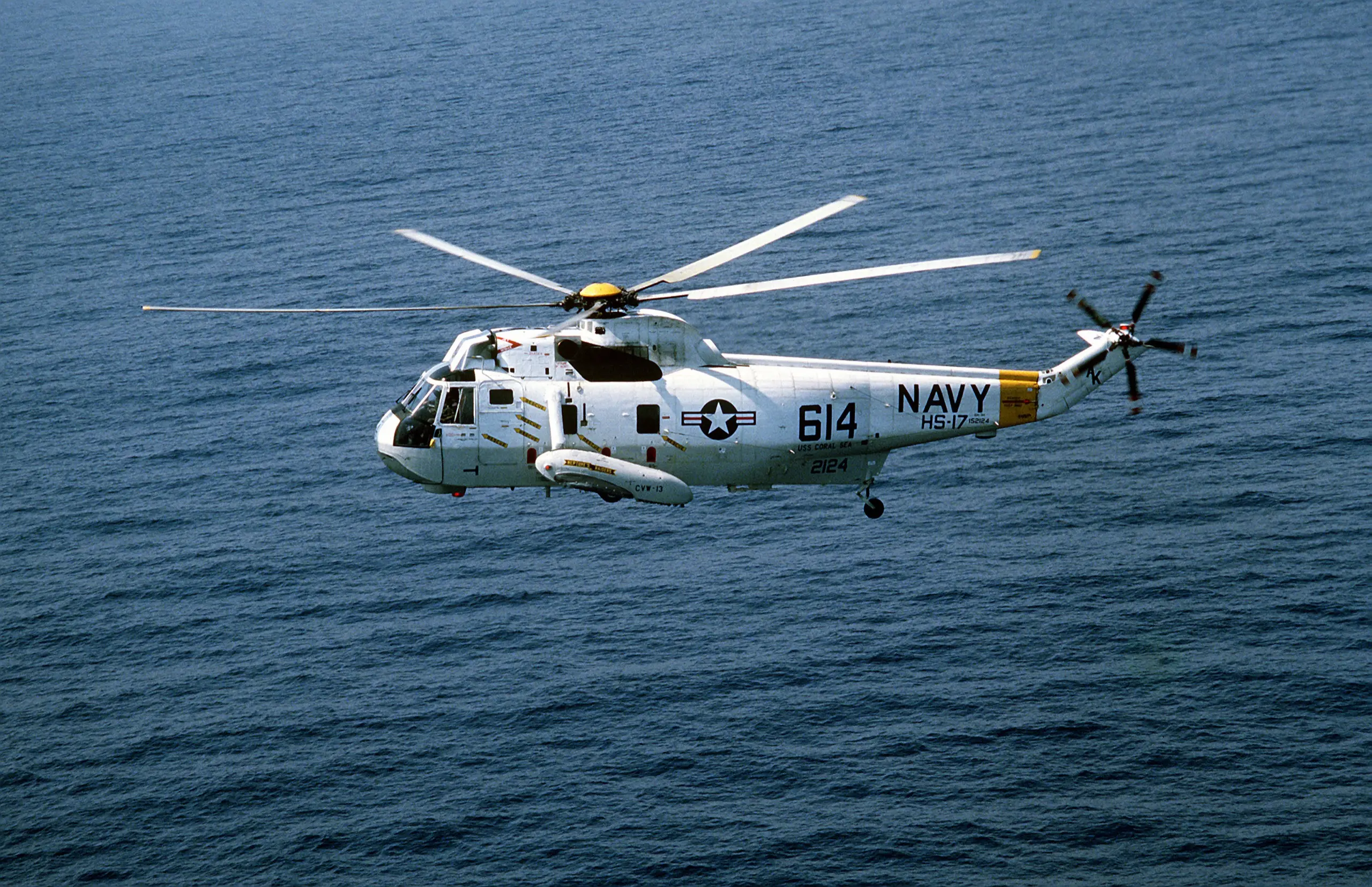
White SH-3H Sea King of squadron HS-17, side number 614, flying low over a deep blue sea

Helicopter · Cold War · Retired

SH-3 Sea King

The submarine hunter that brought the Moon crews home

Sikorsky Aircraft

Apollo crews lifted from the sea by one Sea King, Helicopter 66
5
World helicopter speed record, February 1962
339km/h
With the US Navy, from first delivery (1961) to the last retirement (2009)
48years
Estimated military flight hours, all Sea Kings
5.2million

A Sea King at work hung a few metres above the sea at night, a sonar dangling on a cable beneath it, its crew listening for a Soviet submarine somewhere below. Sikorsky built it for that, and that is what it did for most of its life. On the morning Apollo 11 came home, though, the first aircraft to reach the capsule was one of these white Navy submarine hunters. Picking astronauts out of the Pacific was a sideline, and it is the part everyone remembers.

Before the Sea King, the Navy’s anti-submarine helicopters worked in pairs, because a piston-engined helicopter could carry either the sonar gear or a torpedo, not both. Sikorsky’s HSS-2 used two of General Electric’s new T58 turbines, light and powerful enough that one machine could find a submarine and attack it. It first flew in March 1959 and reached the fleet in 1961, and the following year it was renamed the SH-3A Sea King.

Sikorsky shaped its belly like a boat, a watertight hull, so that a Sea King forced down at sea could stay afloat. The rotor blades and the tail folded so that it fitted on a carrier’s elevators. Its crew of four (two pilots and two aircrewmen) spent long hours in a hover over a cold ocean, the sonar operator in the back watching a screen for the echo of a hull.

A helicopter that could hover patiently over open water, with a winch and room for passengers, was the natural choice when NASA needed men lifted out of the sea. HS-4’s Helicopter 66 recovered five Apollo crews and became the most famous helicopter in the world, and for decades presidents rode in green and white VH-3 Sea Kings flown by the Marines, as Marine One.

The US Navy kept Sea Kings flying for nearly 50 years, through anti-submarine work, combat rescue off Vietnam, search and rescue and plain utility flying. The last one left the Navy in December 2009 and went straight to the Marine presidential squadron as a trainer. Rear Admiral Ron Christenson, a former Sea King squadron commander, told the ceremony: “It’s truly one of the greatest aircraft ever designed.”

Whatever happened to Helicopter 66

The most photographed Sea King of all was an ordinary SH-3D of squadron HS-4, the Black Knights. Its Bureau Number was 152711, and "66" was never its official identity. The squadron painted the number on before each Apollo recovery, and with it the helicopter collected the crews of Apollo 8, 10, 11, 12 and 13, from four different ships. The pilots changed (Donald Jones flew Apollo 8 and 11, Chuck Smiley flew 10 and 13, Warren Aut flew 12), but the number stayed, and little capsule silhouettes began to appear on its nose.

When the Navy moved to three-digit side numbers, 66 became 740, and after Apollo 13 the helicopter went back to hunting submarines, the work it had been built for. On the night of June 4, 1975, it took off from Imperial Beach for a sonar training flight off San Diego. Around half past nine, hovering low with its sonar about 30 metres under the surface, it became unstable and went into the sea, broke up and sank.

All four men aboard got out, and a Coast Guard helicopter picked them up shortly before midnight. The pilot, Lt. Leo Rolek, had a ruptured spleen and died three weeks later. The accident report, heavily censored, records only that the "aircraft impacted water in rearward flight from hover at 40 feet." A former Sea King pilot told the historian Dwayne Day that it was "notoriously easy to accidentally back the Sea King into the water while in a hover, especially at night."

The wreck has never been raised. The report put the crash in water about 1,460 metres deep, but rumours of a shallower resting place persisted, and in 2021 two technical divers found a Sea King wreck off Southern California at around 60 metres. The clues pointed elsewhere, to a shorter sonar cable spool, tail letters from a different squadron and paint from the wrong era. They concluded it was a Sea King lost in 1968. "It wasn't Helo 66," one of them said.

The Helicopter 66 that visitors photograph today is a stand-in. The USS Midway in San Diego displays a Sea King painted with the famous number and its row of capsules, and USS Hornet in Alameda has the one that played it in the film Apollo 13.

Armament

Homing torpedoes
Up to four Mk 43 or Mk 44 torpedoes on the early versions, later the Mk 46.
Depth charges and bombs
Four Mk 14 depth charges or four Mk 54 air depth bombs as alternative loads.
Mk 101 nuclear depth bomb
The early Sea King was cleared to carry one Mk 101, a nuclear anti-submarine weapon.

Missions & Moments

Bringing Apollo 11 Home

Before dawn on July 24, 1969, Commander Donald S. Jones lifted Helicopter 66 off the deck of USS Hornet and flew out into the dark over the Pacific, about 1,500 km south-west of Hawaii. The splashdown point had been moved the day before because of bad weather at the original site, the sky was overcast, and the sea was rough. Somewhere above the clouds, Columbia was coming home from the Moon with Neil Armstrong, Michael Collins and Buzz Aldrin inside.

One of the recovery aircraft caught sight of the capsule while it was still falling at around 20,000 metres. The main parachutes opened at about 3,000 metres, and Columbia hit the water and settled upside down. Within minutes three flotation bags inflated and rolled it upright. Hornet was still about 21 km away and closing fast. The helicopters were already there.

Navy swimmers dropped into the swell. John Wolfram reached the spacecraft first, fixed a sea anchor to it and looked in through the window, the first person on Earth to see the crew. He reported their condition as "excellent." Wesley Chesser and Michael Mallory wrapped a flotation collar around the capsule, and a helicopter dropped a raft that was inflated and tied alongside.

Nobody yet knew for certain that the Moon was sterile, so the next part ran like a quarantine drill. A second raft was inflated upwind, and the decontamination officer, Clancy Hatleberg, climbed into it. A helicopter lowered biological isolation garments and canisters of disinfectant to him. He put on his own suit, was towed to the spacecraft, closed its vents and passed the three astronauts their suits through the briefly opened hatch. They came out one at a time, Armstrong first, then Collins and Aldrin. When the hatch would not latch, Armstrong and then Collins helped Hatleberg shut it. He scrubbed the men down with disinfectant and sprayed the capsule.

Then Helicopter 66 came overhead. It lowered a Billy Pugh net, a rescue basket of rope and floats, and hoisted the crew up one by one, again Armstrong, then Collins, then Aldrin. Inside the cabin, NASA flight surgeon William Carpentier gave them a quick check. Technicians had fixed television cameras to the helicopter, and much of what the world saw of the recovery came from this one Sea King.

Jones set it down on Hornet's deck 63 minutes after splashdown. Sailors rolled the helicopter onto an elevator with the crew still aboard and took it down to the hangar deck, where the astronauts walked about ten steps from its door into a sealed trailer, the Mobile Quarantine Facility. President Nixon, who had watched the recovery from the flag bridge, came down to welcome them. They would stay sealed in until they reached Houston.

Did You Know?

The lower fuselage is a watertight boat hull. A Sea King could land on calm water and float, a real comfort for crews who spent their working lives low over the ocean.
It replaced a pair of helicopters with one. Older HSS-1s worked in teams, one listening with sonar and one carrying the torpedo; the turbine-powered Sea King had the power to carry the sonar, its crew, full fuel and the weapons all at once.
In February 1962 a modified HSS-2 flown by a Navy lieutenant and a Marine captain became the world's fastest helicopter, at 339 km/h. It held the record until 1963.
In 1965 an overloaded Sea King flew non-stop across the United States, from the deck of the carrier Hornet to the deck of the Franklin D. Roosevelt.
Among the early Sea King's approved loads was the Mk 101, a nuclear depth bomb for use against submarines.
When the Navy retired its last Sea King in 2009, the officer in charge called it "the longest serving operational helicopter model in Navy history." The helicopter itself kept working, as a trainer for the Marine squadron that flies the president.

Timeline

  1. 1957

    The Navy funds Sikorsky's HSS-2, a turbine-powered anti-submarine helicopter meant to do the job of two older HSS-1s.

  2. Mar 11, 1959

    Sikorsky test pilot Robert Decker flies the XHSS-2 prototype at Stratford, Connecticut.

  3. Sep 1961

    The first HSS-2 is delivered to the US Navy.

  4. Feb 5, 1962

    Navy Lt. Robert Crafton and Marine Capt. Louis Keck set a world helicopter speed record of 339 km/h in a modified HSS-2.

  5. 1962

    Under the new joint designation system, the HSS-2 becomes the SH-3A Sea King.

  6. 1965

    An overloaded Sea King flies non-stop across the United States, from the carrier Hornet to the carrier Franklin D. Roosevelt.

  7. Dec 27, 1968

    SH-3D BuNo 152711, Helicopter 66 of squadron HS-4, picks up the Apollo 8 crew, the first people to have orbited the Moon.

  8. Jul 24, 1969

    Helicopter 66 lifts Neil Armstrong, Michael Collins and Buzz Aldrin from the Pacific after Apollo 11.

  9. Apr 17, 1970

    Helicopter 66 recovers the Apollo 13 crew, its fifth and last Apollo mission.

  10. Jun 4, 1975

    The former Helicopter 66 goes down at night off Coronado, California, during sonar training.

  11. Dec 11, 2009

    The last operational Navy Sea King, UH-3H BuNo 154121, is retired at Patuxent River and handed to the Marine Corps presidential squadron, HMX-1.

Where to see one today

The real Helicopter 66 lies somewhere off San Diego, but two museum carriers show Sea Kings tied to its story.

United States· 2

  • USS Hornet Sea, Air & Space Museum

    Alameda, California

    Flew in the film Apollo 13, and aboard the carrier that recovered Apollo 11 and 12.

    148999SH-3H · indoors
  • USS Midway Museum

    San Diego, California

    On the flight deck, painted as Helicopter 66 with five Apollo capsules on its nose.

    SH-3 · outdoors

Locations last checked October 2026. Airframes occasionally move, so check with the museum before you travel.

On screen

Where the SH-3 Sea King became a star outside the hangar.

  • Film · 1995

    Apollo 13

    A real Navy Sea King, BuNo 148999, flew the recovery scene in the markings of Helicopter 66. It still wears its Iwo Jima paint aboard the USS Hornet Museum.

Sources

Facts last reviewed October 2026

  1. 1. Dwayne A. Day, “The big white bird: the flights of Helo 66”, The Space Review
  2. 2. NASA History: “50 Years Ago: Hornet + 3, the Recovery of Apollo 11”
  3. 3. Naval History and Heritage Command: Apollo 11: The Navy's Role in the Recovery Operation
  4. 4. Vertical Flight Society: Sikorsky S-61 / HSS-2 Sea King history (September 2016)
  5. 5. This Day in Aviation: “11 March 1959: First flight of the Sikorsky XHSS-2 Sea King” (HSS-2 specifications and weapons loads)
  6. 6. Shephard Media: “Sea King helicopter retires from US Navy” (January 2010, from a NAVAIR release)
  7. 7. Stars and Stripes: “Deep-sea divers' search for Navy Helo 66 wreckage” (September 2021)
  8. 8. FAI: world helicopter speed record of February 5, 1962
  9. 9. USS Midway Museum: SH-3 Sea King
  10. 10. USS Hornet Sea, Air & Space Museum: Exhibits
  11. 11. Gallery and hero photos via Wikimedia Commons (public domain, U.S. Navy, U.S. Marine Corps and NASA): HS-17 over the Mediterranean, GPN-2000-001504, VH-3D at the White House
  12. 12. Museum websites linked in “Where to see one today” (checked October 2026)