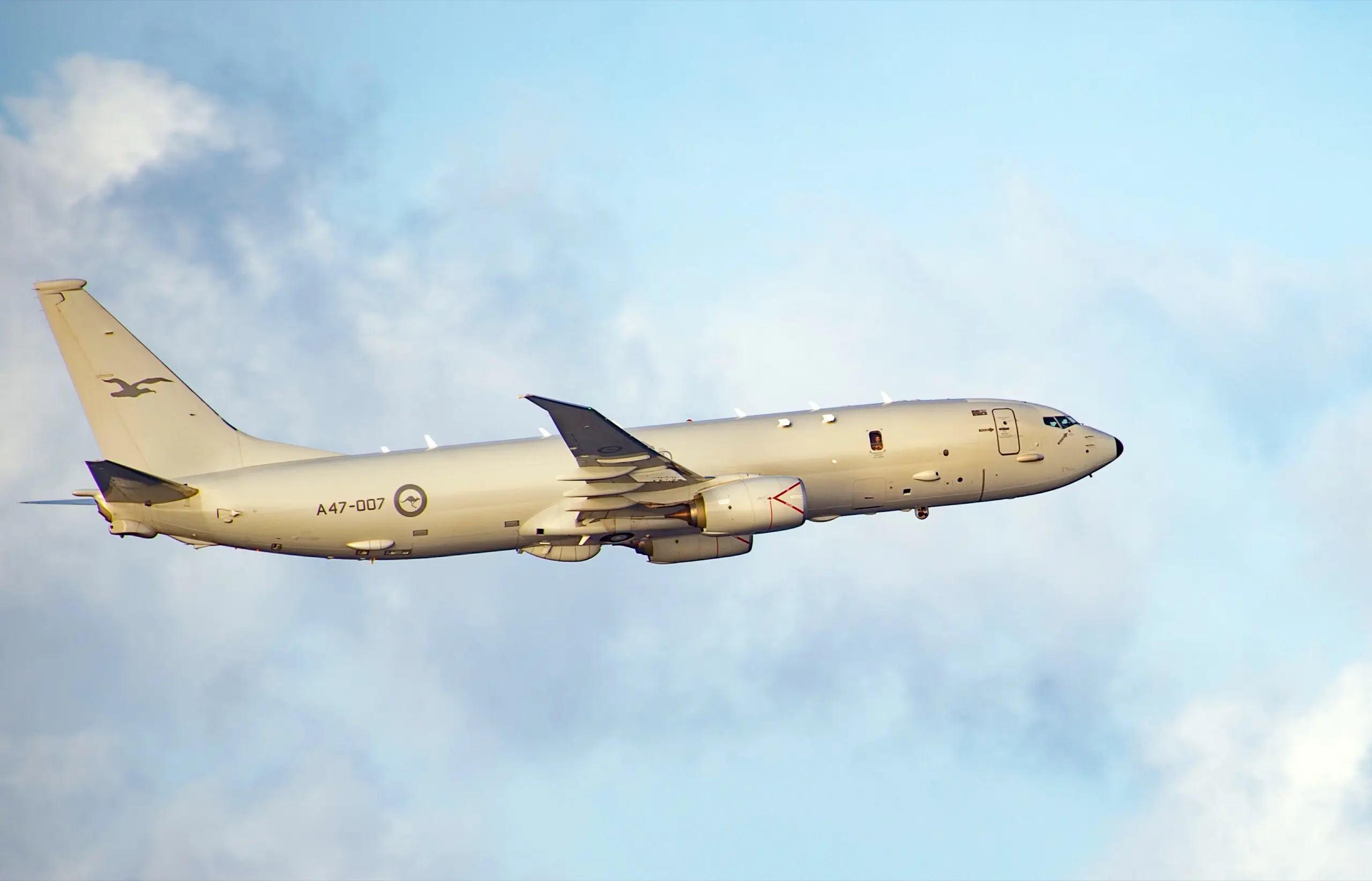
The first P-8 took off from Renton, the factory town south of Seattle where Boeing builds its 737s, and that is where every Poseidon begins: as a Next-Generation 737, the family that flies holiday routes. It comes out with a weapons bay behind the wing, pylons for missiles, a cabin full of operator consoles and launchers for up to 129 sonobuoys. About 86 per cent of its parts are still 737 parts.
It replaced the P-3 Orion, a turboprop that had hunted submarines since 1962, and the two do the job differently. The Orion hunted low over the waves; the Poseidon was designed to do most of its work from high altitude, where it burns less fuel and can watch far more ocean, dropping sonobuoys from above the weather and, with a glide kit, torpedoes too.
Its first operational deployment began in late 2013, when two P-8As of Patrol Squadron 16 flew from Jacksonville to Okinawa. Within months the squadron was searching the southern Indian Ocean for Malaysia Airlines Flight 370, flying eight- and nine-hour missions out of Perth with crews at the windows. By the following spring the commander of the 7th Fleet was calling it a workhorse.
Its patrols over the South China Sea have drawn a different kind of attention. In August 2014 a Chinese fighter barrel-rolled over a P-8 east of Hainan. The next spring, with a CNN team aboard, a Poseidon crew over Fiery Cross Reef was told by the Chinese navy, eight times, to leave. Each time they answered with the same sentence, and each time they kept flying.
Because it is a 737 underneath, other air arms have found it easy to buy. India took delivery first among export customers, then Australia, Britain, Norway, New Zealand, South Korea and Germany, with Canada next. Boeing counts more than 700,000 hours flown across the fleet. Most of them were flown high above an empty sea, listening for a submarine.