Skip to content
Early preview The vault is just opening. New files are added regularly, and some sections are still being built.
VLTARIS
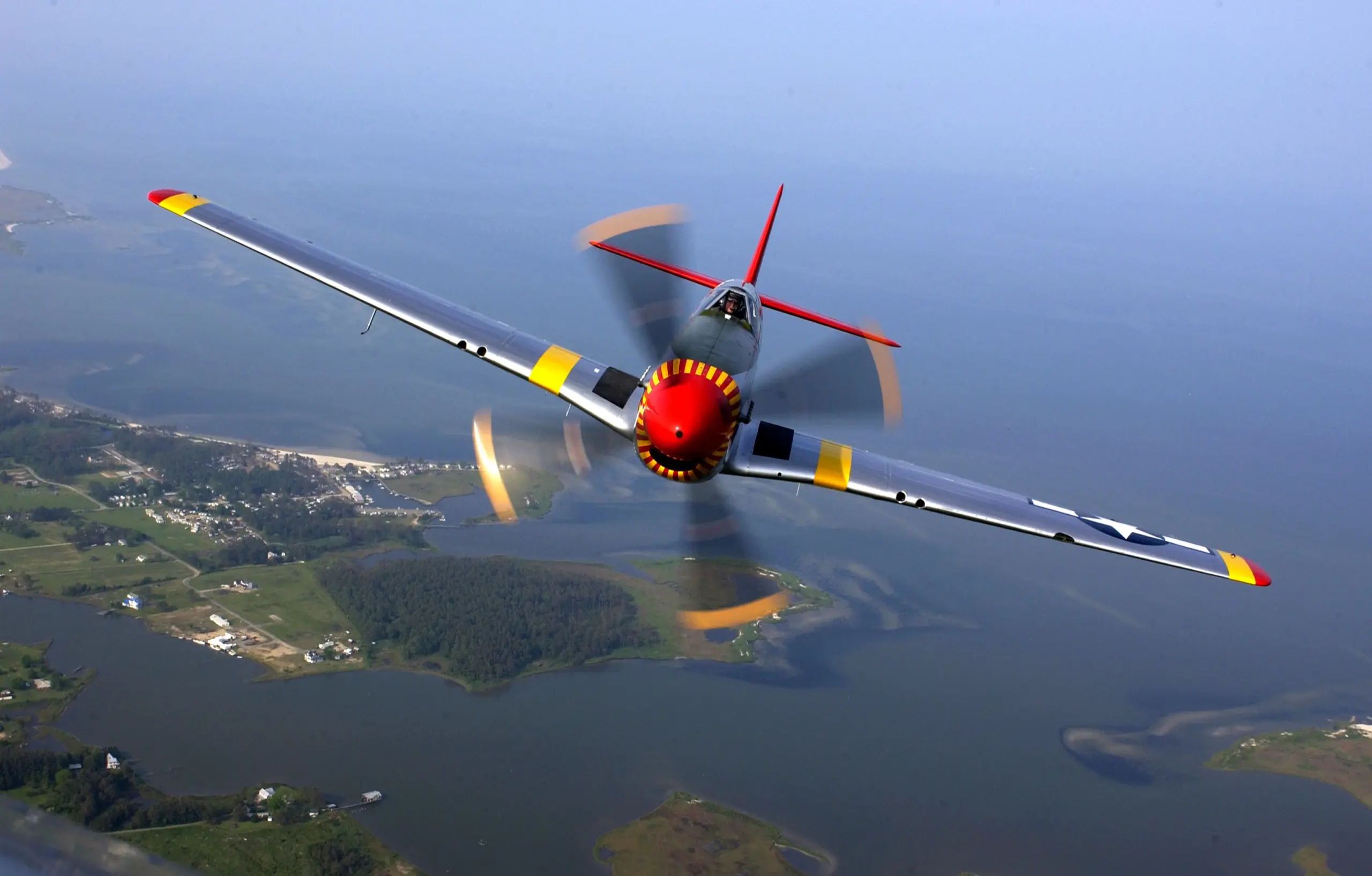
A silver P-51 Mustang with a red tail and red nose banking toward the camera over the coast of Virginia

Fighter · WWII · Retired

P-51 Mustang

Built for Britain, flown to Berlin

North American Aviation

To build the first airframe
117days
Top speed (P-51D)
703km/h
Enemy aircraft destroyed in the air in WWII
4,950
From first flight to the last USAF unit
17years

In the winter of 1943 the B-17 crews flying into Germany noticed something new off their wingtips. The fighter escort had always turned for home partway there, because it could fly no further, and the German fighters had always waited for that moment. Through that year the losses had been heavy enough to put the whole daylight bombing campaign in doubt. Now a new shape sat beside the bombers, and it did not leave. It stayed to the target and it stayed on the way home. Bomber crews called their escorts “little friends”, and this one was the P-51 Mustang.

It had not been built for them. In 1940 Britain asked North American Aviation to build Curtiss P-40s under licence, and North American answered that it could do better and promised a fighter of its own design. The first airframe was finished 117 days later. The RAF bought it and gave it its name; the US Army Air Forces, at first, showed little interest.

The early Mustang’s Allison engine ran out of breath up high, exactly where the bomber war was fought. The fix was a British engine, the Rolls-Royce Merlin that powered the Spitfire, dropped into the American airframe. A good low-level fighter became the finest long-range escort of the war, with the speed to fight anything the Luftwaffe had and the range to reach Berlin. By D-Day the Mustangs and their fellow escorts had broken the German fighter force.

The Tuskegee Airmen flew it too. They were the first Black fighter pilots in the American military, and they painted the tails of their Mustangs bright red, which is where the name Red Tails comes from. They fought one war in the sky and a second at home, against people who said they could not do it. The bomber crews they protected often had no idea who was flying the red-tailed fighters. They knew they wanted them there.

The Mustang went back to war in Korea as the F-51, flew for many other air forces, and the US Air Force kept its last one until 1957. Privately owned Mustangs still fly at airshows alongside F-22s and F-35s in the Air Force’s Heritage Flights, and the sound of a Merlin at full chat still brings a crowd to a standstill.

The engine transplant that changed the war

The Allison engine in the first Mustangs was smooth and strong down low, and its supercharger ran out of breath at altitude. For low-level work that hardly mattered. Over Germany the air war was fought at bomber height, far above where the Allison was happy, and the RAF, which thought highly of the airframe, began to wonder what it could do with a better engine.

The idea came from Duxford, in Cambridgeshire. In 1942 the RAF's Air Fighting Development Unit there, whose job was to test aircraft against each other, suggested to Rolls-Royce's Ronald Harker that a Merlin, from the same family that powered the Spitfire, would transform the Mustang. The British tested Mustangs fitted with the new two-stage, two-speed Merlin, whose supercharger kept the power coming up to around 9,000 m. In America, North American did the same with two Merlins of its own and called the result the XP-51B.

One of the American test aircraft reached about 710 km/h at around 9,000 m, roughly 160 km/h faster than the Allison-powered P-51A at that height. The Smithsonian calls what came next "the world's best long-range, propeller-driven escort fighter."

Most of those British engines were built by an American car company. The Packard Motor Car Company, together with Continental, built more than 58,000 Merlins under licence, and Packard Merlins powered most versions of the P-51.

The airframe did its share. The Mustang was the first aircraft to use the NACA's new laminar-flow wing profile, which had cut drag dramatically in wind-tunnel tests. In the real world the gains were smaller than the lab promised, as NASA's own history admits: wartime mass production and front-line maintenance could never match laboratory smoothness. Even so, that wing, a big fuel load and the Merlin together gave the Mustang what no other single-engine fighter had in quite the same measure, the legs to go wherever the bombers went.

Little friends, all the way to Berlin

Through 1943, American bomber crews over Germany were dying at a rate that threatened to stop the daylight bombing campaign altogether. The US Army Air Forces had no fighter that could escort the heavy bombers all the way to targets in Germany, so the escorts turned back and the bombers went on alone.

Bomber crews called their escort fighters "little friends", and by early 1944 the little friends could stay. Improved P-47s and P-38s, droppable fuel tanks and, above all, the Merlin-powered P-51 solved the range problem. When the first US heavy bombers struck Berlin in March 1944, about 175 P-51B and C Mustangs were already in action alongside P-38 Lightnings. Bomber losses fell and the Luftwaffe's fighter losses climbed sharply, and by June 1944 the German fighter force was too badly broken to seriously contest the D-Day landings.

Shielding the bombers was only part of the work. Once they were safe, Mustang pilots dropped down to strafe airfields, trains and anything else they found on the way home. By the end of the war Mustangs had destroyed 4,950 enemy aircraft in the air, more than any other USAAF fighter in Europe.

The same job existed on the other side of the world. In the spring of 1945, P-51Ds flying from the small island of Iwo Jima began escorting B-29 Superfortresses on the long haul to Japan, and attacking ground targets there at low level.

One more war: Korea

By 1950 the Air Force had renamed its Mustangs F-51s and sold many of them off or passed them to the Reserve and the Air National Guard. Jets had taken over. Then North Korea invaded the South, and with American units forced to fly from Japan, the F-51D could reach targets in Korea that the short-ranged F-80 jets could not.

The work was close air support and attacks on supply lines, low over the battlefield, and the Smithsonian says the Mustang was not well suited to it. The weak spot was the liquid cooling system. A single bullet through a radiator or a pipe was usually enough to bring one down.

On August 5, 1950, Maj. Louis Sebille, a World War II B-26 bomber veteran commanding the 67th Fighter-Bomber Squadron, was attacking enemy troops, artillery and armoured vehicles near Hanchang when anti-aircraft fire badly damaged his F-51. He could have tried to bail out or crash-land. Instead, his Medal of Honor citation says, he "deliberately ignored the possibility of survival", pressed on with his attack, and "dived on the target to his death." It was the first Medal of Honor awarded to a member of the US Air Force.

South Korea began the war with no combat-ready aircraft. Under the code name "Bout One", US instructors led by Dean Hess handed over F-51s and trained South Korean pilots, often flying combat missions alongside them, and a new air force grew out of it. US, South Korean, South African and Australian Mustang units fought on until 1953, when F-86F Sabre jets largely took over.

Armament

Six .50-caliber machine guns
All six sit in the wings of the P-51D; the earlier Merlin Mustangs carried four. The D also brought the new K-14 gunsight and a simpler ammunition feed, which cut down the gun jams that had troubled earlier versions.
Rockets and bombs
Up to ten 127 mm (5-inch) rockets or 907 kg of bombs under the wings. Loaded that way, the Mustang worked as a fighter-bomber over Europe, the Pacific and, later, Korea.

Missions & Moments

Red Tails over Berlin

On the evening of March 23, 1945, the orders for the next day reached the 332nd Fighter Group at Ramitelli, in Italy. The Tuskegee Airmen were to escort B-17 bombers all the way to Berlin and back, the longest mission the Fifteenth Air Force had ever flown. A trip like that needed the biggest drop tanks, about 416 litres each, under every Mustang's wings, and the supply records showed how many of those the group had left: none.

The ground crews went and got them. Capt. Omar Blair of the 366th Air Service Squadron set things in motion, and Staff Sgt. George Watson led a detail that travelled nearly 100 km through the night to collect them, at least some from a railhead at Chieuti. Back at Ramitelli the crew chiefs spent the hours before dawn hanging tanks on wings, and by takeoff the Red Tails were ready. The next day Col. Benjamin O. Davis Jr. personally commended Blair for making the mission possible.

The Mustangs took off, joined the bombers and settled in for the long haul north, one of five fighter groups protecting the formation that day. They stayed with the B-17s all the way into the German capital, and over Berlin the Luftwaffe sent up its newest fighter.

"As we got over the outskirts of Berlin, I first saw these streaks, which I knew were jets. . . . And they were coming up to attack the bombers," 1st Lt. Roscoe Brown remembered decades later. They were Me 262s, the world's first operational jet fighters, faster than any Mustang. The 332nd met around 25 of them.

Brown pulled a reverse peel to get at one. "He didn't see me," he said. "And then I turned into his blind spot, put on my electronic gun sight," and then, in his words, came a "brrrrp" and a "boom!" "There he was." Brown, 1st Lt. Earl Lane and 2nd Lt. Charles Brantley had each shot down a jet, three of the eight destroyed that day.

Three of the B-17s under the group's escort were shot down by enemy aircraft, which says something about that sky. The bombers got through, and the 332nd Fighter Group received a Distinguished Unit Citation for the Berlin mission, the longest the Tuskegee Airmen ever flew. Brown had a plain explanation for the group's standing: "Escort missions gave us our reputation. We got the reputation of being so-called 'Red Tailed Angels,' because of the fact that we stayed close to the bombers."

The crews

Around 990 pilots trained at Tuskegee, Alabama, and about 350 of them went overseas. They were the Tuskegee Airmen, the first African American military pilots in the US armed forces, sent to fight in segregated units. In the summer of 1944 their 332nd Fighter Group in Italy traded its P-47s for P-51 Mustangs and took on the escort of the Fifteenth Air Force's heavy bombers. Their commander, Col. Benjamin O. Davis Jr., was a strict disciplinarian who told his men that proving themselves in combat was the best reply to racism. Roscoe Brown recalled that many bomber pilots remembered the Red Tails and said: "We saw the Red Tail P-51s and they were our saviors." Most of them, he added, never knew the pilots were African American.

Why the tails were red
The 332nd painted the tails of its Mustangs bright red so they could be recognised in combat. Bomber crews soon knew them on sight, and the name Red Tails followed.
The Three Minute Eggs Club
Long missions and bad weather sometimes brought pilots home with fuel for about three minutes of flying, roughly the time it takes to boil an egg. Some Tuskegee Airmen founded a club for it, and membership was limited to pilots who had landed within that margin.
Sticking with the bombers
The 332nd shot down fewer enemy aircraft than the other Mustang groups in Italy and produced no aces, possibly because it stayed close to the bombers instead of chasing fights. According to Air Force historian Daniel Haulman, enemy fighters shot down 27 bombers under its escort, against an average of 46 for the other escort groups.
The scorecard
From June 1944 to the end of the war, the group flew 311 missions, 179 of them escorting bombers. By the end of the war in Europe, the Tuskegee Airmen had shot down 112 enemy aircraft and destroyed 150 more on the ground. About 150 were killed in combat or accidents, and 32 became prisoners of war.

Names worth knowing

  • Benjamin O. Davis Jr. Commander, 332nd Fighter Group

    Led the Red Tails in combat and won the Distinguished Flying Cross, which his father, the Army's first Black general, pinned on him. In 1954 he became the US Air Force's first African American general officer, and he received his fourth star in 1998.

  • Roscoe Brown Jr. Pilot, 100th Fighter Squadron

    Flew 68 combat missions in the P-51, shot down an Me 262 jet over Berlin and later an Fw 190. After the war he earned a doctorate, taught at New York University and led Bronx Community College for 17 years.

  • Andrew Marshall Pilot, 301st Fighter Squadron

    Shot down by flak on a strafing mission over Greece on October 6, 1944. He parachuted to safety, and Greek partisans hid him from the Germans and helped him get back to his squadron.

  • Louis Sebille F-51 pilot, Korea

    Commander of the 67th Fighter-Bomber Squadron. Killed on August 5, 1950, pressing home an attack in his crippled F-51; the first member of the US Air Force to receive the Medal of Honor.

  • Dean Hess Flying minister, Korea

    An ordained minister who became a fighter pilot after Pearl Harbor. In Korea he led the "Bout One" program, flew 250 combat missions in Mustangs and helped shelter and evacuate orphaned children. He gave his book and film royalties to build an orphanage.

Did You Know?

The British asked North American to build someone else's fighter, the Curtiss P-40. North American said no, offered a completely new design instead, and finished the first airframe in 117 days.
When the Smithsonian received its P-51D, both sides of the fuselage carried a slogan in big black letters: "Guard The Victory, Join the AAF." It had probably ended its career on recruiting drives.
The Air Force Museum's P-51D Shimmy IV was the last Mustang assigned to a USAF tactical unit. Its name comes from the pilot's daughter, Sharon, and his wife, Zimmy.
Most versions of the Mustang were powered by a British engine built by an American car company: Packard and Continental built more than 58,000 Merlins under licence.
The P-51 was the first aircraft to use NACA's laminar-flow wing, a profile that showed a fifty percent drop in drag in the wind tunnel.
In 1951, airline captain Charles Blair flew a single-engine P-51C called Excalibur III from Norway over the North Pole to Alaska in about ten and a half hours, navigating with "sun lines" he had worked out himself because magnetic compasses were useless up there.

Myth vs. fact

Myth

The Tuskegee Airmen never lost a single bomber they escorted.

Fact

The story first appeared in the press in 1945, and even Benjamin O. Davis Jr. questioned it. Air Force historian Dr. Daniel Haulman checked the mission reports and found that enemy aircraft shot down 27 bombers under the 332nd's escort, on seven different days. The real record still stands up well: the other escort groups lost an average of 46.

Myth

Tuskegee Airmen were the first Americans to shoot down a German jet.

Fact

Brown, Lane and Brantley did shoot down three Me 262s on March 24, 1945. But Haulman counts at least sixty Me 262s shot down by American pilots before that day, most of them by the Eighth Air Force, and pilots of the 31st Fighter Group downed five more in the same battle over Berlin.

Myth

To reach Berlin, the Red Tails' ground crews robbed a train for drop tanks and jury-rigged P-47 tanks onto their Mustangs.

Fact

The records tell a calmer story than the "Great Train Robbery". The 332nd really had run out of its big drop tanks, and a detail led by Staff Sgt. George Watson drove through the night to collect them, from a railhead at Chieuti. The tanks were the standard type the group's Mustangs had carried for weeks, so nothing needed jury-rigging.

Timeline

  1. Oct 1940

    The NA-73X prototype flies, 117 days after North American promised the British a new fighter. The RAF names it the Mustang.

  2. Fall 1942

    Mustangs in Britain and the US are fitted with Rolls-Royce Merlin engines. One reaches about 710 km/h at around 9,000 m, roughly 160 km/h faster than the Allison-powered P-51A up there.

  3. Jun 1943

    The A-36A dive-bomber Mustang enters combat over Pantelleria in the Mediterranean.

  4. Dec 1943

    The first Merlin-powered P-51B Mustangs enter combat in Europe with the 354th Fighter Group, the "Pioneers".

  5. Mar 1944

    The first US heavy bomber strike against Berlin. About 175 P-51B/C Mustangs are now in action, giving the bombers long-range, high-altitude escort.

  6. Jul 1944

    The Tuskegee Airmen's 332nd Fighter Group receives Mustangs and paints their tails bright red, the marking the Red Tails are named for.

  7. Mar 24, 1945

    The 332nd escorts B-17s all the way to Berlin and back, the longest mission the Fifteenth Air Force ever flew, and shoots down three Me 262 jets.

  8. Spring 1945

    P-51Ds based on Iwo Jima begin escorting B-29 Superfortresses on long-range raids against Japan.

  9. 1946

    The last of 555 lightweight P-51Hs is completed, ending a production run of more than 15,000 Mustangs.

  10. Aug 5, 1950

    Maj. Louis Sebille dives his damaged F-51 onto an enemy gun battery in Korea. He receives the first Medal of Honor awarded to a member of the US Air Force.

  11. 1957

    The last F-51s leave the Air Force Reserve and Air National Guard. One of them, from West Virginia, goes straight to the Air Force Museum.

Where to see one today

Plenty of Mustangs still fly. These are the ones you can walk right up to, with tail numbers for the spotters.

United States· 8

  • Pima Air & Space Museum

    Tucson, Arizona

    Painted as Louis Curdes's Bad Angel. A composite: about 60% original parts, the rest made by museum staff.

    44-63272P-51D
  • Yanks Air Museum

    Chino, California

    A former Bendix race winner. Yanks also has an early Allison-engined P-51A.

    44-74910P-51D
  • National Air and Space Museum

    Washington, D.C.

    In the World War II in the Air gallery, painted as a 353rd Fighter Group escort fighter. A Packard Merlin is displayed nearby.

    44-74939P-51D · indoors
  • Museum of Aviation

    Robins AFB, Georgia

    A rare P-51H, the lightweight final Mustang, which arrived too late for the war.

    44-64265P-51H
  • The National WWII Museum

    New Orleans, Louisiana

    Hangs in Roscoe Brown's Red Tail markings, Bunnie. Rebuilt with a newly built fuselage and wing, so more restoration than original airframe.

    P-51D · indoors
  • National Museum of the US Air Force

    Dayton, Ohio

    The last Mustang assigned to a USAF tactical unit, painted as Col. C.L. Sluder's Shimmy IV of the 325th Fighter Group. The museum also has an A-36A and the record-setting F-82B Betty-Jo.

    44-74936P-51D · indoors
  • Smithsonian Udvar-Hazy Center

    Chantilly, Virginia

    Excalibur III, twice a Bendix race winner and then flown over the North Pole by Charles Blair in 1951.

    P-51C · indoors
  • EAA Aviation Museum

    Oshkosh, Wisconsin

    Two Mustangs here: the XP-51, the first Mustang delivered to the US Army Air Forces and the oldest surviving Mustang, and EAA founder Paul Poberezny's F-51D 44-75007.

    XP-51 & F-51D · indoors

United Kingdom· 2

  • IWM Duxford (American Air Museum)

    Cambridgeshire

    At the airfield where the Merlin Mustang idea was born. Painted as Huie Lamb's Etta Jeanne II of the 78th Fighter Group, which flew from Duxford itself.

    44-73979P-51D · indoors
  • RAF Museum London

    Hendon, London

    Painted as Capt. Donald Emerson's Donald Duck of the 4th Fighter Group. Flown at more than 140 airshows before it was donated in 2003.

    44-74409P-51D · indoors

To hear one, go to an airshow: privately owned Mustangs still fly, often in the US Air Force Heritage Flight alongside today's fighters. The full-size Red Tail P-51 at the Tuskegee Airmen National Historic Site in Alabama is a replica, but the site, where the airmen trained, is well worth the trip.

Locations last checked October 2026. Airframes occasionally move, so check with the museum before you travel.

On screen

Where the P-51 Mustang became a star outside the hangar.

  • Film · 1957

    Battle Hymn

    Rock Hudson plays Dean Hess, the minister turned Mustang pilot who trained South Korean pilots to fly Mustangs and helped evacuate hundreds of orphans to safety. Hess used his royalties to build an orphanage near Seoul.

  • Film · 1987

    Empire of the Sun

    In Steven Spielberg's film, a young Christian Bale watches Mustangs attack a Japanese airfield next to his prison camp and shouts the line every Mustang fan knows: "P-51! Cadillac of the sky!"

  • Film · 2012

    Red Tails

    George Lucas's film about the 332nd Fighter Group, building up to the Berlin mission. Historian Daniel Haulman points out that it takes liberties: on screen the Red Tails are the only escort over Berlin, when in reality five fighter groups were there.

  • Film · 2022

    Top Gun: Maverick

    Maverick keeps a P-51 in his hangar and flies Penny off into the sunset in it at the end. The Mustang is Tom Cruise's own.

Sources

Facts last reviewed October 2026

  1. 1. National Museum of the U.S. Air Force: North American P-51D Mustang fact sheet (history, specifications, Shimmy IV)
  2. 2. Smithsonian National Air and Space Museum: North American P-51D-30-NA Mustang (origins, 117 days, Merlin, Korea, NASM airframe)
  3. 3. Smithsonian National Air and Space Museum: Packard (Rolls-Royce) Merlin V-1650-7
  4. 4. National Museum of the U.S. Air Force: Escort Excellence (Tuskegee Airmen, 332nd Fighter Group, photo captions)
  5. 5. National Museum of the U.S. Air Force: Fighter Escort: "Little Friends"
  6. 6. National Museum of the U.S. Air Force: North American A-36A Apache and North American F-82B Twin Mustang fact sheets
  7. 7. National Museum of the U.S. Air Force: Maj. Louis J. Sebille (with Medal of Honor citation)
  8. 8. National Museum of the U.S. Air Force: "Bout One:" Building a South Korean Air Force (Dean Hess, Battle Hymn)
  9. 9. U.S. Air Force, Veterans in Blue: Roscoe Brown Jr.
  10. 10. The National WWII Museum: "Remembering Tuskegee Airman Roscoe C. Brown Jr." (quotes from his 2012 oral history)
  11. 11. Dr. Daniel L. Haulman (Air Force Historical Research Agency), "Misconceptions About the Tuskegee Airmen" (bomber losses, Berlin mission, drop tanks, Me 262 victories, Red Tails)
  12. 12. Imperial War Museums: IWM Duxford fact sheet (the Air Fighting Development Unit and Ronald Harker)
  13. 13. Roger E. Bilstein, Orders of Magnitude: A History of the NACA and NASA, 1915–1990, NASA SP-4406, chapter 2 (laminar-flow wing)
  14. 14. ESPN: Tom Cruise's P-51 Mustang (2022)
  15. 15. Films: Battle Hymn (Universal, 1957); Empire of the Sun (Warner Bros., 1987); Red Tails (Lucasfilm, 2012); Top Gun: Maverick (Paramount, 2022)
  16. 16. Photos via Wikimedia Commons (U.S. government works, public domain): hero, Bottisham Four, NARA 535842, Red Tail Rendezvous 2025
  17. 17. Smithsonian National Air and Space Museum: North American P-51C Excalibur III
  18. 18. Museum websites linked in "Where to see one today" (checked October 2026)