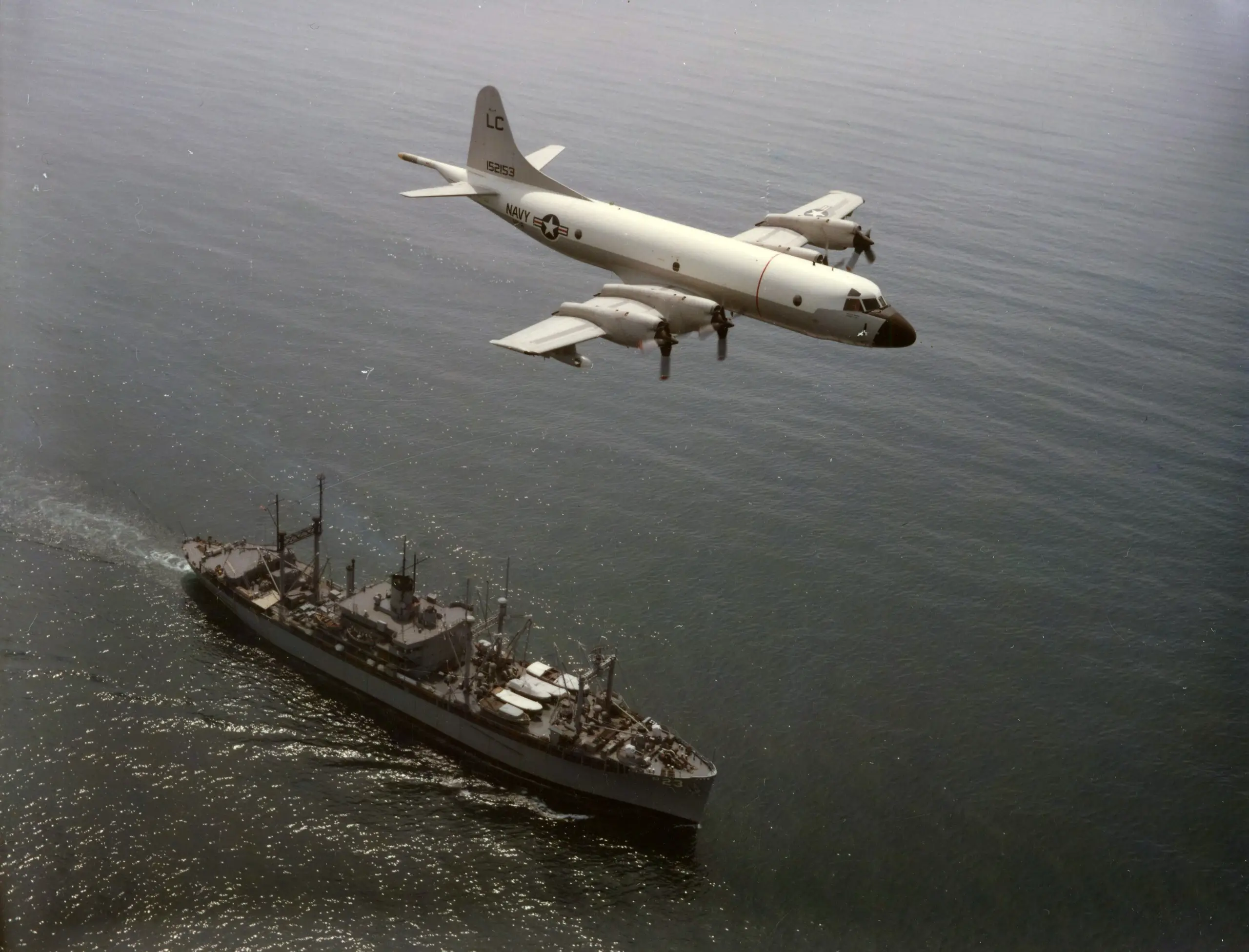
The tail of a P-3 Orion ends in a thin pole about as long as a car. It is not an antenna and not a refuelling probe. It holds a magnetometer, kept well clear of the aircraft’s own metal, and its job is to feel the faint bend a submerged submarine puts in the Earth’s magnetic field. The rest of the aeroplane is arranged around getting that pole low over the right patch of sea and keeping it there: long wings for staying up all day, four turboprops that can be shut down two at a time to save fuel, rows of launch tubes under the belly for sonobuoys, and a bomb bay behind the nose wheel with torpedoes in it.
The airframe came from an airliner. In 1957 the US Navy wanted a replacement for its piston-engined Neptunes, and Lockheed offered a version of its Electra, a four-engined turboprop then entering airline service. The fuselage lost 2.1 metres and gained a weapons bay; the wings, tail and engines stayed as they were. A demonstrator was flying in August 1958, the prototype in November 1959, and the first production aircraft reached Patrol Squadron 8 at Patuxent River in July 1962. Within three months its crews were over the Atlantic shipping lanes, shadowing Soviet freighters during the Cuban Missile Crisis. One VP-44 crew photographed the Anosov, the one Soviet ship that would not uncover its deck cargo, and confirmed that the long crates were missiles.
For the rest of the Cold War the Orion was the aircraft Soviet submarines had to reckon with whenever they left port. Squadrons rotated through Keflavik, Sigonella and Okinawa, and the P-3C of 1969, with a digital mission computer running its sensors, became the version everybody else bought. Lockheed built 650 Orions and Kawasaki built another 107 in Japan, 757 in all, for navies from Norway to New Zealand. Along the way it fought in Vietnam, chased drug runners across the Caribbean, watched Iraqi troop movements in Desert Storm and insurgent trails in Afghanistan, searched for tsunami survivors in 2004 and flew for NOAA into the eyes of hurricanes. The spy version, the EP-3E, landed on a Chinese airfield in 2001 with its nose missing and 24 people aboard, and that is the story most people know it for.
The US Navy’s active-duty patrol squadrons flew their last P-3C in 2020, the Reserve followed, and the last EP-3E made its final flight in February 2025. Their replacement, the P-8A Poseidon, is another airliner with a weapons bay, which says something about how right Lockheed got it the first time. The Orion is not finished, though. In 2026 it still patrols for Japan, Portugal, Greece, Taiwan, South Korea, Pakistan, Chile, Brazil and Argentina, and two of the oldest flying, NOAA’s Kermit and Miss Piggy, marked fifty years of hurricane hunting.


