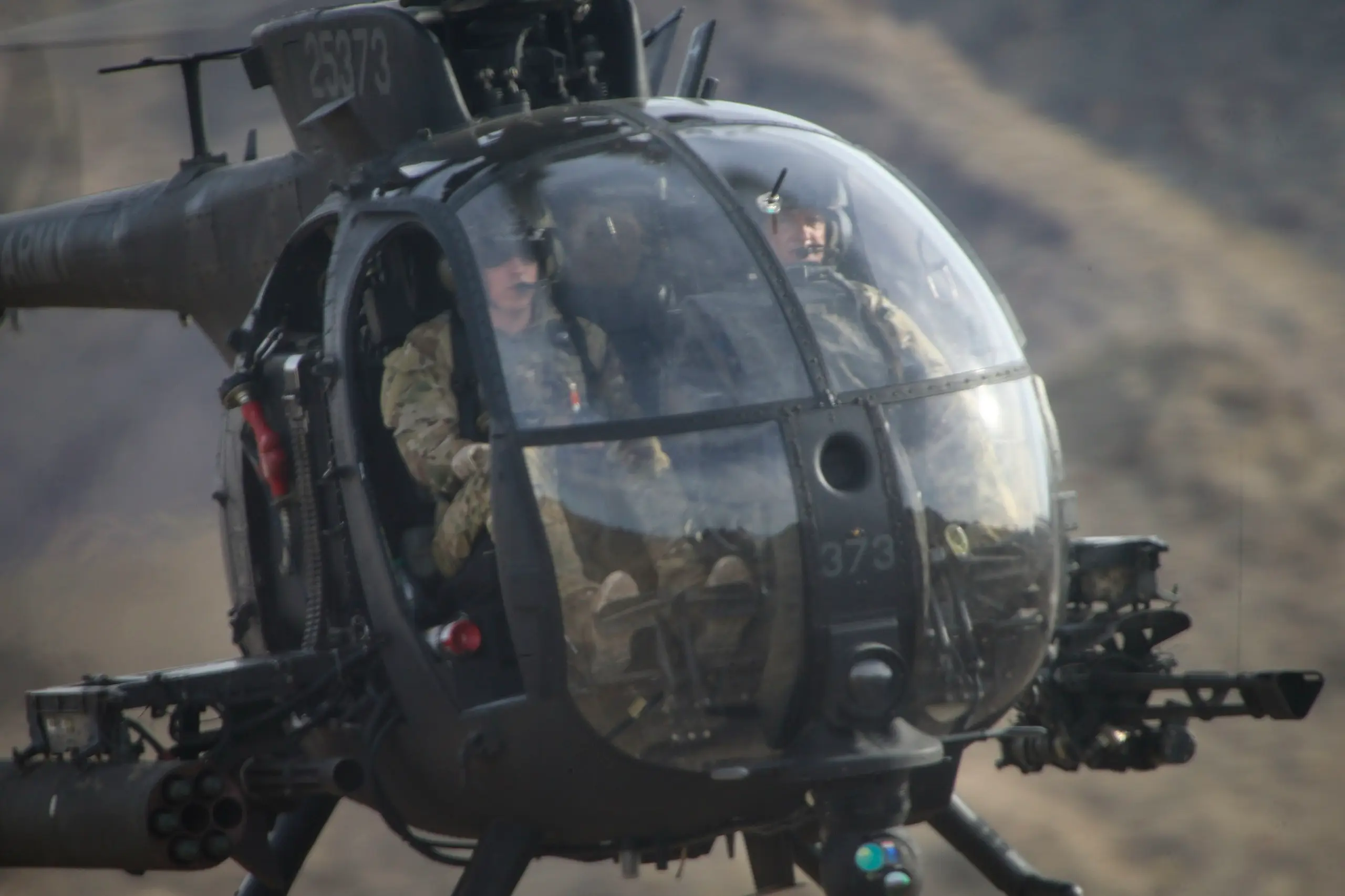
The fuselage of the Hughes Model 369 was so round and compact that people called it the flying egg. Hughes drew it in the early 1960s to win an Army contract for a scout helicopter, and it won. More than 1,400 OH-6A Cayuses were built, and in Vietnam they flew low over the jungle looking for trouble, light enough to dodge and tough enough that crews walked away from hard landings.
After the failed attempt to rescue the American hostages in Iran in 1980, the Army set out to build an aviation unit made only for special operations, and it needed a helicopter small enough to land on a rooftop, a street or the deck of a ship. It picked the old OH-6As. The unit grew into the 160th Special Operations Aviation Regiment, the Night Stalkers, and the scout became the Little Bird.
There are two kinds. The MH-6 is a taxi, with two pilots inside and up to six soldiers sitting on benches along the outside, boots above the skids, ready to jump off the moment it touches down. The AH-6 is the gunship. In place of the benches it carries miniguns, rockets or Hellfire missiles, and it covers the men the MH-6 has just dropped off. Both fold into the back of a transport plane and can be flying again soon after they are rolled out.
Most of their work is secret. Of the part that is public, Little Birds hunted minelayers in the Persian Gulf from oil barges and a frigate in 1987, and landed Delta Force on the roof of a prison in Panama in 1989. In Mogadishu in October 1993, while the fight around the crashed Black Hawks went on, one MH-6, Star 41, set down in an intersection beside the wreck of Super 61 so its co-pilot could run for the wounded.
The Little Birds flying today are MH-6Ms and AH-6Ms, rebuilt with six-bladed rotors, digital cockpits and more power, and an upgraded generation called the MH-6R is on the way. They still look like the egg Hughes sketched sixty years ago, and the job is still the one Task Force 160 gave them in 1981, putting troops on the ground quickly and exactly where they are needed.