Skip to content
Early preview The vault is just opening. New files are added regularly, and some sections are still being built.
VLTARIS
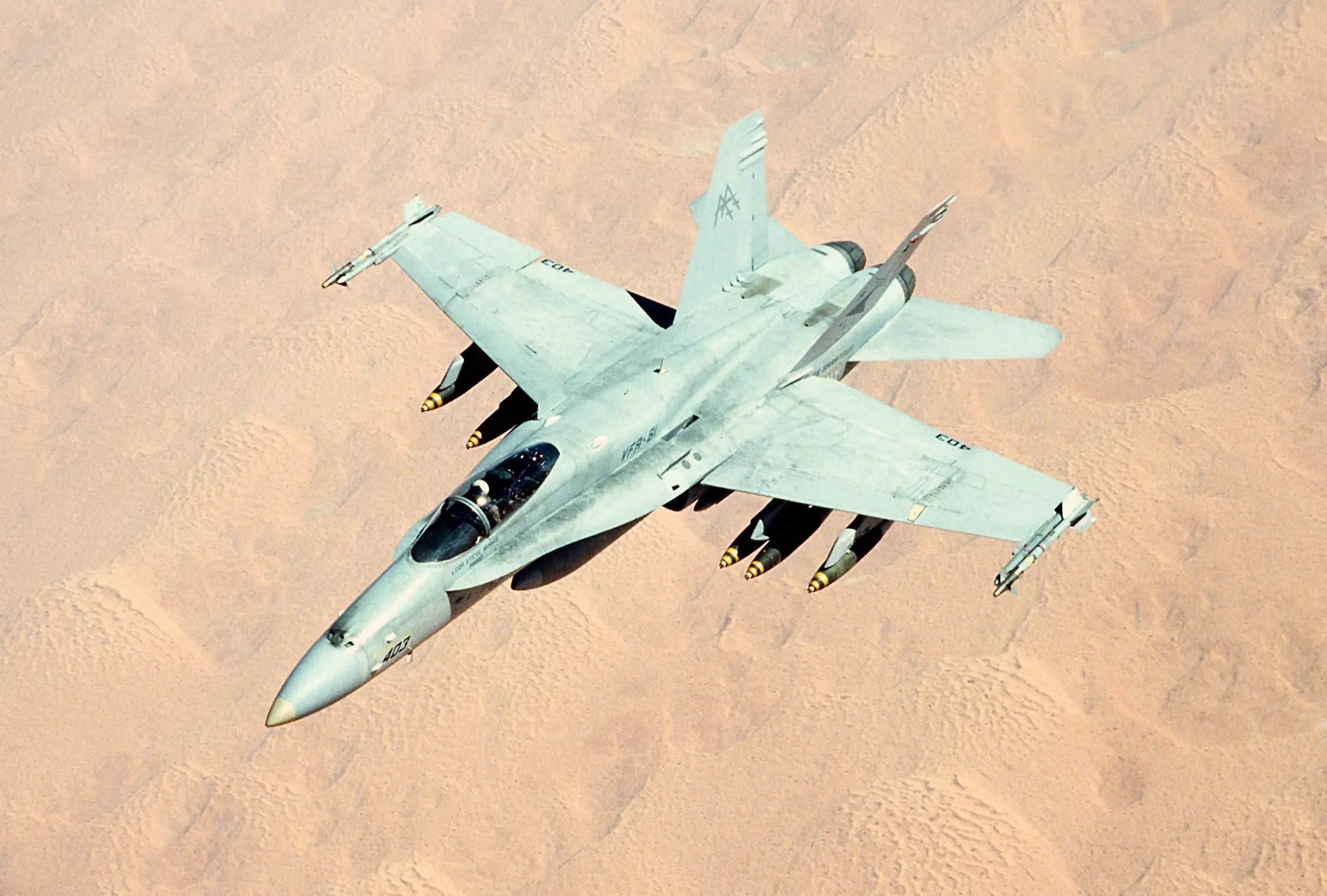
F/A-18C Hornet of VFA-81 armed with missiles and bombs, flying over desert dunes during the Gulf War in 1991

Fighter · Cold War · In service

F/A-18 Hornet

Fighter one minute, bomber the next

McDonnell Douglas & Northrop → Boeing

From the warning call to two MiGs down, 1991
40seconds
To shoot down a Syrian jet, 2017
8minutes
Between Blue Angels in the Diamond 360
46cm
From first flight to today, still on the catapult
47years

Four Hornets flew off USS Saratoga early on 17 January 1991 loaded for a bombing run on an Iraqi airfield. On the way in, two of them shot down a pair of MiG-21s with the bombs still hanging under the wings, then flew on and dropped those bombs on the airfield as briefed. The air-to-air part took under a minute. Nothing else on the deck could have flown both halves of that sortie. The “F/A” in the name stands for fighter and attack, and the Hornet was the first jet designed from the start to be both on the same flight, with the change from one to the other made by one pilot moving one switch.

The design came out of a contest it lost. In 1974 Northrop’s twin-tailed YF-17 and General Dynamics’ YF-16 flew against each other for an Air Force contract, and the YF-16 won. The Navy, told by Congress to build its next fighter from one of the two, looked at the single engine and narrow undercarriage of the YF-16 and chose the other one. McDonnell Douglas, which knew carriers, took the YF-17 and rebuilt it almost completely: stronger structure, a new undercarriage for the slam of a deck landing, folding wings, a tailhook, more fuel, and a cockpit built around digital computers and screens instead of dials. The first F-18 flew in November 1978 and the Hornet entered service in 1983.

It had a good war in 1991 and a longer one after it. Hornets flew from carriers and Marine Corps bases through Desert Storm, the no-fly zones over Iraq, Afghanistan and the 2003 invasion, and in 2017 a Super Hornet from USS George H.W. Bush shot down a Syrian Su-22 near Raqqa, the Navy’s first air-to-air kill in 26 years. Meanwhile the Blue Angels were flying it in blue and gold, and kept doing so for 34 seasons.

The Super Hornet, which first flew in November 1995, is the same idea drawn a quarter larger, with a longer fuselage, 25 per cent more wing, a third more fuel, two more weapon stations and new engines. It replaced the F-14 Tomcat as well as the older Hornets, so for a few years every combat jet on a US carrier deck was some kind of Hornet. The EA-18G Growler, a Super Hornet with jamming pods, took over the electronic warfare job and flew its first combat missions over Libya in 2011. The fleet calls the big one the Rhino.

Hornets of one kind or another have flown for nine air arms on four continents, from Finland to Malaysia. Boeing’s St. Louis line, which built the first one in 1978, delivers the last new Super Hornets in 2027. The jets already built will be on the catapults for a long time after that.

Bombs on, MiGs down: the first morning of Desert Storm

On 17 January 1991, four Hornets of Strike Fighter Squadron 81, the "Sunliners", left the deck of USS Saratoga in the Red Sea and turned for Iraq. Each carried four Mk 84 bombs, about 3.6 tonnes of them per aircraft, and the target was Al Walid air base, known as H-3, in the west of the country. Somewhere short of the target an E-2C Hawkeye radar aircraft called a warning. Two Iraqi MiG-21s were head-on, about 25 kilometres out and closing.

The two pilots in the lead, Lt. Cmdr. Mark "MRT" Fox and Lt. Nick "Mongo" Mongillo, moved one switch and their jets went from bombers to fighters, bombs still hanging under the wings. Fox fired a heat-seeking Sidewinder, which hit, and followed it with a radar-guided Sparrow to make sure. Mongillo locked up the trailing MiG, identified it by eye at a little over eight kilometres and fired. Less than 40 seconds passed between the Hawkeye's call and the missile hits.

Then they went back to the job. The flight switched to air-to-ground again, flew on to Al Walid, dropped their bombs and landed back on Saratoga. In the Navy's own account, the Hornet showed its versatility in Desert Storm by "shooting down enemy fighters and subsequently bombing enemy targets with the same aircraft on the same mission." They were the only US Navy air-to-air victories of the whole war.

The two jets are still around. Fox flew Bureau Number 163508, Mongillo 163502, and both arrived at the National Naval Aviation Museum in Pensacola in the summer of 2019, missing a great many parts. The museum's restorers rebuilt them with pieces taken from retired Blue Angels Hornets, and for a while the airframes were a patchwork of blue and grey under the primer. Fox's jet, back in its Desert Storm colours with an Iraqi flag painted by the cockpit, was unveiled in 2021. The plan is to park it beside a MiG-21 painted as the Iraqi jet it shot down.

The Blue Angels' longest-serving jet

The Blue Angels took delivery of the Hornet in November 1986, their 40th anniversary year, and did not give it up until November 2020. That is 34 seasons, more than twice as long as the team had kept any aircraft before.

A show Hornet is a fleet Hornet with a few careful changes. The 20 mm cannon comes out of the nose and a tank of smoke oil goes in its place, feeding the white trails that let the crowd follow the jets through the sky. The fuel system is altered so the aircraft can fly upside down for far longer than a fleet jet. A spring is fitted to the control stick, adding back-pressure so the pilot can make the tiny corrections that formation flying demands without over-correcting, and a stopwatch is mounted on the dashboard just under the head-up display for the second-by-second timing of the manoeuvres. Navy rules say every modification must be reversible, so the jet can go back to combat if it is ever needed. The Blue Angels Hornet now in the Smithsonian still has its wingtip Sidewinder rails, and if you look under the wing you can find the plugged holes where the bomb racks bolt on.

The pilots fly without G-suits. The team says the inflating air bladders would get in the way of the steady arm pressure that formation flying needs, so the pilots hold their blood pressure up with muscle contractions instead. In the Diamond 360 the four jets fly as close as 46 cm apart, and the team estimates that around 11 million people watch them in a year.

On 18 November 2020, Cmdr. Frank "Walleye" Weisser flew F/A-18C 163439 into Dulles airport and handed it to the Smithsonian's Udvar-Hazy Center. It had been built in 1987, flown over Lebanon in 1989 and in Desert Storm in 1991, and passed through eight squadrons before joining the team in 2015. Under the right side of the cockpit it carries the name of Capt. Gil Rud, the commander who led the team's switch to the Hornet, so that one aircraft stands for the first season and the last. From 2021 the team flies the bigger Super Hornet.

Nose up at 70 degrees: NASA's research Hornet

In October 1984 a Hornet arrived at NASA's Dryden Flight Research Center in the Mojave Desert in pieces, missing around 400 parts. It was Bureau Number 160780, the sixth development F-18 ever built, borrowed from the Navy because it still had a spin-recovery parachute. NASA rebuilt and rewired it, and from April 1987 it became the High Alpha Research Vehicle, HARV for short.

"Alpha" is the pilot's word for angle of attack, how far the nose points above the direction the aircraft is actually travelling. A normal fighter stops flying properly somewhere in the twenties. NASA wanted to know what happened far beyond that. In 1991 the engineers fitted three heat-resistant paddles around each exhaust, which swung into the jet blast to steer the aircraft when the wings and tail could no longer do it. The system weighed about a tonne and cost the jet its ability to go supersonic, and in return the HARV flew under control with its nose pointed 70 degrees above its flight path, and rolled on command at 65. Without the paddles, NASA found, controlled rolling above 35 degrees was close to impossible. Later came hinged strakes on the nose, which worked by nudging the vortices spilling off the forebody.

The programme ended in September 1996 after 385 research flights. The flight data checked the computer models and wind-tunnel results, the tail buffeting from the leading-edge vortices was traced and measured, and NASA says the findings went into the F-22 and the Joint Strike Fighter prototypes. The jet itself, black paddles still on its tail, now sits in the Virginia Air & Space Science Center in Hampton, Virginia.

Making Maverick

When Top Gun: Maverick went into production in 2018, the Navy's Hollywood office signed a production assistance agreement with Paramount, and the film became one of only two it was supporting at the time. "Much like the first film, these are going to be real jets and real U.S. Naval aviators flying in these scenes," Cmdr. Ronald Flanders of Naval Air Forces said that September. A crew had already filmed for several days aboard USS Abraham Lincoln at sea, with no actors, just the ship's daily routine, and more shooting followed at Naval Air Station North Island in San Diego and at Lemoore in central California.

The Super Hornet got the part because the F-35C has one seat, and no actor could have ridden in one. Tom Cruise insisted every actor playing a pilot fly in the real thing, and they did, in the back seats of two-seat F/A-18Fs behind Navy pilots, after training on how to eject and how to survive in the sea. None of them touched the controls. A Pentagon regulation bars civilians from operating Defense Department equipment, and Cruise, who flew more than a dozen sorties as a passenger, was no exception. Paramount paid for the flying at the going rate, $11,374 an hour per jet in 2018, unless a flight could count as scheduled training.

Two of the jets, Super Hornets 165536 and 165667 from the test squadron at China Lake, were painted as Maverick's and Rooster's aircraft and fitted with cameras to film the actors' faces as the real pilots pulled G. After the film wrapped, 165536 went to the Blue Angels, flew as the team's number 5 from the 2021 season, and in May 2026 was trucked to the Palm Springs Air Museum in California, still in blue and gold.

Armament

M61 20 mm cannon
A six-barrel rotary cannon in the nose with 520 rounds. The Blue Angels take theirs out and put a smoke-oil tank in the hole.
AIM-9 Sidewinder
Heat-seeking, carried on the wingtips. Mark Fox's first shot against an Iraqi MiG-21 in 1991 was a Sidewinder. In 2017 an AIM-9X was the first missile fired at a Syrian Su-22, and it missed.
AIM-7 Sparrow & AIM-120 AMRAAM
Radar-guided missiles for longer range. Fox followed his Sidewinder with a Sparrow in 1991; an AMRAAM fired from about half a mile, in the pilot's words, ended the 2017 fight.
Bombs and missiles for the ground
Up to about 6,200 kg of ordnance on a Hornet and 8,000 kg on a Super Hornet, which has two more weapon stations: Mk 80-series and laser-guided bombs, JDAM and JSOW, plus Maverick, HARM and Harpoon missiles.
Buddy store
A Super Hornet can carry a refuelling pod and top up its squadron mates on the way to the target, so the fighter doubles as the carrier's tanker.

Missions & Moments

Head Butt over Raqqa

18 June 2017, eastern Mediterranean. Two F/A-18E Super Hornets of Strike Fighter Squadron 87, the "Golden Warriors", launch from USS George H.W. Bush, swing south of Cyprus, cross Turkey and enter Syrian airspace. In the lead is Lt. Cmdr. Michael "MOB" Tremel, a Pennsylvanian who had flown in some of the first American sorties against Islamic State in Syria three years earlier. On his wing is Lt. Cmdr. Krueger, call sign "JoJo". The job is close air support for the Syrian Democratic Forces fighting for Raqqa. "Everyone's kind of heading to the same place that day, to Raqqa," Tremel said later.

The sky over the city is crowded. An Air Force controller on the ground is calling in strikes, a Russian Flanker is circling overhead, which by then was normal, and the ship's earlier flights have already made low passes to warn Syrian government forces off the SDF positions. Tremel is orbiting at around 6,000 metres, watching the radar, when a contact comes fast from the south. He drops down to look. It is a Syrian Air Force Su-22, a swing-wing bomber, heading straight for the friendly troops.

Radio warnings go out and the Su-22 keeps coming, so Krueger suggests the manoeuvre pilots call a head butt. Tremel flies right over the top of the Syrian jet's canopy, close enough that the pilot cannot miss him, and pumps out flares. He does it three times, and the Su-22 pilot does not turn away. Instead he rolls in and drops two bombs on the SDF below.

Tremel selects a heat-seeking AIM-9X. "It was really crazy, swinging that master arm for the first time in combat with an air-to-air missile selected," he said. The Sidewinder goes, and does not bring the jet down. "Real time, I thought I might have been too close. I thought maybe I hit (the jet) but it didn't fuse in time." He switches to the radar-guided AIM-120 and fires again. "That got the job done from about half a mile." The missile goes into the Fitter's tail, the jet pitches right and then down, and Tremel breaks left to stay out of the debris, a lesson from a training flight years before when he had flown straight through the remains of a drone. He watches the Syrian pilot eject.

From first contact to the shoot-down took about eight minutes. While Tremel finished the fight, Krueger put his own Super Hornet between the Americans and anything else that might come, and the two of them flew home to the ship. "Looking at the wreckage down below us, it was a different feeling," Krueger said.

It was the first time a US Navy aircraft had shot down another aircraft since the Hornets of Desert Storm in 1991. Tremel told the story to a room full of naval aviators at the Tailhook convention that September, and at the next one, in 2018, he was given the Distinguished Flying Cross. Krueger received the Air Medal. Tremel saved his thanks for the sailors who look after missiles that almost never get fired. "For the one day we need them," he said, "it works!"

The crews

Most Hornets have one seat, and the person in it is expected to be a fighter pilot and a bomber pilot on the same flight. The jet was the first designed from the drawing board to do both, and switching between the two is, in the Navy's words, as easy as flipping a switch. The radar, the displays and the weapons change jobs together. The two-seat D and F models add a weapons officer in the back, or a second set of controls for training.

The switch
On the first morning of Desert Storm, Fox and Mongillo went from bombers to fighters, shot down two MiGs, and went back to being bombers, all in one sortie. The Navy says Hornets did that routinely during the war.
Fly-by-wire
The Hornet has a digital flight control system, and the Navy says pilots learn to fly it with relative ease, which leaves them free to run the weapons. It was also the Navy's first tactical jet with a fully digital avionics bus, one reason it has been so easy to upgrade for four decades.
No G-suit for the Blues
Blue Angels pilots fly without G-suits. The inflating bladders would interfere with the steady forearm pressure that keeps a jet 46 cm from its neighbour, so the pilots tense their muscles instead.
Rhino
In the fleet the Super Hornet is known as the Rhino. It is about 25 per cent larger than the Hornet it grew from, and from the outside the quickest tell is the squared-off engine intakes.

Names worth knowing

  • Mark "MRT" Fox & Nick "Mongo" Mongillo VFA-81, January 1991

    Each shot down an Iraqi MiG-21 within moments of the other on the first morning of Desert Storm, with bombs still on the wings. Both jets are now at the National Naval Aviation Museum.

  • Lt. Cmdr. Michael "MOB" Tremel VFA-87, June 2017

    Shot down a Syrian Su-22 over Raqqa, the Navy's first air-to-air kill since 1991, and was awarded the Distinguished Flying Cross. His own summary: “Defending guys on the ground is what I've done my whole career.”

  • Lt. Cmdr. Krueger, "JoJo" Tremel's wingman

    Suggested the head-butt passes, then put his own jet between the Americans and any other threat after the Su-22 went down. Awarded the Air Medal.

  • Cmdr. Frank "Walleye" Weisser Blue Angels

    Flew the team's F/A-18C 163439 on its last flight, into Dulles airport on 18 November 2020, and handed it to the Smithsonian.

  • Capt. Gil Rud Blue Angels, 1986

    Led the team's switch from the A-4 Skyhawk to the Hornet. His name is painted under the right side of the Smithsonian jet's cockpit, a tribute to the first Hornet season.

Did You Know?

Northrop's YF-17 lost the Air Force's lightweight fighter contest to the YF-16, and the Navy, unconvinced that a single-engined jet with narrow landing gear belonged on a carrier, picked the YF-17 anyway and had it rebuilt for the sea.
In Desert Storm the Navy's and the Marines' Hornets flew more than 9,000 sorties between them, with 26 Canadian CF-18s alongside, and of 174 American Hornets only three were lost, one of them in an accident.
Blue Angels pilots do not wear G-suits. The team says the inflating bladders would spoil the steady arm pressure that formation flying needs, so they fight the G with their muscles.
A Super Hornet can be the tanker as well as the fighter. With a refuelling pod under the belly it tops up its squadron mates on the way to the target.
NASA's research Hornet arrived at Edwards in October 1984 in pieces, missing about 400 parts. NASA put it back together, and it went on to fly 385 research flights.
Every change the Blue Angels make to a jet has to be reversible, so it can go back to war. The Smithsonian's Blue Angels Hornet still has its Sidewinder rails, and the plugged holes under the wings where the bomb racks bolt on.

Timeline

  1. 1975–76

    Congress tells the Navy to build its new fighter from one of the Air Force's lightweight prototypes. The Navy chooses the twin-engined YF-17, which had lost the Air Force contest to the YF-16, and McDonnell Douglas turns it into the F-18.

  2. Nov 1978

    The first Hornet flies. It is the first tactical jet designed from the start to be both a fighter and a bomber.

  3. 1983

    The Hornet enters service, replacing the F-4 Phantom and the A-7 Corsair II.

  4. Apr 1986

    First combat, in the strikes on Libya.

  5. Nov 1986

    The Blue Angels take delivery of the Hornet. They will fly it for 34 seasons.

  6. Jan 17, 1991

    Mark Fox and Nick Mongillo of VFA-81 shoot down two Iraqi MiG-21s on the first morning of Desert Storm, then carry on and bomb their airfield.

  7. Nov 1995

    The Super Hornet flies for the first time: a quarter larger, with a third more fuel and two more weapon stations.

  8. Jul 2002

    VFA-115 takes 12 Super Hornets to sea on USS Abraham Lincoln, the type's first deployment.

  9. Jun 18, 2017

    Lt. Cmdr. Michael Tremel shoots down a Syrian Su-22 near Raqqa, the Navy's first air-to-air kill since 1991.

  10. Nov 18, 2020

    The Blue Angels' last Hornet season ends with F/A-18C 163439 flown into the Smithsonian. The team flies Super Hornets from 2021.

  11. Mar 2024

    The Navy signs for a final 17 Super Hornets. Production is due to end in 2027, after almost half a century of Hornets rolling out of St. Louis.

Who flies it

  • United States

    ~420 Super Hornets

    US Navy

    Every carrier air wing flies Super Hornets, plus EA-18G Growlers. The last fleet squadron with original Hornets switched to Super Hornets in 2019. Fleet figure as reported in March 2024.

  • United States

    US Marine Corps

    Still flies F/A-18C and D Hornets, which the F-35 is replacing.

  • Australia

    Super Hornets and Growlers, the only Growler operator outside the US. Its original Hornets retired as the F-35A arrived, and 25 of them went to Canada.

  • Canada

    Known in Canada as the CF-188. Flies from Bagotville, Quebec and Cold Lake, Alberta, and sent 26 jets to Desert Storm.

  • Kuwait

    Hornets, now joined by Super Hornets.

  • Malaysia

    A small fleet of two-seat F/A-18Ds.

Also flown by: Spain · Finland · Switzerland

Fleet figures as of October 2026; numbers change as aircraft are delivered and retired.

Where to see one today

Hornets are still working aircraft, so the museum examples are the ones with a story. These are confirmed on the museums' own websites, with Bureau Numbers for the spotters.

United States· 3

  • National Naval Aviation Museum

    NAS Pensacola, Florida

    Mark Fox's jet from 17 January 1991, the one that shot down an Iraqi MiG-21 with bombs still on the wings. The museum is on an active base, so check visitor access first.

    163508F/A-18C
  • Smithsonian Udvar-Hazy Center

    Chantilly, Virginia

    Flew in Desert Storm, then with the Blue Angels from 2015 to 2020. It arrived under its own power on 18 November 2020.

    163439F/A-18C (Blue Angels) · indoors
  • Virginia Air & Space Science Center

    Hampton, Virginia

    NASA's High Alpha Research Vehicle, which flew with its nose 70 degrees above its flight path, thrust-vectoring paddles still fitted.

    160780F-18 HARV (NASA) · indoors

Vintage Aviation News reported in 2026 that the Palm Springs Air Museum in California was reassembling Super Hornet 165536, the Blue Angels jet that was painted as Maverick's aircraft for the film, for long-term display. Check the museum's website before you go.

Locations last checked October 2026. Airframes occasionally move, so check with the museum before you travel.

On screen

Where the F/A-18 Hornet became a star outside the hangar.

  • Film · 2022

    Top Gun: Maverick

    Maverick's jet this time is a two-seat F/A-18F Super Hornet, and the actors really flew in the back seats behind Navy pilots, at $11,374 an hour. One of the film's jets went on to fly with the Blue Angels.

Sources

Facts last reviewed October 2026

  1. 1. Royal Canadian Air Force: CF-188 Hornet (Hornet specifications; page dated August 2025)
  2. 2. Boeing: F/A-18 Super Hornet and EA-18G Growler (Super Hornet specifications, operators)
  3. 3. U.S. Navy fact file text for the F/A-18 Hornet, as reproduced by GlobalSecurity.org: F/A-18 Hornet, specifications, history and F/A-18E/F Super Hornet (YF-17 origins, first flights, Desert Storm sortie figures, the fighter/attack switch, armament, operators)
  4. 4. Boeing news release: “Boeing F/A-18 E/F Super Hornets Head Out on First Deployment”, July 25, 2002 (first deployment, tanker role, weapon stations)
  5. 5. GlobalSecurity.org: Strike Fighter Squadron 115 (first Super Hornet fleet squadron)
  6. 6. National Naval Aviation Museum: F/A-18C Hornet, BuNo 163508 and “From One Hornet to Another” (2020; the restoration of the two MiG killers, Blue Angels Hornet years)
  7. 7. Vintage Aviation News: “Naval Aviation Museum Receives MiG-21 and F/A-18s for Gulf War Display”, August 27, 2019 (the 17 January 1991 engagement in detail, airframe histories) and “Desert Storm F/A-18 MiG Killer Unveiled”, October 22, 2021
  8. 8. Stars and Stripes: “Navy retires F/A-18C Hornet from combat as F-35C nears operational status”, 2018 (last Hornet deployment, VFA-34, Navy quotes on Desert Storm, Marine Corps Hornets, Super Hornet 25% larger)
  9. 9. Aviation International News: “End of the Line for the Fleet's Legacy Hornets”, January 31, 2019 (first combat 1986, production to 2000, overseas operators, ex-Australian jets to Canada)
  10. 10. Navy Times: “The inside story of how a US Navy pilot shot down a Syrian jet”, September 10, 2018 (Tremel's account and quotes, awards)
  11. 11. Military.com: “‘A Different Feeling’: Navy Pilots Describe Shooting Down SU-22”, September 16, 2017 (Tailhook panel, head-butt passes, Krueger's role, first kill since 1991)
  12. 12. U.S. Navy Blue Angels: History and Frequently Asked Questions (Hornet November 1986 to November 2020, Super Hornet from 2021, 18-inch spacing, no G-suits, modifications, spectators)
  13. 13. Smithsonian National Air and Space Museum: “A Blue Angel Makes Its Final Flight Into The National Collection”, December 7, 2020, and the collection record for F/A-18C 163439 (airframe history, Blue Angels modifications, 34 seasons, Gil Rud)
  14. 14. NASA: F-18 High Alpha Research Vehicle (programme phases, 385 flights, thrust-vectoring vanes, BuNo 160780, current location)
  15. 15. Virginia Air & Space Science Center: Aircraft exhibits (F-18 HARV on display)
  16. 16. U.S. Navy News Service via GlobalSecurity.org: “Navy and Marine Corps Aircraft Strike Libya”, March 20, 2011 (first Growler combat missions)
  17. 17. FlightGlobal: “Boeing extends Super Hornet production to 2027 with final new-build order from USA”, March 20, 2024 (final 17 jets, about 420 in service)
  18. 18. Fortune / Bloomberg: “‘Top Gun: Maverick’ studio paid U.S. Navy more than $11,000 an hour for fighter jet rides”, May 26, 2022 (hourly rate, Pentagon rules, actors' training, Rhino nickname, filming locations)
  19. 19. Motion Picture Association, The Credits: “Real Navy Jets and Aviators Will Satiate Top Gun: Maverick's Need for Speed”, September 2018 (Cmdr. Flanders quotes, production agreement, carrier filming)
  20. 20. Vintage Aviation News: “Palm Springs Air Museum Prepares Top Gun: Maverick F/A-18E Super Hornet for Display”, 2026 (BuNos 165536 and 165667, cameras, Blue Angels service, move to Palm Springs)
  21. 21. Gallery photos via Wikimedia Commons (U.S. government works, public domain), including the hero photo, Mark Fox in his cockpit and the NASA HARV
  22. 22. Museum websites linked in “Where to see one today” (checked October 2026)