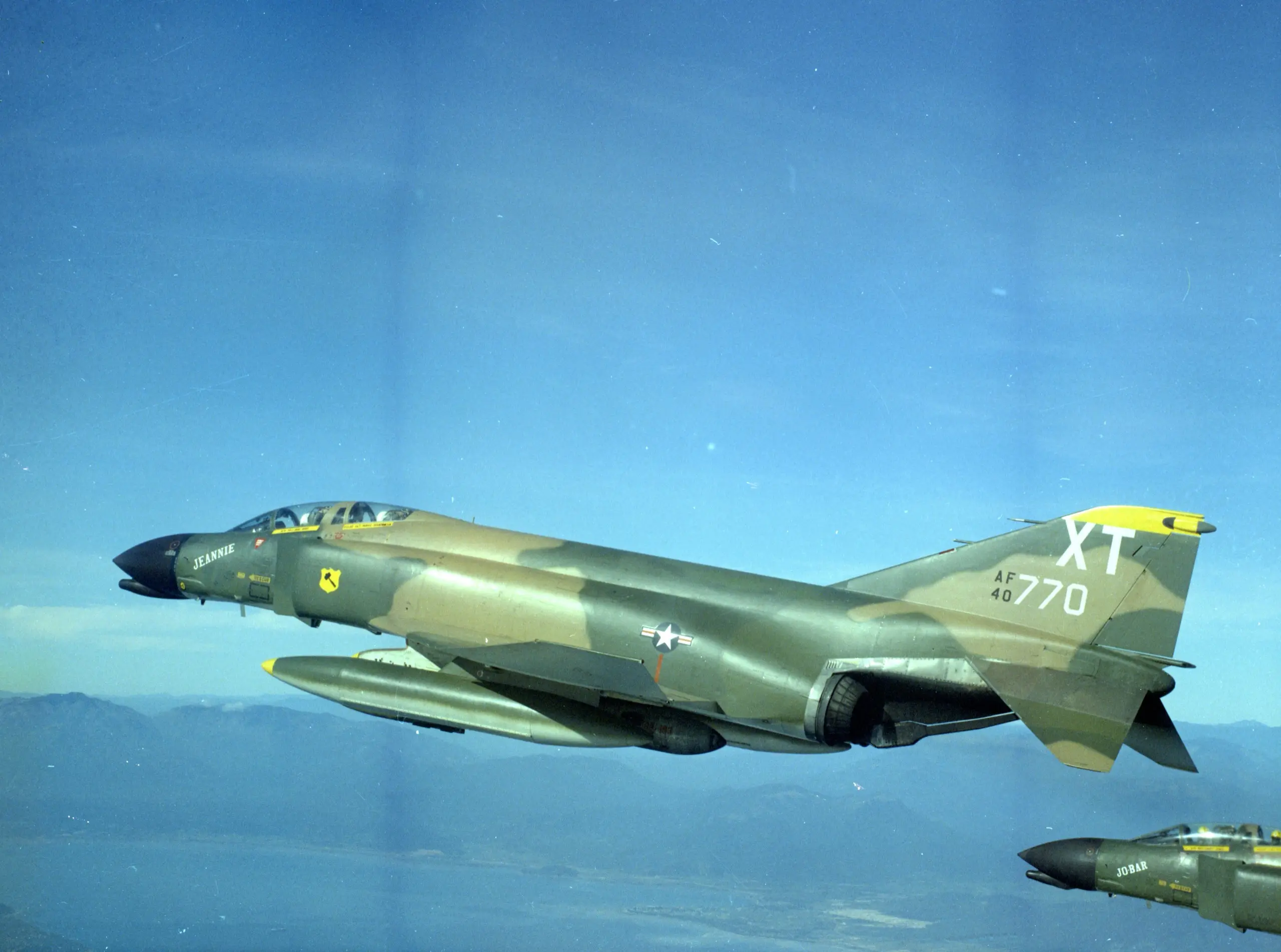
In December 1959 a Navy commander named Lawrence Flint pointed a brand-new fighter straight up over the California desert and did not level off until he was more than 30 kilometres above it, higher than any aircraft had flown before. The fighter was the Phantom, and over the next three years it took the records for the highest flight, the fastest at low level, the fastest at any level and the quickest climb. McDonnell had built it for the Navy as a long-range interceptor, a jet that would launch from a carrier, run down Soviet bombers at twice the speed of sound and kill them with radar-guided missiles from well beyond gun range. What the Navy actually got was a jet with so much thrust to spare that it could be handed almost any job.
It looks like an argument that was never settled. The wingtips bend up, the tailplane bends down, the nose droops and the two big intakes sit on the sides like saddlebags. The people who flew it called it Double Ugly, the Rhino, the Flying Anvil and Old Smokey. None of that mattered once the throttles went forward. In 1962 the Air Force, which had never wanted a Navy fighter, picked the Phantom for itself as both a fighter and a bomber, and by 1965 its F-4Cs were flying from Thailand against North Vietnam.
Vietnam was the war the Phantom was not designed for and the one that made it. Over the North it flew escort for the F-105 bombers, then carried bombs itself, then flew reconnaissance as the RF-4C, then hunted surface-to-air missile sites. It was the jet that Robin Olds used to spring the most famous ambush of the air war, seven MiG-21s in twelve minutes on January 2, 1967, and the jet in which every American ace of the war earned the title, two Navy officers and three from the Air Force. It also went to war without a gun, which cost crews dearly, and the F-4E that finally carried one in its nose became the most-built Phantom of all. That story gets its own section further down.
Production ran from 1958 to 1979 and stopped at 5,195, a total that among supersonic jets only the MiG-21 has beaten. Britain fitted its own Rolls-Royce engines and flew it from HMS Ark Royal. Japan built its own under licence. West Germany, South Korea, Greece and Turkey flew it for decades, and the Air Force found one last job for it after retirement: as the QF-4 target drone, flown with and without pilots, until the final flight in December 2016.
More than sixty years after the first flight, the Phantom is still a front-line aircraft in Greece and Turkey, and for a few more years the sound of two J79s in afterburner will be something you can hear rather than something you read about.


