Skip to content
Early preview The vault is just opening. New files are added regularly, and some sections are still being built.
VLTARIS
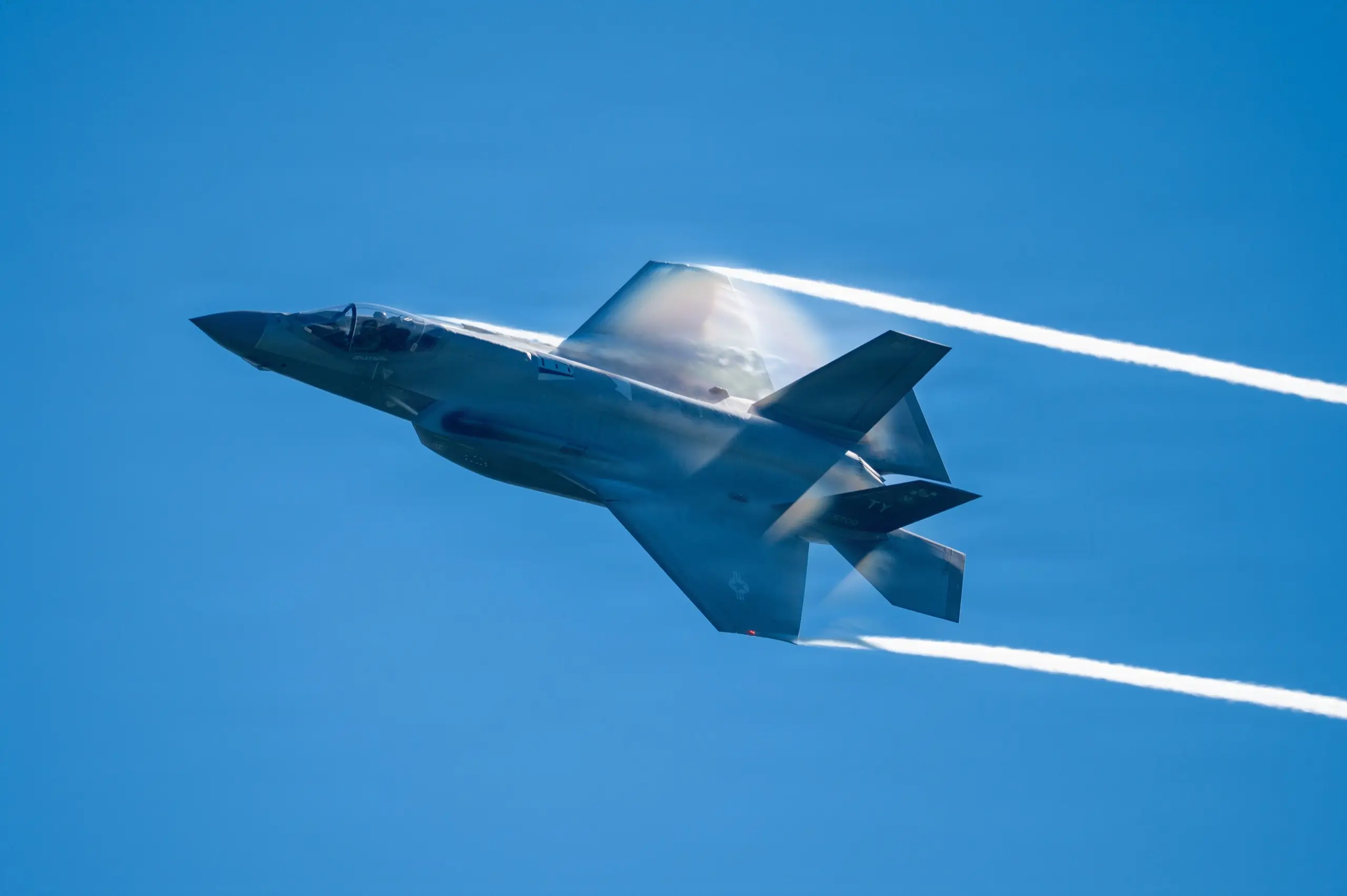
F-35A banking hard against a clear blue sky, a cloud of vapor over its wing and white trails streaming from its wingtips

Fighter · Modern · In service

F-35 Lightning II

One stealth fighter, three ways to land

Lockheed Martin (with Northrop Grumman and BAE Systems)

Delivered by September 2026
1,375+
Top speed, with its weapons tucked inside
Mach 1.6
Versions: runway, hover and carrier
3
Flight hours, passed in March 2025
1million+

An F-35B coming in to land slows down until it is not moving at all. It hangs there like a helicopter, held up by a fan behind the cockpit and an engine nozzle swivelled to point at the ground, and then settles straight down. Its two sisters land the ordinary way: the F-35A on a concrete runway, the F-35C on a carrier deck, caught by a wire. One design, three versions, built for the US Air Force, Navy and Marine Corps and a long line of allies. All three carry their weapons inside, wear a skin that soaks up radar, and give their pilot a helmet that can see through the floor.

The design came out of a contest. In the late 1990s the Pentagon asked Boeing and Lockheed Martin to build prototypes for a Joint Strike Fighter, and Lockheed’s answer to the hover requirement was that big fan buried behind the cockpit. In July 2001 its X-35B flew a short takeoff, a supersonic dash and a vertical landing in a single flight, an aviation hat trick nobody had managed before, and that October Lockheed won. In 2006 the jet got its name, borrowed from the P-38 Lightning of the Second World War, and flew for the first time.

What followed became the most expensive weapons program in history. The Government Accountability Office puts the lifetime cost of the US fleet at more than $1.7 trillion, most of it for decades of operating and maintaining the jets, and critics have spent years picking apart its delays, its software and how often it is ready to fly. Its defenders point to what it does once it is up there. It sees the enemy first, shares what it sees with everyone else, and stays hidden while it does.

The buyers have kept coming regardless. By September 2026 more than 1,375 had been delivered, flying with air forces and navies from Norway to Japan and turning small ships into aircraft carriers along the way. US Marines flew the first American F-35 combat strike over Afghanistan in 2018, and Air Force F-35As joined the fight against the Islamic State the next year.

It is replacing a whole generation of fighters, from the F-16 and A-10 to the Hornet and the Harrier, and some of its operators plan to fly it into the 2060s. Whatever anyone thinks of the bill, this is the aircraft Western air power will be built around for a long time to come.

Three jets in one

The US Air Force wanted a jet for long concrete runways. The Navy needed one tough enough to be flung off a catapult and slammed onto a deck. The Marines, and the British, wanted something that could operate from short decks and rough strips, and land straight down. The Joint Strike Fighter had to satisfy all three customers at once, and instead of three different aircraft Lockheed built one family that shares a shape, an engine, a cockpit and a brain.

The F-35A is the conventional one, built for the Air Force and in the largest numbers. It is the only version with a 25 mm cannon built into the airframe, which lets it take over from both the F-16 and the A-10.

The F-35C belongs to the Navy. It has a larger wing and bigger control surfaces for slow, precise carrier approaches, extra ailerons at the wingtips, a strengthened skeleton to survive catapult launches and arrested landings, and wings that fold to save space below deck. On November 3, 2014, one caught the wire on USS Nimitz off San Diego, the first F-35C arrested landing at sea.

The F-35B is the one with the fan. A drive shaft runs forward from the engine to a Rolls-Royce lift fan sitting upright just behind the cockpit. When the pilot asks for a hover, the fan spins up, the rear nozzle swivels down, and small ducts under the wings keep the jet level, so fan and nozzle hold the jet up between them. The Marine Corps calls it the world's first operational supersonic short takeoff and vertical landing aircraft. The Harrier could hover but never go supersonic, and the F-35B does both.

Small ships, big punch

A ship that wants to fly F-35Bs does not need catapults, arresting wires or a deck the length of a supercarrier. It needs a heat-proof spot for the jet to land on, and that changes what a warship can be.

The first time it happened at sea was on October 3, 2011, when a test F-35B came down vertically on the deck of the amphibious assault ship USS Wasp. Since then, the jet has turned flat-tops all over the world into aircraft carriers. Britain's two new carriers, HMS Queen Elizabeth and HMS Prince of Wales, carry F-35Bs; by June 2021 the jets had flown from both. In 2023 a Marine test pilot, Maj. Paul Gucwa, flew the first rolling vertical landing aboard Prince of Wales: instead of stopping alongside the ship and stepping sideways onto the deck, the jet arrives with some forward speed, which could let pilots bring back heavier loads of fuel or weapons. "It was a wonderful experience to see our training and preparation lead to a predictable and comfortable outcome," he said.

Italy's navy landed its first F-35B on the carrier ITS Cavour on July 30, 2021. On October 3, 2021, US Marine F-35Bs flew from the Japanese helicopter carrier JS Izumo. Japan had not operated fixed-wing aircraft from its ships since the end of the Second World War.

The US Marines have pushed the idea furthest. In April 2022 they tested a "Lightning carrier", packing a record 16 F-35Bs from three squadrons onto the amphibious assault ship USS Tripoli. It was never meant to replace a real supercarrier, but it showed how much stealthy firepower a "small" ship can now carry.

Wonder Woman's glass airplane

The F-35 has no head-up display. Every fighter for decades has had one, a small glass screen on top of the instrument panel that floats speed, altitude and targets in front of the pilot's eyes, and the F-35 is the first modern fighter to do without it. Everything is projected onto the visor of the pilot's helmet instead, so the information goes wherever the pilot looks.

Six infrared cameras are spread around the outside of the jet. The program calls the set the Distributed Aperture System, and a computer stitches their pictures into one seamless sphere around the aircraft, day or night. When the pilot turns their head, the helmet shows the matching slice of that sphere. Look down between your knees and you see the ground beneath the jet, as if the cockpit floor weren't there. The program office says pilots have described it as "like flying Wonder Woman's glass airplane."

The same cameras warn of incoming missiles and aircraft and keep track of wingmen, and the program office points out that seeing through the jet is particularly useful when an F-35B pilot is hovering above a landing spot that the aircraft's own nose would otherwise hide.

Eleven minutes without a pilot

On the afternoon of September 17, 2023, a Marine F-35B was coming home to Joint Base Charleston, South Carolina, through a heavy rainstorm. At the controls was Charles "Tre" Del Pizzo, a veteran former Harrier pilot about to take command of the Marines' operational test squadron. He was trying to land in hover mode, inside the clouds, with no view of the ground. Then the jet's electrics went haywire. Both main radios, the transponder and the landing aids failed, and by his account his helmet display and main cockpit screens went dark three times in 41 seconds. Blind in the clouds, low over the ground and unsure whether the jet was still responding, he pulled the ejection handle.

He came down in a backyard, and the homeowner called 911. "I guess we've got a pilot in our house, and he says he got ejected," the homeowner told the dispatcher. Then the pilot came on the line: "We have a military jet crash. I'm the pilot. We need to get rescue rolling. I'm not sure where the airplane is."

Nobody else knew either. The F-35's automatic flight controls had kept it flying, its transponder was dead, and its stealthy shape didn't help. Joint Base Charleston ended up asking the public for help finding a missing stealth fighter. The wreck turned up the next day in a forest in Williamsburg County. The jet had flown on alone for 11 minutes and 21 seconds, about 103 km from the airfield. Nobody on the ground was hurt.

The Marine Corps' final investigation blamed pilot error, saying he had ejected "from a flyable aircraft, albeit during a heavy rainstorm compounded with aircraft electrical and display malfunctions." Two other Marine boards had backed his decision, and the flight manual told pilots to eject if the jet stopped responding at low altitude. He was later relieved of his command and retired, still a fan of the F-35. Looking back, he said his first thought had not been for himself: "My biggest fear was that I'd hurt someone."

The jet that went on holiday

On June 14, 2025, a British F-35B from the carrier HMS Prince of Wales ran into bad weather over the Indian Ocean and diverted to the nearest big runway: Thiruvananthapuram airport, in the southern Indian state of Kerala. It landed safely. Then it developed a technical fault and could not go back to its ship.

Engineers from the carrier came ashore and couldn't fix it. The jet sat on the tarmac in the monsoon rain, guarded around the clock by RAF personnel, while a team of 14 specialist engineers was flown out from Britain. They towed it into a hangar and got to work.

India, meanwhile, fell in love with the "lonely F-35B". A spoof online advert offered it for sale with features like "automatic parking, brand-new tyres, a new battery and an automatic gun to destroy traffic violators". Social media users suggested it deserved Indian citizenship. Kerala's own tourism department joined in, posting a picture of the jet under coconut palms with the line "Kerala, the destination you'll never want to leave."

After more than five weeks, on July 22, 2025, the repaired jet finally took off and headed for Darwin, Australia, to catch up with its carrier. Indian social media waved it off with a cheerful "adios".

Armament

25 mm cannon
A GAU-22/A cannon. The F-35A carries it inside the airframe. Marine F-35Bs carry it in a stealthy pod under the belly.
AIM-120 AMRAAM
Radar-guided air-to-air missiles, carried in the internal bays. A typical stealthy load is two AMRAAMs and two bombs. Wingtip rails can also take AIM-9X Sidewinders.
Guided bombs
GPS-guided JDAMs and laser-guided Paveways. When stealth matters less, six extra pylons under the wings and fuselage let it carry far more, a heavy configuration often called beast mode.
B61-12 nuclear bomb
Since October 2023 specially certified F-35As can carry it, making the F-35A the first fifth-generation fighter cleared for a nuclear weapon.

Missions & Moments

The hat trick

July 20, 2001. Long before sunrise, people were gathering at a hangar in the California desert. The Pentagon was about to choose between two prototypes for the biggest fighter contract in history: Boeing's X-32 and Lockheed Martin's X-35. And today the X-35B, the jump-jet version, was going to try something no aircraft had ever done. It was also, by coincidence, the anniversary of the day Neil Armstrong and Buzz Aldrin walked on the Moon.

The pilot was a US Marine, a former Harrier pilot who had flown combat missions in Desert Storm. Driving in, Maj. Art "Turbo" Tomassetti looked for one sign. "As we drove in, we can start to see the glow of the hangar lights; and then as soon as you can get a glimpse of the ground, you can see if the aircraft is outside." It was. Painted on its tail was the mission's emblem, three playing cards rising out of a top hat, the sign of a hat trick.

The plan was called Mission X: a short takeoff, a level supersonic dash and a vertical landing, all in one flight. Each piece had been done before, never all three together. The Harrier could take off short and land vertically, but it could never break the sound barrier. After the 5 a.m. briefing, Tomassetti walked out to the jet. "The rest of the world just eroded behind me," he said. He walked around the X-35B and patted its nose, a ritual he had kept since Desert Storm.

The jet took off automatically at just 80 knots, lift fan roaring. In the climb Tomassetti switched it from hover mode to conventional flight and pushed on to about 7,600 m and Mach 1.05. Then came 30 seconds of flying dead straight so the engineers on the ground could collect their data, and his mind wandered to another pilot over the same desert. "For the first time, in those few seconds, I thought about what this all meant – a couple of decades ago, there was another guy in another airplane flying supersonic over this same patch of desert, and he was doing that for the first time. And here I am in this new airplane, doing it again." The other guy was Chuck Yeager.

Back over the airfield, he converted the X-35B into its hover mode, slowed to a stop about 45 m above the ground, and let it sink gently onto the runway. The hat trick was complete.

With fuel to spare, the team wanted a bonus: a vertical takeoff from the hover pad. Tomassetti advanced the throttle, and the light jet just teetered on its landing gear. Everything looked fine. Control said he was good to go. He said no. "I don't think so, I think we're done for the day," he told them. Years later he called it the hardest kind of courage: "Sometimes you need the courage to say no, when everything inside of you wanted to say yes."

Six days later, BAE Systems test pilot Simon Hargreaves flew Mission X again. On October 26, 2001, Lockheed Martin won the contract, and the X-35B's propulsion system went on to earn the Collier Trophy for 2001, one of aviation's highest honors. Today that same jet, the first X-35 ever built, sits in the Smithsonian's Udvar-Hazy Center, with its lift fan on display beside it.

The crews

The F-35 seats one pilot, whose main screen is the visor of a helmet rather than a head-up display on the panel. The jet was designed to do the work of several older types, and its computers fuse what its radar, cameras and sensors see into one picture, so the pilot can spend their attention on decisions instead of dials. By September 2026 more than 3,610 pilots and 21,980 maintainers had been trained on it, many of them at Luke Air Force Base in Arizona, where pilots from partner nations learn alongside Americans.

Made to measure
Every pilot's helmet is fitted individually at a Pilot Fit Facility, because the images on its visor have to line up perfectly with their eyes. The latest Generation III helmet brought better night vision, optics and displays. The one worn in the 2023 Charleston mishap was described as a nearly half-million-dollar piece of kit.
Built by Harrier pilots
Art Tomassetti and Simon Hargreaves, two of the pilots who taught the X-35B to hover, had both flown the Harrier jump jet first. After the first F-35B vertical landing, Graham Tomlinson said: "The low workload in the cockpit contrasted sharply with legacy short takeoff/vertical landing (STOVL) platforms."
Smiles all round
Art Tomassetti, the Mission X pilot, went on to teach the first 12 Marines to fly the F-35. He made a habit of reaching their jets before they climbed out after landing, just to see their faces. "Each Marine had a smile," he remembered.
Better than the simulator
After the very first F-35 flight in 2006, chief test pilot Jon Beesley said the jet "handled well, better than the simulator." He compared it to the F-22 Raptor, and said that in most cases it handled even better.

Names worth knowing

  • Tom Morgenfeld X-35 chief test pilot

    Flew the X-35A on its first flight in October 2000, using just over 600 m of runway, and later pushed the X-35B to Mach 1.2.

  • Col. Art "Turbo" Tomassetti Mission X pilot, US Marine Corps

    A former Harrier pilot and Desert Storm veteran who flew the X-35B's historic hat trick on July 20, 2001, then taught the first Marines to fly the F-35.

  • Simon Hargreaves BAE Systems test pilot

    Repeated Mission X six days after Tomassetti, adding an aerial refueling, then landed the X-35B vertically at about double the hover weight of earlier jump jets.

  • Jon Beesley Lockheed Martin chief test pilot

    Took AA-1, the first F-35A, into the air over Fort Worth on December 15, 2006.

  • Graham Tomlinson F-35 lead STOVL pilot

    A retired RAF fighter pilot who made the first F-35B vertical landing in March 2010, onto a pad about 29 m square at Patuxent River.

Did You Know?

Mission X was flown on July 20, 2001, the anniversary of the first Moon landing. The X-35B's tail carried a special emblem for the day: three playing cards rising from a top hat, for an aviation hat trick.
The X-35 team had a plan B. If the X-35B had failed, Art Tomassetti said, "we could have put that short takeoff propulsion system in the X-35C and continued to go and execute the test program."
The name Lightning II honors two ancestors: Lockheed's twin-boomed P-38 Lightning of the Second World War, and Britain's supersonic English Electric Lightning of the 1950s.
In 2001 the X-35B landed vertically while weighing more than 15 tonnes, about twice what earlier jump jets could hover with.
The F-35A is the first fifth-generation aircraft ever certified to carry a nuclear weapon, and the first new US fighter or bomber to earn that status since the early 1990s.
Britain expects to keep flying its F-35s until 2069. Pilots who will fly them in their final years may not have been born yet.

Myth vs. fact

Myth

The F-35 can't dogfight: an old F-16 beat it.

Fact

The story comes from a leaked 2015 test report, and the F-35 program office accepted the document was genuine. But the jet in that test was an early development aircraft without its stealth coating, its combat software, its sensors or the helmet that lets the pilot aim missiles by looking. The flight was a handling test, meant to show it could fly to the edge of its limits without exceeding them. The program office added that in larger exercises, four-ship flights of F-35s won every encounter with F-16s, thanks to their sensors, weapons and stealth. The F-35 is built to kill from long range, before a dogfight ever starts.

Myth

The Lightning can't fly in lightning.

Fact

Partly true, for a while. Twice, F-35s were told to keep well clear of thunderstorms: around 2010, and again in 2020, when damaged tubes were found in the system that fills the fuel tanks with inert nitrogen gas so a lightning strike can't ignite the fumes. Those were precautions while faults were fixed, not a design limit, and a redesigned part has gone into new F-35As since late 2020. F-35s have been hit by lightning in flight, and the program office says none of the reported strikes stopped a pilot from flying safely. One real quirk remains: the composite skin doesn't offer much natural lightning protection, so F-35s parked outside often sit beside portable lightning rods.

Myth

America can switch off other countries' F-35s with a secret kill switch.

Fact

No such switch has ever been shown to exist. When the rumor spread across Europe in March 2025, Switzerland's defence department said it was not possible to remotely control or block its jets, Belgium's defence chief said there was no indication it was possible, and Lockheed Martin called it a false narrative. The real dependence is more ordinary. F-35s rely on American-run spare parts, maintenance and mission-data networks, so any operator cut off from that support would see its fleet wither over time.

Timeline

  1. Oct 24, 2000

    Test pilot Tom Morgenfeld makes the first flight of the X-35A, from Palmdale to Edwards Air Force Base, California.

  2. Jul 20, 2001

    Mission X: the X-35B makes a short takeoff, a supersonic dash and a vertical landing in a single flight, an aviation first.

  3. Oct 26, 2001

    The Pentagon picks Lockheed Martin's X-35 over Boeing's X-32 to win the Joint Strike Fighter competition.

  4. Jul 7, 2006

    Air Force chief of staff Gen. T. Michael Moseley unveils the name Lightning II at a ceremony in Fort Worth, Texas.

  5. Dec 15, 2006

    Chief test pilot Jon Beesley takes AA-1, the first F-35, into the air over Fort Worth.

  6. Mar 18, 2010

    Graham Tomlinson flies the first F-35B vertical landing, hovering for about a minute before setting down at NAS Patuxent River, Maryland.

  7. Jul 2015

    Marine Fighter Attack Squadron 121 makes the Marine Corps the first service to declare the F-35 ready for operations.

  8. Aug 2, 2016

    The US Air Force declares its F-35A operational.

  9. Sep 27, 2018

    Marine F-35Bs from USS Essex fly the first American F-35 combat strike, against a target in Afghanistan.

  10. Feb 28, 2019

    The US Navy declares the carrier-based F-35C operational with Strike Fighter Squadron 147.

  11. Sep 2026

    Germany and Finland receive their first F-35s, and Canada's first jet flies, with more than 1,375 F-35s delivered worldwide.

Who flies it

  • United States

    about 500

    US Air Force

    F-35A. The Air Force plans to buy 1,763 in all, replacing F-16s and A-10s.

  • United States

    US Marine Corps

    F-35B and F-35C, replacing the Harrier and Hornet. The first service to declare the F-35 operational, in 2015.

  • United States

    US Navy

    F-35C on its supercarriers.

  • United Kingdom

    Royal Air Force and Royal Navy

    F-35Bs flown from the carriers HMS Queen Elizabeth and HMS Prince of Wales; 37 were in service in mid-2025. The UK has also ordered its first F-35As and expects to fly F-35s until 2069.

  • Italy

    Air Force and Navy

    Both the F-35A and the F-35B, flown from the carrier ITS Cavour. Italy also assembles F-35s at its own factory in Cameri.

  • Netherlands

    F-35A; declared operational in 2021.

  • Norway

    F-35A, including NATO quick-reaction alert duty.

  • Denmark

    F-35A; first jet delivered in 2021.

  • Australia

    F-35A, the Royal Australian Air Force's front-line fighter.

  • Japan

    F-35A and F-35B, with a planned total of 147, the largest buy outside the United States. Japanese F-35As are assembled in Nagoya.

  • South Korea

    F-35A; declared operational in 2023.

  • Belgium

    F-35A, replacing the F-16. The first Belgian jet arrived for training at Luke AFB, Arizona, in early 2025.

  • Poland

    32 F-35As ordered; the first, nicknamed Husarz, was rolled out in 2024.

  • Germany

    35 F-35As ordered; the first was handed over in September 2026.

  • Finland

    64 F-35As ordered; the first arrived in Finland in September 2026.

  • Canada

    88 F-35As planned; Canada's first jet flew in September 2026.

  • Singapore

    F-35A and F-35B on order.

  • Switzerland, Czech Republic, Greece, Romania

    F-35As on order, with deliveries still to come.

Fleet figures as of October 2026; numbers change as aircraft are delivered and retired.

Where to see one today

Every production F-35 is still flying, so there are no retired ones to visit yet. What you can see are the prototypes that won the contest, including the very jet that flew Mission X.

United States· 2

  • Patuxent River Naval Air Museum

    Lexington Park, Maryland

    The Navy's concept demonstrator, now the star of the museum's Test & Evaluation Hall.

    X-35C (carrier demonstrator) · indoors
  • Steven F. Udvar-Hazy Center, National Air and Space Museum

    Chantilly, Virginia

    The Mission X jet itself. It first flew as the X-35A, was converted with the lift fan, and made history on July 20, 2001. Its huge lift-fan propulsion system is displayed right next to it.

    X-35B (the first X-35 ever built) · indoors

The US Air Force's F-35A Demonstration Team flies at air shows across the United States every season, and its pass with the weapons-bay doors open is a crowd favourite.

Locations last checked October 2026. Airframes occasionally move, so check with the museum before you travel.

Sources

Facts last reviewed October 2026

  1. 1. U.S. Air Force: F-35A Lightning II fact sheet (specifications)
  2. 2. Air & Space Forces Magazine: F-35 Lightning II weapons file (USAF inventory, armament, first Air Force combat, Mach 1.6 with internal load; checked October 2026)
  3. 3. Lockheed Martin: F-35 Fast Facts (deliveries, flight hours, pilots and maintainers trained, planned buys and recent milestones; current as of September 29, 2026)
  4. 4. Lockheed Martin: X-35B completes flight testing following history-making short takeoff, supersonic dash, vertical landing (Aug. 1, 2001)
  5. 5. Lockheed Martin: F-35 Joint Strike Fighter succeeds in first vertical landing (Mar. 18, 2010)
  6. 6. DVIDS / F-35 Joint Program Office: Mission X blasts high into history (Art Tomassetti's account)
  7. 7. DVIDS / F-35 Joint Program Office: X-35A test pilot remembers flight (first flight, Oct. 24, 2000)
  8. 8. F-35 Joint Program Office: Helmet Mounted Display System and Distributed Aperture System
  9. 9. F-35 Joint Program Office: news archive, including "Blast From the Past" features on the Lightning II name (July 2023), the first F-35 flight (Dec. 2022), the Navy's IOC (Feb. 2023) and the first F-35C arrested landing at sea (Nov. 2023), plus reports on the USS Tripoli Lightning carrier test (Apr. 2022), the first Italian F-35B landing on ITS Cavour (Aug. 2021), F-35Bs on HMS Prince of Wales (June 2021), the first rolling vertical landing (Oct. 2023) and the first Danish F-35 (Apr. 2021)
  10. 10. U.S. Navy and U.S. Marine Corps photo captions via Wikimedia Commons: first vertical landing at sea, USS Wasp (Oct. 3, 2011) and F-35B at MCAS Iwakuni ("the world's first operational supersonic short takeoff and vertical landing aircraft", 2017)
  11. 11. Smithsonian National Air and Space Museum: Lockheed Martin X-35B STOVL (variants, Collier Trophy, display) and Supersonic STOVL: the X-35B propulsion system
  12. 12. Patuxent River Naval Air Museum: Test & Evaluation Hall (X-35C, checked October 2026)
  13. 13. CNN Money: Lockheed awarded $200b fighter contract (Oct. 26, 2001)
  14. 14. Air & Space Forces Magazine: The name is Lightning II (2006)
  15. 15. CNBC / Reuters: F-35 fighter completes first flight (Dec. 15, 2006)
  16. 16. Times of San Diego: First combat strike by F-35B is from San Diego-based USS Essex (Sept. 27, 2018)
  17. 17. Breaking Defense: F-35A officially certified to carry nuclear bomb (Mar. 2024)
  18. 18. The War Zone: Watch a Marine Corps F-35B fire its gun pod (Dec. 2020)
  19. 19. The War Zone: F-35B stealth fighters operate for the first time from a Japanese aircraft carrier (Oct. 2021; also VMFA-121's 2015 IOC)
  20. 20. Fort Worth Report: Lockheed F-35 Lightning II fighter jet logs 1 million flight hours (Mar. 3, 2025)
  21. 21. NBC News: F-35 911 call: 'We've got a pilot in our house, and he says he got ejected' (Sept. 22, 2023)
  22. 22. The War Zone: Final conclusions on crash of F-35B that flew without a pilot for 64 miles released (Oct. 2024; quotes the 2nd Marine Aircraft Wing release)
  23. 23. The War Zone: Sacked Marine pilot whose F-35B flew without him gives his side of the story (Mar. 2025, drawing on the Post and Courier)
  24. 24. BBC News: UK experts begin repairs on fighter jet stuck in India's Kerala for three weeks (July 7, 2025) and UK fighter jet stuck in India for five weeks leaves for Australia (July 22, 2025)
  25. 25. BBC News: Delays and shortages in UK's F-35 fighter jet fleet, watchdog says (July 2025; UK fleet size and 2069 out-of-service date)
  26. 26. Air & Space Forces Magazine: F-35 SPO responds to "can't dogfight" blog (July 2015)
  27. 27. Air & Space Forces Magazine: No lightning for F-35A Lightnings until further notice (June 2020)
  28. 28. The War Zone: Critical repair could allow Air Force F-35s to fly near lightning storms (Feb. 2022) and Air Force tweet showing F-35As protected by lightning rods (2021)
  29. 29. The War Zone: You don't need a kill switch to hobble exported F-35s (Mar. 2025; Swiss and Belgian statements)
  30. 30. U.S. Government Accountability Office: F-35 Aircraft: DOD and the military services need to reassess the future sustainment strategy (GAO-23-105341, Sept. 2023)