Skip to content
Early preview The vault is just opening. New files are added regularly, and some sections are still being built.
VLTARIS
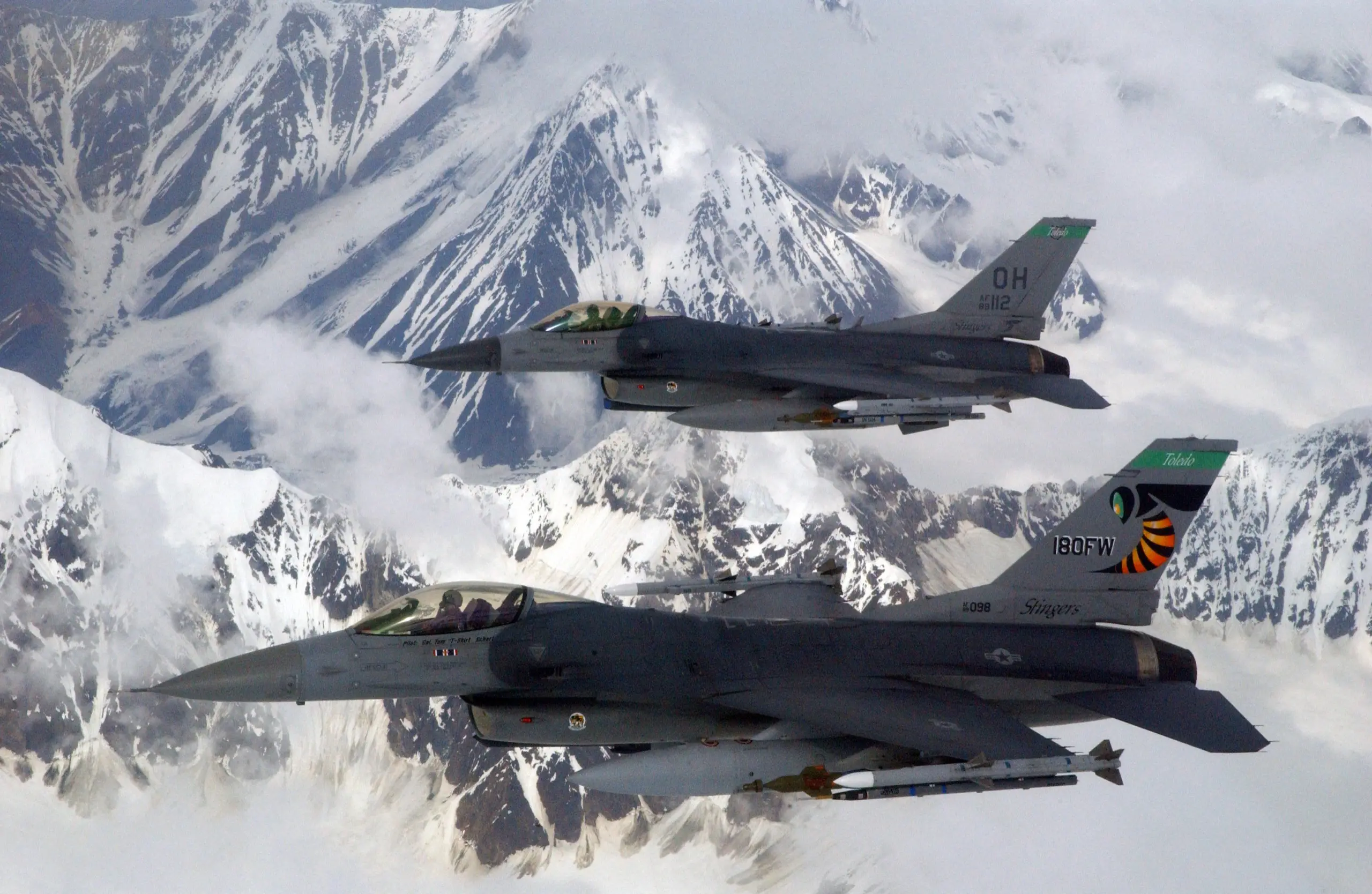
Two grey F-16C Fighting Falcons flying side by side over jagged snow-covered Alaskan mountains

Fighter · Cold War · In service

F-16 Fighting Falcon

The small fighter that took off by accident

General Dynamics → Lockheed Martin

Its accidental first flight
6minutes
Turns it can pull on a full load of internal fuel
9G
Delivered since 1978
4,600+
Still flying worldwide (2025)
~3,100

In the early 1970s the US Air Force was buying the F-15, a big and expensive fighter, and a small group of reformers, championed by the fighter pilot and theorist John Boyd, argued for something else: a light, simple, agile dogfighter that could turn harder than anything in the sky and would not cost a fortune. The argument became the Lightweight Fighter competition, and the winner was a small jet from General Dynamics in Fort Worth, Texas. It was meant to be the cheap one. It did not stay small for long, and it has become one of the most successful fighters ever built.

Its first flight was not on the schedule. During a high-speed taxi test in January 1974 the prototype began rolling from side to side on the runway, and the test pilot decided the safest place for it was in the air. The hop lasted six minutes, and it is still one of the most famous first flights in aviation.

The jet was built to pull 9 G, nine times the force of gravity, and the cockpit was laid out with that in mind. The pilot sits in a seat tilted back 30 degrees, under a bubble canopy with a nearly all-round view, and flies with a side stick and fly-by-wire controls: no cables or pushrods run to the control surfaces, only electrical signals. Pilots loved it from the first day. Within months of the Air Force choosing it, Belgium, Denmark, the Netherlands and Norway signed up together for 348 of them.

Since then more than 4,600 F-16s have been delivered, to more than two dozen countries, and around 3,100 are still flying. The F-16 fought in Desert Storm, over Bosnia and Kosovo, and above Iraq and Afghanistan. It flies with the Thunderbirds. On September 11, 2001 two of them took off from Andrews with no missiles, their pilots ready to ram a hijacked airliner, and since 2024 it has defended the skies over Ukraine.

Half a century after the accidental first flight, new F-16 Block 70s are still coming off a production line in Greenville, South Carolina, and a modified F-16 is teaching artificial intelligence how to dogfight.

Flight Zero: the first flight nobody scheduled

On 20 January 1974, at Edwards Air Force Base in California, General Dynamics test pilot Phil Oestricher climbed into the first YF-16 prototype for what the paperwork called a high-speed taxi. The run card was simple: accelerate down the runway, see how the jet handled, bring it safely to a stop. The first flight proper was not due until 2 February.

The run card did not tell the whole story. "Few people know this, but we actually intended to lift the airplane off the ground that day," Oestricher said later. The idea was a gentle hop: a few seconds of power, let the main wheels come up a little, then roll on down the runway.

As the nose came up, the left wing dropped. Oestricher fed in a correction and the little jet snapped into a rapid rocking roll. "Every time I tried to correct the oscillation, I got a full-rate roll," he explained. Two problems were working against him at once. The roll controls were far too sensitive, and the engine nozzle had been wired so that it closed as soon as the weight came off the wheels, which, in his words, "essentially doubled the thrust at idle." With the throttle pulled right back, the jet was still accelerating. A missile on the left wingtip brushed the runway, the right tailplane struck the concrete, and the prototype bounced on its main wheels, now pointing off the side of the runway.

There was no safe way left to keep it on the ground, so Oestricher pushed the power up and flew. He climbed away gently in a shallow left turn, circled wide, came back on a long, careful approach and touched down six minutes after the unplanned takeoff. Engineers had the control sensitivity fixed that same evening. Twelve days later, with a new tailplane, Oestricher flew the official first flight on schedule. His report said: "The airplane was comfortable and enjoyable to fly immediately."

He always played it down. "It's nice to sneak up on a plane," he said, "and learn as much as you can before you commit to taking off and flying it for an extended period." Fifty years later, in 2024, the Air Force's F-16 demonstration jet was repainted in the prototype's red, white and blue to mark the anniversary.

Basher 52: six days in the woods

Captain Scott O'Grady's patrol over Bosnia on 2 June 1995 was a routine one. He and his flight lead, Captain Bob Wright, were enforcing a NATO no-fly zone from Aviano Air Base in Italy. Below them, unspotted by intelligence, sat a mobile SA-6 missile battery that kept its radar switched off until the last possible moment. "I received an illumination inside my threat warning system. And now I'm looking out to see if I see any missiles being shot at us. I never saw them," O'Grady said. Two missiles came up through the clouds. One burst between the jets. The other hit O'Grady's F-16 and broke it apart.

He ejected through the flames and pulled his parachute open early, worried the fire would burn it. The descent was long, and in full view of the ground. Paramilitary soldiers were already moving toward his landing spot. He hit the ground, dumped the parachute and ran for the trees. "And within moments, we had people walking right by me," he said: a man and a boy, just a couple of metres away. He lay face down with his camouflaged gloves over his head and ears. "Thank God there were no dogs there," he later told debriefers.

He stayed hidden for six days. He slept by day under camouflage netting and moved only in the dead of night. Armed men searched nearby and he often heard gunfire. Once, cows grazed right at his feet. He ate grass, plants and ants, and when his water ran out he soaked up rainwater with a sponge. His wingman hadn't seen a parachute, so back at Aviano many feared he was dead. O'Grady stayed off the radio for days, because downed pilots who call too early are often caught.

Just after 2 a.m. on 8 June, a fellow F-16 pilot, Captain T.O. Hanford, was flying overhead, low on fuel and still listening. A voice answered his calls: Basher 52. A pilot who knew O'Grady from Aviano recognised it at once. Within hours, Marines of the 24th Marine Expeditionary Unit lifted off from the assault ship USS Kearsarge in two CH-53E Super Stallions, escorted by Cobra gunships and Harrier jets, with about 40 aircraft in the wider rescue package. Leading them in over the hills, a Cobra pilot radioed, "I see your yellow smoke."

Then O'Grady burst out of the pines with a pistol in his hand and ran for the second helicopter. "I'm ready to get the hell out of here," he said. The pickup took only minutes, but the ride home did not go quietly: shoulder-fired missiles and small-arms fire came up at the helicopters, and rounds punched into their fuselages. They made it back over the Adriatic, and O'Grady, starving after a week of bugs, wolfed down a field ration on the way. President Clinton called him "one amazing kid." O'Grady gave the credit away: "I was just doing my job."

The jet that catches you when you black out

Pull hard enough in a turn and the blood drains from your brain. Vision greys, then goes black, and then you are unconscious, still strapped into a jet in full afterburner. Pilots call it G-LOC, and the F-16, designed to turn harder than almost anything, flies right on the edge of it.

Cockpit video declassified in 2016 shows what that looks like. An Arizona Air National Guard student pilot, in a training dogfight, pulled hard enough to lose consciousness. His F-16 rolled over and plunged toward the desert, nose down at about 55 degrees, going faster and faster. His instructor called again and again: "Two, recover!" No answer. At about 2,650 metres the jet rolled wings-level and pulled out of the dive on its own, and the student woke up to a world that was the right way up.

What saved him was the Automatic Ground Collision Avoidance System, Auto GCAS, built by Lockheed Martin's Skunk Works with the Air Force Research Laboratory and NASA over nearly three decades of research. It constantly compares the jet's path with a digital map of the terrain. If a crash becomes unavoidable, it takes control at the last moment, rolls the wings level and pulls 5 G. Since it entered service in late 2014, Lockheed Martin credits it with saving at least 13 pilots.

The F-16 has also been teaching machines to fight. A heavily modified two-seater called the X-62A VISTA became the test jet for DARPA's Air Combat Evolution program. In September 2023, with an artificial intelligence agent at the controls, it flew against a human pilot in another F-16: the first AI-versus-human dogfight in real aircraft. Safety pilots sat aboard but never had to take over. The engagements built up to head-on passes where, as one Air Force test pilot put it, "we got as close as 2,000 feet at 1,200 miles per hour." In May 2024, Air Force Secretary Frank Kendall rode in the back seat while the AI flew. The jet that first flew by accident is now teaching computers to fly on purpose.

Armament

20 mm cannon
An M61A1 multibarrel Gatling gun with 500 rounds, built into the jet.
Air-to-air missiles
Up to six on the wingtips and under the wings: heat-seeking AIM-9 Sidewinders and radar-guided AIM-120 AMRAAMs. The F-16 scored the AMRAAM's first-ever kill, in 1992.
Bombs and strike weapons
A long menu of guided and unguided air-to-surface weapons. Lockheed Martin has certified the jet for more than 180 weapon and store types.
Self-defence
Flares to decoy heat-seeking missiles, plus electronic countermeasure pods to jam radars.

Missions & Moments

The Unarmed Scramble

On the morning of September 11, 2001, the pilots of the D.C. Air National Guard's 121st Fighter Squadron watched the towers burn on television at Andrews Air Force Base, just outside Washington. Then word came that a hijacked airliner, United Flight 93, might be heading for the capital. Before that morning, no armed fighters stood on alert over Washington. The squadron's F-16s were on the ramp with no missiles, carrying only a little over a hundred bullets each. Arming them would take time nobody had.

The decision was made to launch immediately. Lieutenant Heather Penney, a rookie and one of the first generation of American women fighter pilots, would fly as wingman to her commander, Col. Marc Sasseville. "It was decided that Sass and I would take off first, even though we knew we would end up having to take off before our aircraft were armed," she recalled. With nothing to shoot with, there was only one way to stop an airliner. "We wouldn't be shooting it down. We would be ramming the aircraft, because we didn't have weapons on board to be able to shoot the airplane down."

They worked out the plan while pulling on their flight gear. "As we were putting on our flight gear … Sass looked at me and said, 'I'll ram the cockpit.' And I had made the decision that I would take the tail off the aircraft," Penney said. A Boeing 757 with no nose and no tail would fall almost straight down, keeping the wreckage away from the city. Sasseville skipped his usual checks, climbed into the cockpit and went. "We didn't have any missiles and we didn't have combat loads of bullets. We were going to have to hit the airplane and disable it somehow," he said.

Both pilots thought about whether they could eject first. "I was hoping to do both at the same time," Sasseville admitted. "It probably wasn't going to work, but that's what I was hoping." Penney had decided she couldn't risk it: "You only got one chance. You don't want to eject and then miss. You've got to be able to stick with it the whole way."

The two F-16s climbed into the empty sky over Washington, hunting for a low, silent airliner. They never found it. Flight 93 was already gone. Its passengers and crew had fought back against the hijackers, and the plane had come down in a field near Shanksville, Pennsylvania. "Much later during the postmortem, I realized we took off half an hour after the passengers crashed Flight 93," Penney said. "They would have reached D.C. before we ever took off."

For ten years she barely spoke about it in public, until the tenth anniversary in 2011. Since then she has always pointed to the people on the airliner, not the jets. "Sass and I owe our lives to them," she said. The F-16 was built to win dogfights. That morning its pilots were ready to use the airplane itself as the last weapon they had.

The crews

One pilot flies the F-16. The single-seat F-16C is the fighter; the two-seat F-16D is mostly a trainer, with the student up front and the instructor behind. Nobody who flies it calls it the Fighting Falcon. To its pilots it is the Viper, and they are Viper drivers.

Fighting while lying back
Most fighter seats tilt back about 13 degrees. The F-16's tilts back 30 degrees, which makes the pilot more comfortable and more tolerant of high G.
A stick on the side
There is no control stick between the pilot's knees. A side stick beside the pilot's hand responds to pressure and sends electrical signals to the controls, which is what fly-by-wire means.
The best view in the business
The one-piece bubble canopy gives a clear view forward and upward and far more to the sides and rear than older fighters. Oestricher wrote in 1974: "The visibility is so great that it requires some time to adapt."
Show jets that can go to war
The Thunderbirds have flown F-16s since 1983. Their jets are changed so little for air shows that a Thunderbird F-16 can be made combat-ready in less than 72 hours.

Names worth knowing

  • Phil Oestricher Test pilot

    Flew the YF-16's accidental first flight in January 1974, then its official first flight twelve days later.

  • Lt. Col. Gary North First US Air Force F-16 kill

    Shot down an Iraqi MiG-25 on 27 December 1992 with an AIM-120, the missile's first kill. His F-16D was later painted in a special heritage scheme. North rose to four-star general and commanded Pacific Air Forces.

  • Capt. Robert "Wilbur" Wright Triple kill

    Shot down three Bosnian Serb J-21 Jastreb jets in one mission on 28 February 1994, the first single-mission triple kill by a US Air Force pilot since the Korean War.

  • Capt. Scott O'Grady Basher 52

    Shot down over Bosnia in 1995, he evaded capture for six days before Marines flew in to rescue him.

  • Lt. Heather Penney & Col. Marc Sasseville September 11, 2001

    Took off from Andrews with no missiles, ready to ram United Flight 93. Penney was a rookie and one of the first generation of American women fighter pilots; Sasseville later became a lieutenant general.

  • Capt. Christopher Stricklin Thunderbird 6

    When his Thunderbirds F-16 went down at an Idaho air show in 2003, he steered it away from a crowd of more than 60,000 people and ejected less than a second before impact. He walked away unhurt.

  • Nicole Malachowski Thunderbirds pilot

    The first woman ever selected to fly as a Thunderbirds pilot, in the team's F-16s.

Did You Know?

Pilots call it the Viper, not the Fighting Falcon. The nickname came from the starfighters in Battlestar Galactica, which was on TV just as the F-16 entered service.
The prototype's fly-by-wire flight controls were analog. The YF-16 flew with no flight-control software at all.
Captain Robert Wright's triple-kill jet from 1994, tail number 2137, was still deployed overseas in 2023, and his son, Captain Jett Wright, later flew it too.
The first European F-16s were not built in Texas. Belgium and the Netherlands had their own final assembly lines, with parts made in all five partner countries.
In the 1991 Gulf War, F-16s flew more sorties than any other aircraft in the coalition.
After the 2003 crash in Idaho, the Air Force noted it was only the second crash since the Thunderbirds started flying F-16s in 1982.

Timeline

  1. Jan 20, 1974

    A high-speed taxi test at Edwards Air Force Base goes wrong, and test pilot Phil Oestricher takes the YF-16 into the air to save it. The official first flight follows on February 2.

  2. Jan 13, 1975

    The YF-16 beats Northrop's YF-17 in the Air Force's Lightweight Fighter competition.

  3. 1975

    At the Paris Air Show, Belgium, Denmark, the Netherlands and Norway sign up for 348 F-16s, with assembly lines in Belgium and the Netherlands.

  4. Dec 1976

    The first single-seat F-16A flies.

  5. Jan 1979

    The first operational F-16A is delivered to the 388th Tactical Fighter Wing at Hill Air Force Base, Utah.

  6. 1983

    The Thunderbirds fly their first air show season in the F-16, the jet they still fly today.

  7. 1991

    In Desert Storm, F-16s fly more sorties than any other aircraft.

  8. Dec 27, 1992

    Lt. Col. Gary North shoots down an Iraqi MiG-25: the first air-to-air kill for a US Air Force F-16, and the first ever for the AMRAAM missile.

  9. Sep 11, 2001

    Two D.C. Air National Guard F-16s with no missiles take off to stop United Flight 93, their pilots ready to ram it.

  10. Sep 2023

    The X-62A VISTA, a modified F-16, flies the first dogfight between an AI pilot and a human in a real jet.

  11. Aug 4, 2024

    The first F-16s arrive in Ukraine, donated by European allies.

Who flies it

  • United States

    US Air Force, Air National Guard, Air Force Reserve

    The largest fleet by far. The Thunderbirds fly it too.

  • Belgium

    53

    One of the four original European partners. Belgium plans to hand all of its F-16s to Ukraine by 2029 as F-35s arrive.

  • Ukraine

    First jets arrived in August 2024, donated by European air forces. More are on the way.

  • Argentina

    Bought 24 ex-Danish F-16s; the first 12 had arrived by September 2026.

  • Slovakia

    New-build F-16 Block 70s, all 14 completed by December 2025.

  • Bulgaria

    New-build F-16 Block 70s.

Also flown by: Portugal · Greece · Turkey · Poland · Romania · Egypt · Jordan · Morocco · Iraq · Bahrain · Oman · United Arab Emirates · Pakistan · South Korea · Taiwan · Singapore · Thailand · Indonesia · Chile

Former operators: Netherlands, Denmark, Norway, Italy

Fleet figures as of October 2026; numbers change as aircraft are delivered and retired.

Where to see one today

With thousands still flying, retired Vipers are easy to find: many bases keep one by the gate. These museum jets have the best stories, several of them from the Thunderbirds.

United States· 6

  • Pima Air & Space Museum

    Tucson, Arizona

    An early two-seater, last flown by the South Carolina Air National Guard.

    78-0077F-16B
  • March Field Air Museum

    Riverside, California

    An early production jet, recovered from the desert boneyard by the museum in 2024.

    79-0365F-16A
  • Air Force Armament Museum

    Eglin AFB, Florida

    Spent its career testing weapons at Eglin.

    80-0573F-16A
  • Museum of Aviation

    Robins AFB, Georgia

    Another original Thunderbirds jet, flown by the team for a decade until 1992.

    81-0676F-16A
  • National Museum of the US Air Force

    Dayton, Ohio

    In the Cold War Gallery. One of the first F-16s the Thunderbirds received in 1982.

    81-0663F-16A · indoors
  • Hill Aerospace Museum

    Hill AFB, Utah

    Flew with the Thunderbirds from 1982 to 1991. Hill was also the first base to get operational F-16s, in 1979.

    79-0388F-16A · indoors

Want to see one fly? The US Air Force Thunderbirds and the F-16 Viper Demonstration Team perform at air shows every year, and European F-16 operators often bring theirs to shows too.

Locations last checked October 2026. Airframes occasionally move, so check with the museum before you travel.

Sources

Facts last reviewed October 2026

  1. 1. U.S. Air Force: F-16 Fighting Falcon fact sheet (specifications, design features, history, Desert Storm sorties)
  2. 2. Joe Stout, “What A Wonderful Airplane: YF-16 First Flight (Flight 0)”, Code One (Lockheed Martin)
  3. 3. Stephen Bridgewater, “Viper at 50”, Royal Aeronautical Society, January 2024
  4. 4. Lockheed Martin: F-16 Fast Facts (August 2025) and F-16 product page
  5. 5. Lockheed Martin: First flight of the F-16 Block 70 (2023)
  6. 6. Lockheed Martin: Auto GCAS
  7. 7. "Kamikaze: F-16 pilots planned to ram Flight 93", NBC News, 9 September 2011 (quoting C-SPAN and The Washington Post)
  8. 8. "Fighter pilots recall mission to take down Flight 93 on 9/11", CBS News, 2021
  9. 9. Purdue University: “Fighter pilot, a Purdue alumna, was prepared to sacrifice her life on 9/11”
  10. 10. "How six days behind enemy lines transformed Scott O'Grady", CNN, December 2015
  11. 11. "One Amazing Kid", U.S. News & World Report, June 1995 (reproduced at F-16.net)
  12. 12. UPI: Marines rescue downed U.S. pilot (8 June 1995)
  13. 13. Air Force Historical Foundation: December 27, 1992
  14. 14. The War Zone: First AIM-120 AMRAAM and U.S. F-16 kill happened 30 years ago (2022)
  15. 15. Air & Space Forces Magazine: F-16 with three air-to-air kills still flying (2023)
  16. 16. David Cenciotti, Auto-GCAS saves an unconscious F-16 pilot, The Aviationist, September 2016 (footage first published by Aviation Week)
  17. 17. DefenseScoop: AI dogfighting flight tests against a human F-16 pilot (April 2024)
  18. 18. Lockheed Martin: Secretary Kendall flies in AI-piloted X-62A VISTA (May 2024)
  19. 19. Pima Air & Space Museum: General Dynamics F-16B (the Viper nickname)
  20. 20. Hill Aerospace Museum: F-16A Fighting Falcon 79-0388
  21. 21. Museum of Aviation: F-16A 81-0676; March Field Air Museum: F-16A; Air Force Armament Museum: F-16A 80-0573
  22. 22. National Museum of the U.S. Air Force: General Dynamics F-16A Fighting Falcon
  23. 23. U.S. Air Force photo captions via Wikimedia Commons: Thunderbirds crash, Mountain Home AFB, 2003 and YF-16 anniversary livery, 2024
  24. 24. DVIDS: First woman Thunderbird pilot proud to serve
  25. 25. "Ukraine confirms F-16s have arrived in country", CNN, 4 August 2024
  26. 26. The Aviationist: Final flight of the Dutch F-16s (2024), Denmark retires its F-16 fleet (2026), Argentina receives its first six F-16s (2025) and Ukraine F-16 update (2026)
  27. 27. Air Data News: Argentina receives six more F-16s (2026) and Belgium may transfer 53 F-16s to Ukraine by 2029
  28. 28. Lockheed Martin: Production of initial F-16 Block 70 fleets for Bulgaria and Slovakia completed (December 2025)
  29. 29. Gallery photos via Wikimedia Commons (public domain, U.S. Air Force and Department of Defense)
  30. 30. Museum websites linked in “Where to see one” (checked October 2026)