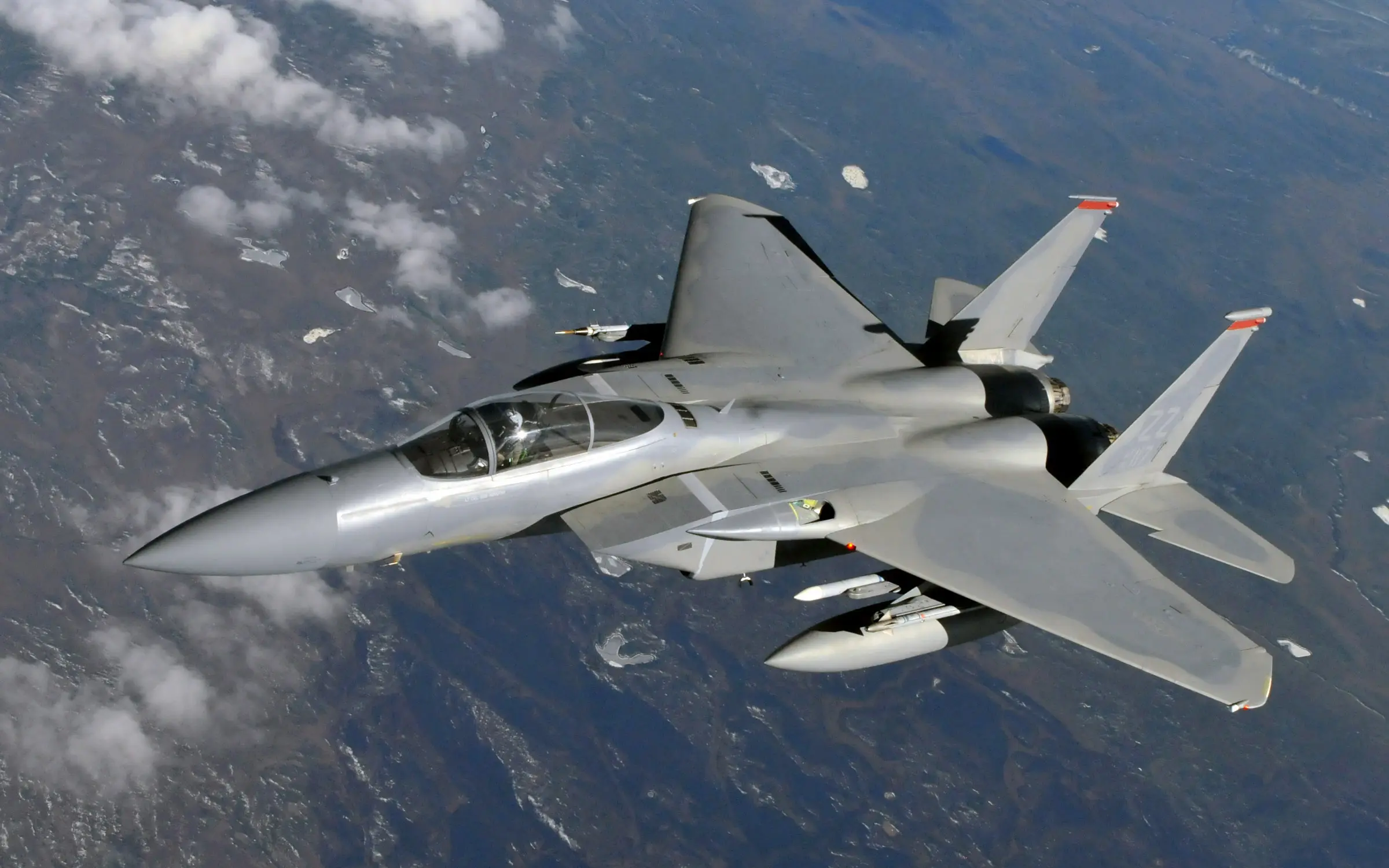
The two engines in an F-15 push harder than the whole aircraft weighs. No American fighter had managed that before, and it means a pilot can stand the Eagle on its tail, climb vertically and watch the airspeed rise rather than fall. In 1975 a stripped, unpainted example did exactly that from a standing start on a runway in North Dakota and passed 30,000 metres 3 minutes and 27.8 seconds after the brakes came off. The rest of the aircraft follows the same logic: two big engines, a wing large enough to turn hard without bleeding speed, and a radar and cockpit arranged so that one person could find an enemy and shoot without looking down.
It came out of the Vietnam years, when American fighters had been built to carry bombs and intercept bombers and had struggled against small, agile MiGs. The Air Force wanted an aircraft that did one job, air superiority, better than anything else in the world, and McDonnell Douglas delivered the first one to Edwards Air Force Base for its maiden flight on July 27, 1972. The first combat squadron, at Langley in Virginia, got its Eagles in January 1976. By 1979 the improved F-15C was going to Kadena on Okinawa, and all through the 1980s Eagles from Alaska met Soviet bombers over the Bering Sea and flew them politely home.
The war it was built for never came, but the ones it got were lopsided. In Desert Storm in 1991 the Air Force scored 37 air-to-air victories, and F-15Cs took 34 of them, starting with a MiG-29 at ten past three on the first morning. Eagles patrolled the no-fly zones over Iraq for the rest of the decade and shot down Serbian MiG-29s over Kosovo in 1999. No American Eagle has ever been lost to another aircraft. The record has a shadow, too: in April 1994 two F-15Cs over northern Iraq shot down two US Army helicopters they had taken for Iraqi ones, and 26 people died.
Along the way the pure fighter grew a second career. The two-seat F-15E Strike Eagle, with a weapon systems officer in the back, infrared pods that let it fly low at night on autopilot and the ability to carry almost any bomb in the inventory, went to war in 1991 less than two years after entering service, and it has been the Air Force’s first choice for strike work ever since, from Scud hunting in Iraq to close air support over Afghanistan. One Strike Eagle crew, called in to help a special forces team, destroyed an Iraqi helicopter with a laser-guided bomb.
More than fifty years after the first flight, the Eagle is being built again. Boeing kept the line open for export customers, and the Air Force, short of fighters as its F-15Cs aged past forty, ordered a modernised version, the F-15EX Eagle II, which first flew in 2021 and reached its first squadron in Oregon in 2024. The first examples for Japan’s Kadena Air Base left the factory in 2026. A jet that was supposed to retire years ago now has deliveries scheduled into the next decade and an airframe the Air Force expects to serve into the 2050s.