Skip to content
Early preview The vault is just opening. New files are added regularly, and some sections are still being built.
VLTARIS
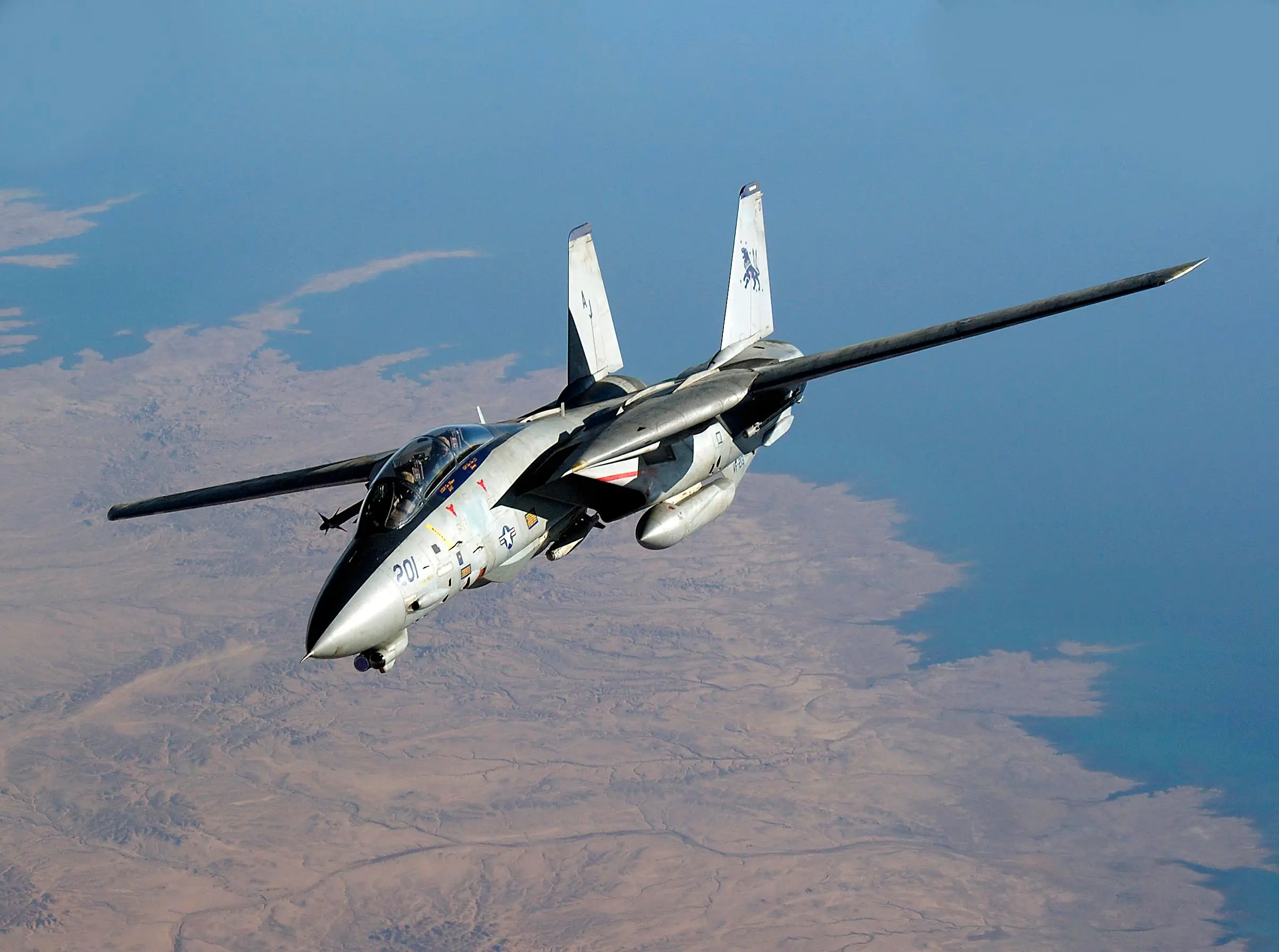
F-14D Tomcat of VF-213 in flight with wings spread, high above a desert coastline

Fighter · Cold War · Retired

F-14 Tomcat

Wings out to land, swept back to hunt

Grumman

Targets it could attack at once
6
Wing sweep, set in flight
20°–68°
Ever built
712
From first flight to farewell
36years

On the catapult a Tomcat’s wings stick straight out, 19.5 metres from tip to tip, the shape a jet needs to come down gently onto a carrier deck. By the time it has climbed away they have slid back until the whole aircraft looks like a paper dart, the shape it needs to run down bombers at more than twice the speed of sound. Most fighters settle on one shape somewhere between the two and live with the compromise. The Tomcat carried both.

The jet came out of an argument in Washington. In the 1960s the Pentagon wanted the Navy and the Air Force to share one fighter, the F-111. The Navy’s version came out far too heavy for carriers, and Vice Admiral Tom Connolly told Congress so. The project died in 1968, Grumman won the contest that replaced it, and on December 21, 1970 the first F-14 flew on Long Island. Grumman named its fighters after cats (Wildcat, Hellcat, Bearcat), and one of the inspirations for this one’s name was the admiral called Tom who had cleared the way.

The job it was built for belonged to the Cold War: protect the carrier fleet from long-range Soviet bombers, and engage them far beyond visual range. For that it carried a radar that could track 24 targets at once and the long-range AIM-54 Phoenix, which let one two-man crew attack six of those targets at the same time. The pilot flew. The radar intercept officer in the back seat ran the hunt. Between them they could hit an attacker long before it got anywhere near the ships.

That war never came. The ones that did were smaller: two Libyan fighters shot down in 1981, two more in 1989, the Gulf War, and in its last years a second career dropping laser-guided bombs over Afghanistan and Iraq. In the middle of all that, a 1986 film called Top Gun made it the most famous fighter on the planet.

The US Navy flew it for 36 years and retired it in 2006, which was not quite the end. Iran, the only country the Tomcat was ever exported to, was still flying F-14s nearly half a century after the 1979 revolution. And in museums across the United States, Tomcats sit with their wings swept back, looking fast while standing still.

Swing wings: why the Tomcat changed shape

A carrier fighter has to do two things that want different wings. Coming aboard a ship it needs to fly slowly and gently, hanging on big wings at low speed. Far out over the ocean, running down bombers at twice the speed of sound, it needs short, sharply swept ones. Grumman's answer was to stop choosing and give the aircraft both, with a way to switch between them in flight.

The outer wings pivot. For takeoff, landing and slow flight they sit out wide at 20 degrees of sweep. As speed builds they slide back, as far as 68 degrees for high-speed flight, and the jet becomes a dart. The pilot was not asked to tend this all day either. Grumman patented a system in which a digital computer reads the aircraft's speed and altitude and sets the sweep on its own.

Grumman had tried the idea once before. Its earlier XF10F Jaguar also had swing wings, and it never got past the prototype stage. The Tomcat is where the idea finally came good.

One more setting exists only for the ship. Parked on a crowded flight deck, the wings can be pushed back further than they ever go in flight, an "oversweep" that brings the span from about 19.5 m down to 10.1 m. On a carrier, where every metre of deck is argued over, that is a lot of room.

After the Navy: the shredder, the ban and the Maverick Act

When the Navy retired the Tomcat in 2006, most of the fleet flew to the military's aircraft boneyard at Davis-Monthan Air Force Base in Arizona, and by mid-2007 there were 165 Tomcats parked there. That is normally where an old warplane waits in the desert sun, quietly giving up spare parts. The Tomcat's retirement was louder than that.

The reason was Iran, the only other country flying F-14s, and very keen on spare parts. In January 2007 the Associated Press reported that middlemen for Iran, China and other countries had used gaps in the Pentagon's surplus sales to get hold of sensitive military gear, F-14 parts among it. The Pentagon froze all sales of Tomcat parts, then brought in the shredder. A contractor with a 45-tonne shear and a 54-tonne shredder cut 23 Tomcats into scrap at the boneyard, for about $900,000. The landing gear gave the machines trouble. Built from steel and titanium to take the slam onto a carrier deck, it was too tough for them and had to be cut apart by hand with a torch.

Congress went further. On January 28, 2008, President George W. Bush signed a law banning the Pentagon from selling off F-14 parts at all. A jet that had been a showpiece of American airpower was now, officially, too dangerous to sell as scrap.

Nearly two decades later the story turned again. In April 2026 the US Senate unanimously passed the Maverick Act, which lets the Navy hand three surplus Tomcats still in storage to the U.S. Space and Rocket Center in Huntsville, Alabama, free of charge and stripped of any combat capability. The bill allows the Navy to supply spare parts to "make one of the F-14D aircraft flyable", and lets nonprofit groups restore and operate the jets for airshows and commemorative events.

In October 2026 the bill was still waiting for the House of Representatives, and even if it passes, getting a Tomcat back into the air would be a long restoration job. But for a fighter the government once fed into a shredder, the chance of hearing one overhead again is quite a comeback.

Armament

AIM-54 Phoenix
The Tomcat's signature weapon. Up to six long-range missiles, built to stop bomber raids far from the carrier, and a crew could attack six targets at once at ranges of more than 140 km.
AIM-7 Sparrow
Radar-guided, medium range. Three were fired in the opening moments of the 1989 fight with Libyan MiG-23s, and one of them found its MiG.
AIM-9 Sidewinder
Heat-seeking, for close range. In 1989 a Sidewinder finished off the second Libyan MiG-23.
M61 20 mm cannon
A six-barrel rotary cannon in the nose, for when a fight got too close for missiles.
Bombs and pods
In its later years it took on ground attack: Mk 80-series bombs, laser-guided bombs and JDAM, aimed with a LANTIRN targeting pod. With the TARPS pod it doubled as the fleet's reconnaissance jet.

Missions & Moments

Two Floggers Splashed

January 4, 1989, just before noon over the Mediterranean. Two F-14A Tomcats of Fighter Squadron 32, the "Swordsmen", are flying a routine combat air patrol for the carrier USS John F. Kennedy, more than 100 km off the Libyan coast. Then two contacts appear on the radar: Libyan MiG-23 Floggers, just airborne from Al Bumbaw airfield near Tobruk and heading their way.

The usual pattern was well known on both sides. A Tomcat locked its powerful radar onto a Libyan jet, and the Libyan jet turned for home. This pair did not. The Tomcats turned away to avoid a fight, and the MiGs turned back toward them. They turned away again. The MiGs followed again. After the fifth time, a voice from the lead Tomcat was recorded on tape: "Bogies have jinked back at me again for the fifth time. They're on my nose now, inside of 20 miles."

That was enough. "Master arm on," came the call. "Master arm on." The weapons were live. At "Fourteen miles. Fox 1. Fox 1" the lead fired a Sparrow missile, then a second one. Neither hit. By now the MiGs were close enough to see, and the second Tomcat fired its own Sparrow. "OK, he's got a missile off," the lead's backseater reported. Then: "Good hit. Good hit on 1." "Roger that. Good kill. Good kill." One MiG was gone.

The second MiG was still coming. The lead Tomcat swung in behind it for a heat-seeking Sidewinder shot, and for a few seconds the tape is nothing but a crew fighting for a missile lock: "Shoot him." "I don't got a tone." Finally the tone came, the Sidewinder flew, and it exploded in the MiG's tailpipe. "Good kill. Good kill." Then: "We're showing two chutes in the air here." Both Libyan pilots had ejected.

The whole fight took less than eight minutes from first contact. The call back to the carrier was calm: "Roger. Two Floggers. Two Floggers splashed. We're heading north." The four men in those two cockpits were Cmdr. Joseph Connelly, Cmdr. Leo Enwright, Lt. Herman Cook III and Lt. Cmdr. Steven Collins.

Libya insisted its jets had been "unarmed, on routine reconnaissance, ordinary flying." The Pentagon answered by releasing the cockpit tapes and photos showing missiles on at least one MiG. President Reagan put it simply: "Our pilots acted completely in self-defense."

The Tomcat whose Sparrow hit, side number AC207, still exists. Rebuilt in the 1990s as an F-14D(R), it stands today in the Smithsonian's Udvar-Hazy Center outside Washington, D.C. You can walk right up to it.

The crews

Two seats, one behind the other. The pilot sat up front. Behind him sat the radar intercept officer, the RIO, who ran the big radar and the weapons. Navigation, finding targets, jamming and firing were split between the two, so a Tomcat crew worked as a team in a way single-seat pilots never had to. One 1986 film introduced them to the rest of the world.

The office in the back
From the rear seat, the RIO could track 24 targets at once, at more than 300 km, and attack six of them. The pilot flew; the RIO hunted.
Hollywood's favourite
Top Gun (1986) made the F-14 perhaps the most widely recognised Navy fighter ever. The National Naval Aviation Museum went looking for a Tomcat to display right after the film's success.
Hard work on deck
The Tomcat was a handful to keep flying. Its last squadron commander put it at about three to four times more maintenance hours per flight hour than the newer Hornet, one big reason the Navy retired it.
Thrown off a ship, over and over
The F-14A now at Seattle's Museum of Flight retired in 2001 after 1,188 catapult launches and almost 5,000 flight hours.

Names worth knowing

  • Connelly, Enwright, Cook & Collins VF-32, January 1989

    The four crew members who shot down two Libyan MiG-23s over the Mediterranean. One of their jets is now in the Smithsonian.

  • David Venlet RIO, Gulf of Sidra 1981

    Flew as a VF-41 backseater in the 1981 Gulf of Sidra fight, the day the Tomcat scored its first kills. Decades later, as a vice admiral, he took charge of the F-35 program.

  • Capt. William G. Sizemore II The last combat landing

    Flew the Tomcat's final combat mission, landing F-14D 161159 on USS Theodore Roosevelt on February 8, 2006. That jet is now in the National Naval Aviation Museum.

  • Cmdr. Richard LaBranche Last Tomcat squadron commander

    Led VF-31 "Tomcatters" home from the last Tomcat war cruise in 2006: “Saying good bye to the Tomcat will be like saying good bye to an old friend.”

  • Lt. Cmdr. Chris Richard & Lt. Mike Petronis The farewell flight

    Flew F-14D 163902 in the Navy's retirement ceremony at Oceana in September 2006.

  • Capt. Dale Snodgrass More Tomcat hours than anyone

    Flew Tomcats for nearly 25 years and logged more than 4,800 hours in them, more than any other pilot. He once ferried a brand-new F-14 nonstop from the United States to Iran. His verdict: “It was the biggest, the fastest, the coolest.” And: “It had presence.”

Did You Know?

The Tomcat's first operational job wasn't a dogfight. In 1975 it flew protective patrols over the evacuation of Saigon, and no enemy fighter ever showed up.
The US Marine Corps nearly had Tomcats too. A Marine squadron was set to stand up in 1974, until the Corps decided to keep its Phantoms instead.
When two Tomcats downed two Libyan Su-22s in 1981, it was the first time a swing-wing jet shot down another swing-wing jet. The Su-22 could sweep its wings too.
On deck its wings could be pushed back beyond their flying limit, shrinking the span from 19.5 m to 10.1 m, just to save parking space on the carrier.
One reason the Navy retired it was sheer effort: it needed three to four times more maintenance hours per flight hour than the Hornet that replaced it.
The very last US Navy Tomcat flight, on October 4, 2006, ended on Long Island, a short hop from the Grumman factories where Tomcats were built.

Myth vs. fact

Myth

Top Gun sent Navy recruiting up by 500%.

Fact

A favourite statistic that does not survive a look at the numbers. An Australian Associated Press fact check using the Navy's own recruiting data found enlistments rose by about 8% in the year the film came out (94,878 recruits against 87,593 the year before), while the number of trained naval aviators grew by 14% over four years. The film really did spark huge interest, though: some cinemas even let recruiters set up tables in their lobbies.

Myth

Tom Cruise flew the Tomcat in Top Gun.

Fact

Navy pilots did the flying. One of them, Scott Altman (call sign "Scooter"), stood in for Maverick in the aerobatic sequences, and by his own count he got to "buzz the tower" nine times. Altman later became a NASA astronaut and commanded the final Space Shuttle mission to repair the Hubble Space Telescope in 2009.

Timeline

  1. Apr 1968

    The Navy's version of the F-111 is cancelled as too heavy for carriers. A new fighter contest follows, and Grumman wins it.

  2. Dec 21, 1970

    The first F-14 flies on Long Island, New York, near the Grumman plant that built it.

  3. Jun 1972

    The first F-14As are delivered to the Navy. Fighter Squadron 124 starts training the crews.

  4. Sep 1974

    The Tomcat enters operational service with the fleet.

  5. Apr 1975

    Tomcats fly protective patrols over the final evacuation of Saigon. No enemy fighters come up to meet them.

  6. Aug 19, 1981

    First combat: two Tomcats of VF-41 shoot down two Libyan Su-22s over the Gulf of Sidra.

  7. Nov 1987

    The F-14B arrives, with new General Electric F110 engines.

  8. Jan 4, 1989

    Two VF-32 Tomcats shoot down two Libyan MiG-23s near Tobruk. One of the pair now sits in the Smithsonian.

  9. Feb 8, 2006

    The last Tomcat combat mission ends with a landing on USS Theodore Roosevelt after a sortie over Iraq.

  10. Sep 22, 2006

    After 36 years, the Navy retires the F-14 at a final flight ceremony at Naval Air Station Oceana, Virginia.

  11. Oct 4, 2006

    The last US Navy Tomcat flight: F-14D 164603 flies from Oceana to Republic Airport on Long Island, a short hop from where Tomcats were built.

Who flies it

  • Iran

    The only export customer, supplied before the 1979 revolution. How many (if any) Iran still flies is not publicly known.

Former operators: United States

Fleet figures as of October 2026; numbers change as aircraft are delivered and retired.

Where to see one today

Seeing a Tomcat today means visiting a museum. These are the ones we confirmed on the museums' own websites, with Bureau Numbers (the Navy's tail numbers) for the spotters.

United States· 7

  • National Naval Aviation Museum

    NAS Pensacola, Florida

    Flew the last Tomcat combat mission in 2006, the last of its 224 combat sorties. The museum is on an active base, so check visitor access first.

    161159F-14D
  • National Naval Aviation Museum

    NAS Pensacola, Florida

    The fifth Tomcat built, on a pedestal at the entrance with its nose pointed at the sky. It was the first F-14 ever put on public display.

    157984F-14A · outdoors
  • Cradle of Aviation Museum

    Garden City, New York

    The third Tomcat built, a test aircraft, displayed a short drive from where it was made.

    157982F-14A
  • Hickory Aviation Museum

    Hickory, North Carolina

    Flew in the Navy's Tomcat retirement ceremony at Oceana in 2006.

    163902F-14D
  • Midland Army Air Field Museum (CAF High Sky Wing)

    Midland, Texas

    The only surviving jet from the Tomcat's first fight, over the Gulf of Sidra in 1981. Restored by volunteers in 2016; check opening times before you go.

    160403F-14A "Fast Eagle 102"
  • Smithsonian Udvar-Hazy Center

    Chantilly, Virginia

    As side number AC207 it shot down a Libyan MiG-23 on January 4, 1989. The real thing.

    159610F-14D(R) · indoors
  • The Museum of Flight

    Seattle, Washington

    Served with six squadrons, including the "Jolly Rogers", and logged 1,188 catapult launches. In the Aviation Pavilion.

    160382F-14A

Many more Tomcats guard museum entrances and base gates across the United States. Check a museum's website before you go: airframes do move.

Locations last checked October 2026. Airframes occasionally move, so check with the museum before you travel.

On screen

Where the F-14 Tomcat became a star outside the hangar.

  • Film · 1980

    The Final Countdown

    The carrier USS Nimitz sails through a time storm to the day before Pearl Harbor, and its Tomcats end up dogfighting Japanese Zeros. The Navy backed the film, the F-14s are real, and many wear the skull and crossbones of the VF-84 "Jolly Rogers".

  • Film · 1986

    Top Gun

    The film that made the Tomcat famous far beyond the Navy. The Navy lent the production two aircraft carriers, several bases and real F-14 crews, while Paramount paid for every flight hour of the aerial scenes.

  • Film · 2022

    Top Gun: Maverick

    Maverick and Rooster steal an old F-14 from an enemy base and fly it home. The "stolen" Tomcat was a real, engineless museum jet (BuNo 159631) from the San Diego Air & Space Museum, trucked to Lake Tahoe and towed for the taxiing shots.

Find it in

Sources

Facts last reviewed October 2026

  1. 1. Smithsonian National Air and Space Museum: Grumman F-14D(R) Tomcat, BuNo 159610 (missions, armament, 1989 engagement)
  2. 2. Naval History and Heritage Command, National Naval Aviation Museum: F-14A Tomcat (history and specifications)
  3. 3. Naval History and Heritage Command, National Naval Aviation Museum: F-14D Tomcat, BuNo 161159 (Phoenix and radar, Saigon, last combat mission, specifications)
  4. 4. Naval History and Heritage Command: Naval Aviation 2000–2010 and Today in History: September 22 (retirement and last flight)
  5. 5. National Naval Aviation Museum: “New Look for Museum's Iconic F-14 Tomcat” (BuNo 157984, Connolly and the name)
  6. 6. National Naval Aviation Museum: “Tomcats Battle Floggers” (1989 crews)
  7. 7. Deseret News, “U.S. releases video, audiotape of dogfight”, January 6, 1989 (cockpit tape transcript, Reagan and Libyan statements)
  8. 8. UPI, Pentagon briefing on the Libyan MiG-23 shootdown, January 5, 1989 (timing and distance)
  9. 9. DVIDS / American Forces Press Service: “Squadron Homecoming Marks End of Era for Tomcats” (2006)
  10. 10. NASA Technical Memorandum 81972: Limited Evaluation of an F-14A Airplane Utilizing an Aileron-Rudder Interconnect Control System (1981; wing sweep range)
  11. 11. Grumman Aerospace (R. W. Kress & M. C. Stettler): US Patent 3,940,094, “Wing sweep control system” (1976)
  12. 12. Cradle of Aviation Museum: Grumman F-14A Tomcat, BuNo 157982 (first flight, production totals)
  13. 13. The Museum of Flight: Grumman F-14A Tomcat, BuNo 160382
  14. 14. Hickory Aviation Museum: Grumman F-14D Tomcat, BuNo 163902
  15. 15. Grissom Air Museum: F-14B Tomcat (F-14D procurement)
  16. 16. CAF High Sky Wing: Restoration of Fast Eagle 102 (BuNo 160403, the 1981 engagement)
  17. 17. U.S. House Armed Services Committee: Biography of Vice Adm. David J. Venlet (Ret.) (2014)
  18. 18. Associated Press via Deseret News: “U.S. to shred F-14s, deny Iran any parts”, July 3, 2007 (boneyard, shredding, Dale Snodgrass)
  19. 19. CBS News / Associated Press: “Shredding F-14s To Keep Parts From Iran”, July 2, 2007
  20. 20. Aero-News Network: “President Signs Bill Outlawing Sale Of F-14 Parts”, January 29, 2008
  21. 21. U.S. Congress: S. 4161, Maverick Act (text as passed by the Senate) and bill status (passed Senate April 28, 2026; held at the desk in the House since May 4, 2026, checked October 2026)
  22. 22. AAP FactCheck: “Maverick Top Gun stat turns out to be a real goose”, June 14, 2022 (recruiting figures from U.S. Navy Recruiting Command)
  23. 23. American Homefront Project (WUNC): “1986's 'Top Gun' Led To A Military Recruiting Boom”, August 17, 2020 (Navy support for filming, recruiters in cinemas)
  24. 24. NASA: “Two Space Explorers Inducted into U.S. Astronaut Hall of Fame” (Scott Altman, Top Gun and STS-125)
  25. 25. University of Illinois Alumni Association: “Alumni Interview: Scott Altman”, July 2, 2019
  26. 26. Military.com: “How the Navy Stole the Show In a Movie About the USS Nimitz Going Back in Time to 1941”, July 28, 2021
  27. 27. The Aviationist: “Tomcat vs Zero: When The F-14 Of The 'Jolly Rogers' Flew To Hollywood”, October 25, 2012
  28. 28. San Diego Air & Space Museum: “Work Underway to Feature Iconic Tomcat in front of the San Diego Air & Space Museum” (2023)
  29. 29. The War Zone: “Photos Show F-14 Used In Top Gun 2 Production Snared In Carrier's Crash Barricade”, February 15, 2019
  30. 30. Vintage Aviation News: “San Diego Air and Space Museum to Move F-14A Tomcat to Balboa Park”, November 7, 2025 (BuNo 159631, Lake Tahoe, towed for taxiing)
  31. 31. Museum websites linked in “Where to see one today” (checked October 2026)