Skip to content
Early preview The vault is just opening. New files are added regularly, and some sections are still being built.
VLTARIS
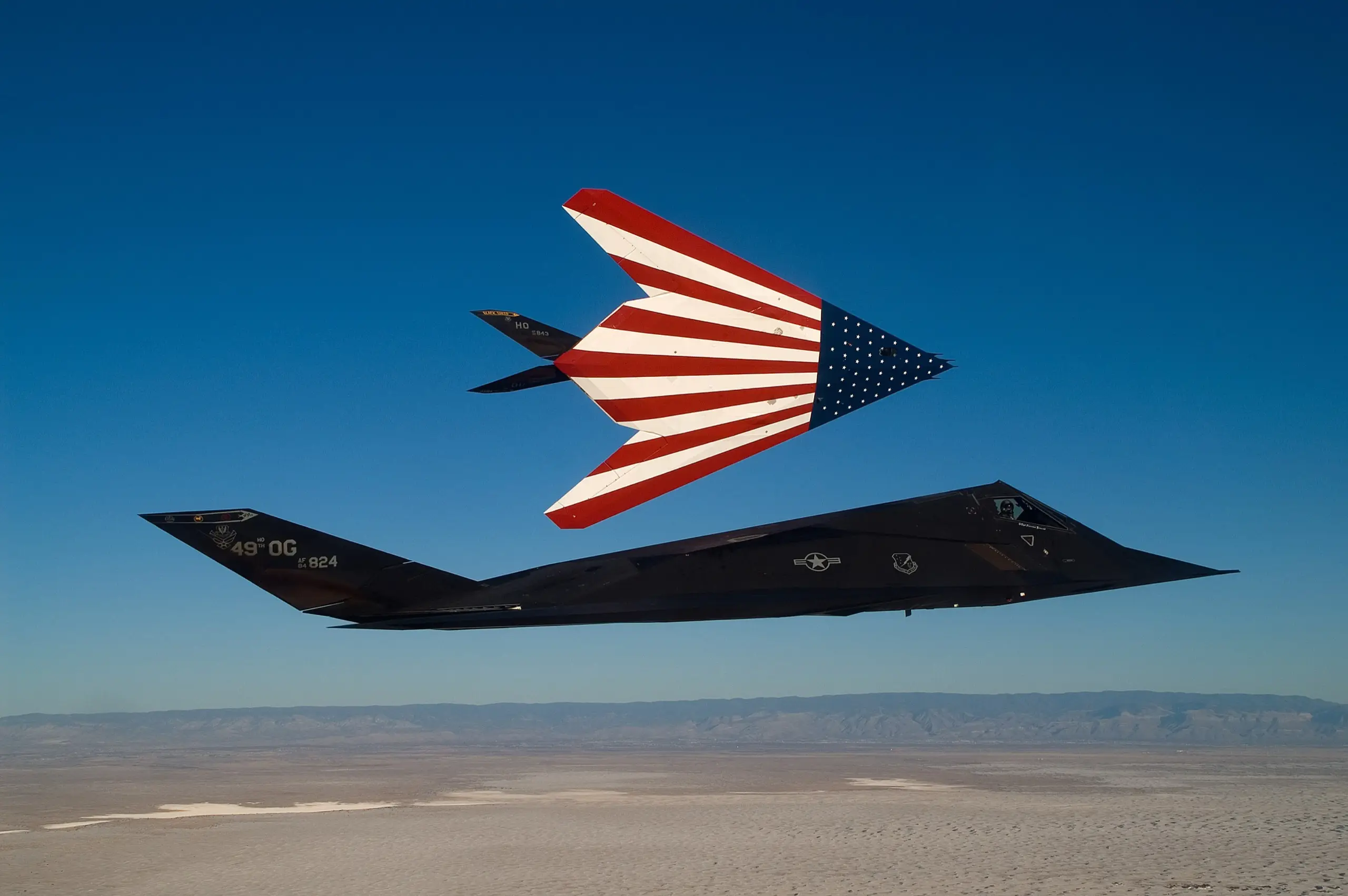
An all-black F-117 Nighthawk flying low over a desert below a second F-117 painted as an American flag

Attack · Cold War · Retired

F-117 Nighthawk

Seven years in the dark before anyone saw it

Lockheed Skunk Works

Of Desert Storm's first-day targets, from 2.5% of the attack jets
31%
Operational before its first public appearance
7years
Lost in combat, and its pilot was rescued
1
Planned to keep flying until at least
2034

There is not a curve on it. Every surface of the F-117 is a flat panel set at an angle, so that the whole jet looks like something folded out of black paper, a cut diamond with wings. That was maths, not style. The computers of the 1970s could work out how radar bounced off a flat plate but not off a curve, so Lockheed’s Skunk Works built the first stealth aircraft entirely out of shapes it could calculate. Each facet throws radar waves away into the sky instead of back to the set that sent them, and on an enemy screen the jet showed up, if at all, as a faint blip that would not stay put.

It first flew in 1981 and was ready for war by 1983, and for years afterwards the Air Force would not admit it existed. The fleet lived at a hidden base in the Nevada desert and flew only after dark, and the pilots who flew it couldn’t tell their own families what they did at work. The public did not see one up close until 1990.

The “F” in the name promises a fighter. The Nighthawk had no radar, no gun and no way to fight another plane. It was a precision bomber with a pair of bombs tucked inside, and its whole defence was not being seen. On the first night of Desert Storm in 1991 that was enough: F-117s flew alone over downtown Baghdad, the most heavily defended airspace on Earth, and every one came home.

Only one was ever lost to enemy fire, over Serbia in 1999, and the rescue of its pilot before dawn is told further down this page. Lockheed built 64 in all, five test aircraft and 59 production jets. Every stealth aircraft since, from the B-2 bomber to the F-22 and F-35, owes something to this odd black arrowhead.

The Air Force officially retired the F-117 in 2008. As of 2026 a small fleet is still flying, playing the enemy in training and testing new sensors, with plans to keep it going until at least 2034. It still goes to work over Nevada after sunset.

The Hopeless Diamond

Radar-guided surface-to-air missiles had taken a heavy toll on American aircraft over Vietnam, and by the early 1970s the Soviet Union was pouring money into an air defence wall that NATO jets might not survive. Planners worked through the loss rates and concluded that, in a European war, the US Air Force could run out of aircraft within about two weeks. In 1975 the Pentagon's research agency, DARPA, asked industry for something different: an aircraft the enemy simply couldn't track.

The answer came from Moscow. A Lockheed engineer named Denys Overholser found a little-known paper by the Soviet physicist Pyotr Ufimtsev that explained how to calculate the way radar waves bounce off flat surfaces. With a small team, Overholser turned it into a computer program called Echo. The computers of the day couldn't handle curves, but they could handle flat panels, so designer Bill Schroeder drew an aircraft made of nothing but flat facets, like a cut gemstone, each one angled to fling radar energy away from the receiver instead of back to it.

Kelly Johnson, the Skunk Works' own legend, didn't like the look of it, and doubters inside Lockheed nicknamed it the "Hopeless Diamond." Ben Rich, the new Skunk Works boss, backed it anyway. Then came the tests. As the F-117 Stealth Fighter Association tells it, a wooden model on a pole at a desert radar range was so hard to see that the operators couldn't find it at all, until a bird landed on top of it. The radar was picking up the bird. At the decisive test against Northrop's design at White Sands, the Lockheed model reflected less radar energy than the pole it was mounted on, so the team had to build a stealthier pole.

Two small, flyable test jets called Have Blue followed in 1977, hidden away at Groom Lake in Nevada. Both eventually crashed, one after a hard landing and the other after an in-flight fire, and both pilots survived. Neither accident had anything to do with stealth, and the data they gathered won Lockheed the contract for the real thing. To build it fast, the Skunk Works raided other aircraft for parts: flight controls based on the F-16's, engines from the Navy's F/A-18, the B-52's navigation system, and brakes from a Gulfstream business jet. "It is an odd-looking flying machine," Ben Rich said, "but we got it operational in record time."

Creatures of the night: the secret years at Tonopah

Tonopah is a remote airfield in the Nevada desert, and for most of the 1980s the F-117 fleet lived there and came out only after dark. Every new jet arrived the same way: at night, in the cargo hold of a giant C-5 transport. Early on, the working day often didn't begin until an hour after sunset.

The people who flew and fixed it lived double lives. Once a week, pilots and maintainers living near Nellis Air Force Base said goodbye to their families, boarded a contract airliner and vanished to Tonopah. Four days later they came home, and they could not say where they had been or what they had done. "They could never tell their families what they were doing," recalled former Air Force Chief of Staff Gen. David Goldfein. "The level of secrecy was so high that if they … ever divulged the secret, the penalty was very severe … it was Manhattan Project-like security."

There were two cover stories, one inside the other. The unit flew A-7 Corsairs as a visible cover and told outsiders it did night-time avionics testing. If anyone ever glimpsed a strange black shape, a second, deeper cover was ready: a top-secret program that flew acquired Soviet-type jets. "I think it's the only program in history that had a top-secret program as its cover," Goldfein said.

The secret held for years. When the Pentagon admitted in November 1988 that the jet existed, it released one grainy photo that was deliberately misleading, and most experts who tried to work out the shape from that picture got it badly wrong. On 21 April 1990, two F-117s flew into Nellis and taxied up to a crowd. It was the first time anyone outside the program, including the crews' own families, had seen the jet up close. Daylight changed life for the pilots too. As their wing commander, Col. Tony Tolin, put it: "It is a lot easier, especially on your first ride in a single-seat airplane, if you can see outside."

First night over Iraq

At 3 a.m. Baghdad time on 17 January 1991, Desert Storm was due to begin. Nobody, the pilots included, knew for certain whether stealth would work against Iraq's Soviet-built air defences. "We trusted the engineers," Maj. Greg Feest said years later. "We were briefed: Here's your signature against these types of SAMs, here's your signature against AAA. But you know, we couldn't verify anything."

Feest was flying the lead jet out of Khamis Mushayt, a mountain base in Saudi Arabia. His target was an air defence command bunker at a desert town called Nukhayb, a key link between Iraq's border radars and Baghdad. Minutes before H-hour, while Apache helicopters were knocking out radar sites along the border, he put the crosshairs on the bunker roof and released a 900 kg laser-guided bomb. "I saw the bomb go in," he said. "I saw it penetrate. Then the explosion came out the hole the bomb had made, and then the doors blew off the bunker. I knew I had knocked out the target." It was the first bomb of the war. Feest had also dropped the F-117's first bomb in Panama, 13 months earlier.

Then the sky lit up. The anti-aircraft fire was so heavy that Feest worried the glow alone would show his black jet to the gunners. "I actually thought I was going to get shot down," he admitted. "Flying that first night, after seeing what we had to fly through, we all thought we would probably never make it home." Every F-117 came back. The Iraqi gunners had been firing blind, into the dark.

The official Gulf War Air Power Survey put numbers on that night. The F-117s made up 2.5 percent of the attack aircraft on the first day and hit 31 percent of the targets. They were the only coalition jets sent against the heavily defended heart of downtown Baghdad. A non-stealthy strike that same night needed 41 aircraft, most of them escorts and jammers, to get eight bombers to one target. Every F-117 was a bomber, and it brought two bombs. Maj. Robert Eskridge described what it was like leaving a target over Baghdad: "Nobody has ever been able to egress a target fast enough. Nobody. Ever."

Retired, but not gone

The F-117 was officially retired on 22 April 2008. The last four jets flew from Holloman Air Force Base to the Skunk Works at Palmdale, where the airplane was born, for a farewell so secretive that only people who had worked on the program could attend. Then they flew on to Tonopah, the hidden base where it had all begun, and were put into recallable storage.

Then they kept flying. Photographers started catching F-117s on low-level training routes in Nevada and California. In 2021 they flew mock dogfights against California Air National Guard F-15s. In May 2023, Air Force photographers shot them landing in Alaska for the big Northern Edge exercise. In September 2025, two were spotted refuelling from a KC-46, a tanker that didn't exist when the Nighthawk retired.

A "retired" jet stays in the air because real stealth aircraft to practise against are rare. The F-117s play the enemy in exercises, teaching pilots to find and fight stealthy opponents, and they serve as flying test beds for new radars and sensors. As of 2026, the Air Force plans to keep them flying for test and training through at least 2034. In 2023 about 45 airframes were still in flying or restorable condition, with two or three a year being demilitarised as the fleet slowly winds down.

Some of the retirees have found new homes in museums. In October 2026, F-117A 85-0818, "The Overachiever", the only Nighthawk to fly combat in all four of the type's wars, crossed the country inside a C-5 to join the Smithsonian's national collection, under the same roof as the SR-71 Blackbird and the Space Shuttle Discovery.

Armament

Two internal bomb bays
Everything rides inside, because a bomb hanging under a wing lights up on radar. The usual load was two 900 kg-class bombs, one per bay, about 2,270 kg of weapons in all.
GBU-27 laser-guided bomb
A laser-guided, hardened-steel penetrator developed specifically for the F-117, able to punch through more than 1.8 m of reinforced concrete. In the Gulf War, only F-117s carried it.
GPS-guided bombs
Desert Storm showed that lasers struggle with clouds and smoke, so later upgrades let the Nighthawk carry satellite-guided bombs as well.
Nothing else
No gun, no air-to-air missiles, and no radar of its own. The F-117 had no way to fight another aircraft. Its only defence was not being seen.

Missions & Moments

Vega 31: the night stealth was shot down

27 March 1999, the fourth night of NATO's air war over Serbia. Lt. Col. Dale Zelko, call sign Vega 31, has just put two bombs on a target near Belgrade and turned for home, back to Aviano in northern Italy. Then his warning systems show that Serbian air defences have found him. The F-117 is no dogfighter, so all Zelko can do is watch and press on. Missiles explode around the jet, so bright that he closes his eyes, and the aircraft pitches and rolls violently. The "invisible" airplane has been hit. He pulls the ejection handles.

Hanging under his parachute in the moonlight, with the lights of Belgrade off to his right, his first thought is of home: "My mom is not going to be happy with me." His second is cold and clear. Capturing the pilot of a stealth fighter would be a propaganda gift, and he is not going to give it to them. On his survival radio he calls: "Mayday, mayday, mayday, Vega 31." Then he lands in a ploughed field about 30 km west of Belgrade, hides his parachute, moves to a hiding spot he picked out on the way down and smears Serbian mud over his face. Tucked inside his T-shirt, over his heart, is a folded American flag. It belongs to the young airman who prepared the target folder for this mission.

Within minutes, a rescue machine is spinning up across the region. A-10s take off from Aviano as on-scene commanders, call sign Sandy. Two MH-53 helicopters and an MH-60G Pave Hawk, packed with pararescuemen, launch from Tuzla, in Bosnia. It goes wrong in all the usual ways: the first position report puts Zelko far from where he really is, the A-10s and helicopters are given different radio frequencies, and everyone runs low on fuel. Meanwhile, around 80 Serbian soldiers and police comb the fields. They find his ejection seat. They find his boot prints.

Then low cloud fills the valley, and the A-10 pilot overhead, Capt. John Cherrey, can no longer see the ground. Committing the helicopters is his call, so he asks the only person who knows. "Vega 31, is it OK to come in there?" Silence. Zelko has no idea how close the searchers are. "Vega 31, if you don't answer, we're going to have to not do this now and come back later." A beat. "Let's go for it."

The helicopters slip in at treetop height through the dark. One crewman spots power lines just in time, and the formation leaps over them. Missile sites wake up around them, and an F-16 above fires an anti-radiation missile to silence one. Over the field, Capt. James Cardoso in the lead MH-53 can see enemy vehicles on the roads, but not Zelko's signal, which isn't working. "Just give me any … signal," he barks. Zelko lights a flare. The whole field blazes up. "It was like the sun coming up in my goggles," said Pave Hawk pilot Capt. Chad Franks, who drops steeply and lands about 30 metres from the survivor.

Two pararescuemen, Staff Sgt. Eric Giacchino and Senior Airman John Jordan, run out with rifles ready. Zelko is kneeling, hands raised, exactly as trained. "How ya doin', sir?" one of them says. "We are here to take you home." The Pave Hawk is on the ground for 40 seconds. Serbian vehicles are about 45 metres away as it lifts off. One of the helicopter's pilots turns out to be a former cadet of Zelko's from the Air Force Academy. At sunrise, back at Aviano, there is one thing Zelko insists on doing before he sleeps. He gives the young airman back her flag.

The story has a second ending. In 2011, twelve years after their first meeting on a radar screen, Zelko sat down face to face with Zoltán Dani, the Yugoslav missile officer who had shot him down. They met as civilians and as friends, a reunion told in the documentary The Second Meeting.

The crews

Everyone in the F-117 wing was a volunteer, screened before a three-year tour. Pilots needed at least 1,000 flying hours before they could even apply. They flew alone, mostly at night, on long single-ship missions with the radios silent. Officially the jet had no nickname at first. Crews used "Nighthawk", but pilots preferred "the Black Jet."

No two-seaters
There was never a two-seat F-117 for training, so a new pilot's first flight was solo. "We don't have any two-seat F-117s," said wing commander Col. Tony Tolin, "so if you can fly the simulator, you can fly the aircraft."
The tip of a spear
The faceted nose falls away so steeply that from the cockpit you barely see the aircraft at all. "It's like riding on the tip of a spear," said F-117 pilot Capt. Philip McDaniel.
Meet Elvira
Pilots planned every route with a computer program and threat database they nicknamed "Elvira". It knew the world's air defence radars and worked out the angles and headings that kept the jet hardest to see.
Where "Nighthawk" came from
The name began with the secret unit's first patch, around 1980. A unit member picked "nighthawks", and the intelligence sergeant drew the bird from a picture in a dictionary, adding a ruby eye for the jet's laser.

Names worth knowing

  • Ben Rich Skunk Works chief

    Took over Lockheed's Skunk Works from Kelly Johnson in 1975 and bet the department on the "Hopeless Diamond" when even Johnson didn't like it. His team shared the 1989 Collier Trophy for the F-117.

  • Denys Overholser The radar maths

    The Lockheed engineer who found a Soviet physicist's paper on radar reflections and turned it into Echo, the program that made stealth shapes predictable.

  • Maj. Greg Feest Two firsts

    Dropped the F-117's first bomb in Panama in 1989 and the first bomb of Desert Storm in 1991. He later retired as a major general.

  • Lt. Col. Dale Zelko Vega 31

    The only F-117 pilot ever shot down. He evaded capture in a Serbian farm field until rescuers reached him, and years later became friends with the missile officer who had shot him down.

Did You Know?

The maths behind the F-117's shape came from a Soviet physicist, Pyotr Ufimtsev. Lockheed used his work on radar reflections to design the jet built to slip through Soviet air defences.
Every F-117 was delivered to its base the same way: at night, inside the cargo hold of a C-5.
To save time, it was built partly from other aircraft: F-16-based flight controls, F/A-18 engines, a B-52's navigation system and brakes from a Gulfstream business jet.
Its radar cross section, how big it looks on an enemy screen, has been likened to a hummingbird.
The dictionary that inspired the Nighthawk patch noted the bird's other name, goatsucker. The F-117 training unit promptly adopted it.
The canopy of Vega 31, displayed in a Belgrade museum, carries the name of a different pilot, Capt. Ken "Wiz" Dwelle. Dale Zelko just happened to be flying that jet that night.

Myth vs. fact

Myth

The F-117 was invisible to radar.

Fact

It was never invisible, and the Air Force never claimed it was. The official term is low observable: the jet was designed to be seen only fleetingly, too briefly and too faintly to be tracked and shot at. Desert Storm pilots knew some radars could spot them up close and planned their routes to keep that time short. In 1999, Serbian air defences made the point by shooting one down.

Myth

It was a fighter. The "F" says so.

Fact

Despite the "F" and the "Stealth Fighter" nickname, it had no radar, no gun and no air-to-air weapons, and could not fight another aircraft at all. It was a precision bomber that carried two bombs and relied entirely on not being seen.

Myth

Its pilots called it the "Wobbly Goblin" because it was hard to fly.

Fact

Outsiders coined that name (also spelled "Wobblin' Goblin"), assuming the faceted jet must handle badly. Its pilots said it flew like any other Air Force jet. "We take offense at the term 'Wobbly Goblin,'" F-117 pilot Capt. Joe Salata said in 1990. "We just call it 'the Black Jet.'"

Timeline

  1. 1977

    Lockheed's two small Have Blue demonstrators begin secret test flights at Groom Lake, Nevada, and prove that a faceted aircraft can fool radar.

  2. Jun 18, 1981

    The first F-117 flies, 31 months after the decision to begin full-scale development.

  3. Oct 1983

    The 4450th Tactical Group declares the F-117 operational at Tonopah, Nevada. It flies only at night, and officially it does not exist.

  4. Nov 10, 1988

    The Pentagon admits the jet exists and releases a single grainy photo, chosen to mislead.

  5. Dec 19, 1989

    First combat: two F-117s bomb near the Rio Hato barracks during Operation Just Cause in Panama.

  6. Apr 21, 1990

    Two F-117s land at Nellis Air Force Base for the first public showing. Many of the crews' own families see the secret for the first time.

  7. Jan 17, 1991

    Maj. Greg Feest drops the first bomb of Desert Storm. Over the war, F-117s fly 1,271 sorties without a single loss or battle damage.

  8. Mar 27, 1999

    Over Serbia, a missile brings down Vega 31, the only F-117 ever lost in combat. Its pilot, Lt. Col. Dale Zelko, is rescued before dawn.

  9. Mar 20, 2003

    F-117s open Operation Iraqi Freedom with a strike on Baghdad.

  10. Apr 22, 2008

    Official retirement. The last four jets fly from Holloman to Palmdale and on to recallable storage at Tonopah.

  11. Sep 14, 2026

    The Smithsonian announces that F-117A “The Overachiever” will go on display at its Udvar-Hazy Center in late October.

Where to see one today

Most F-117s are still parked at Tonopah, but a growing handful have been released to museums. These are the ones you can stand next to.

United States· 5

  • Ronald Reagan Presidential Library

    Simi Valley, California

    Aircraft No. 803, restored by the Skunk Works and on permanent display since December 2019.

    F-117A “Unexpected Guest”
  • Strategic Air Command & Aerospace Museum

    Ashland, Nebraska

    A lifelong test jet with the most test flight hours in the fleet. On display in Hangar A since 2025, after five years of restoration.

    85-0831F-117A · indoors
  • National Museum of the US Air Force

    Dayton, Ohio

    The second F-117A ever built, a test aircraft retired to the museum in 1991. In the Cold War Gallery.

    F-117A · indoors
  • Hill Aerospace Museum

    Roy, Utah

    Aircraft No. 799 flew 54 combat sorties, and more in Operation Iraqi Freedom than any other F-117.

    F-117A “Midnight Rider”
  • Smithsonian Udvar-Hazy Center

    Chantilly, Virginia

    The only F-117 to fly combat in all four of its wars. Being reassembled in the restoration hangar, visible from the glass overlook, and due on the museum floor in late October 2026.

    85-0818F-117A “The Overachiever” · indoors

More on the way: "Raven Beauty" (82-0819) arrived at the Stafford Air & Space Museum in Weatherford, Oklahoma in 2024 and is being prepared for display, and "Lone Wolf" (85-0816), credited with the first bomb of Desert Storm, is under a multi-year restoration at the North American Aerospace Museum (formerly Evergreen) in McMinnville, Oregon. In Serbia, the Museum of Aviation at Belgrade airport has long displayed wreckage of Vega 31 itself, including its canopy and ejection seat; check before you travel.

Locations last checked October 2026. Airframes occasionally move, so check with the museum before you travel.

On screen

Where the F-117 Nighthawk became a star outside the hangar.

  • Game · 1991

    F-117A Nighthawk Stealth Fighter 2.0

    MicroProse's F-19 Stealth Fighter (1988) let players fly a guessed-at stealth jet while the real one was still secret. Once the F-117 was revealed, the sequel swapped in the real aircraft.

Sources

Facts last reviewed October 2026

  1. 1. National Museum of the U.S. Air Force: Lockheed F-117A Nighthawk fact sheet
  2. 2. Air Combat Command: F-117A Nighthawk (Retired) fact sheet
  3. 3. Air & Space Forces Magazine: F-117 Nighthawk (Weapons & Platforms, 2026)
  4. 4. Darrel Whitcomb, “The Night They Saved Vega 31”, Air Force Magazine, December 2006
  5. 5. James P. Coyne, “A Strike by Stealth”, Air Force Magazine, March 1992
  6. 6. “The Black Jet”, Air Force Magazine, July 1990
  7. 7. John A. Tirpak, “The F-117 and the Future of Stealth”, Air & Space Forces Magazine, September 2025
  8. 8. Richard P. Hallion, “The F-117: Now Washington Can See Stealth in the Light of History”, Air & Space Forces Magazine, September 2026
  9. 9. Air & Space Forces Magazine: “Farewell ‘Black Jet’” (April 2008) and “F-117 to be Exhibited at Air and Space Museum” (September 2026)
  10. 10. Smithsonian National Air and Space Museum: F-117 Nighthawk Joins the National Air and Space Museum Collection (press release, 14 September 2026)
  11. 11. Lockheed Martin: F-117 Nighthawk and “Ben Rich: The Invisible Man”
  12. 12. F-117 Stealth Fighter Association: F-117 Development, About the F-117, Site history and A Look Back (the Nighthawk patch)
  13. 13. Associated Press via GlobalSecurity: “F-117 is leaving the same way it arrived, stealthily” (April 2008)
  14. 14. Vintage Aviation News: “National Air and Space Museum Welcomes F-117 Nighthawk ‘The Overachiever’” (October 2026)
  15. 15. Gulf War Air Power Survey, Summary Report (U.S. Air Force, 1993)
  16. 16. Mike Killian, “The F-117 Nighthawk Lives On, Until 2034”, Vintage Aviation News (2026)
  17. 17. The Aviationist: F-117s spotted while refuelling from KC-46 (October 2025)
  18. 18. U.S. Air Force / DVIDS: F-117 Nighthawks land at JBER for Northern Edge 23-1 (May 2023)
  19. 19. Balkan Insight: “Serbia Keeps Downed US Stealth Bomber on Show” (2015)
  20. 20. PBS: The Second Meeting (dir. Željko Mirković, 2012)
  21. 21. Strategic Air Command & Aerospace Museum: F-117 Nighthawk; Vintage Aviation News on its unveiling (2025) and on “Raven Beauty” at the Stafford Air & Space Museum (2024)
  22. 22. Hill Aerospace Museum: F-117 Nighthawk
  23. 23. The Aviation Geek Club: “Lone Wolf” arrives at Evergreen Aviation & Space Museum (October 2023)
  24. 24. MicroProse: F-117A Nighthawk Stealth Fighter 2.0; DOS Days: game history
  25. 25. Ben R. Rich & Leo Janos, Skunk Works: A Personal Memoir of My Years at Lockheed (Little, Brown, 1994)
  26. 26. Photos via Wikimedia Commons (public domain, U.S. Air Force): hero, over Nellis, bomb drop, Maj. Bowley, Desert Storm line-up, Desert Shield refuelling, Have Blue, Northern Edge 2023, climatic lab, Silver Stealth formation
  27. 27. Museum websites linked in “Where to see one today” (checked October 2026)