Skip to content
Early preview The vault is just opening. New files are added regularly, and some sections are still being built.
VLTARIS
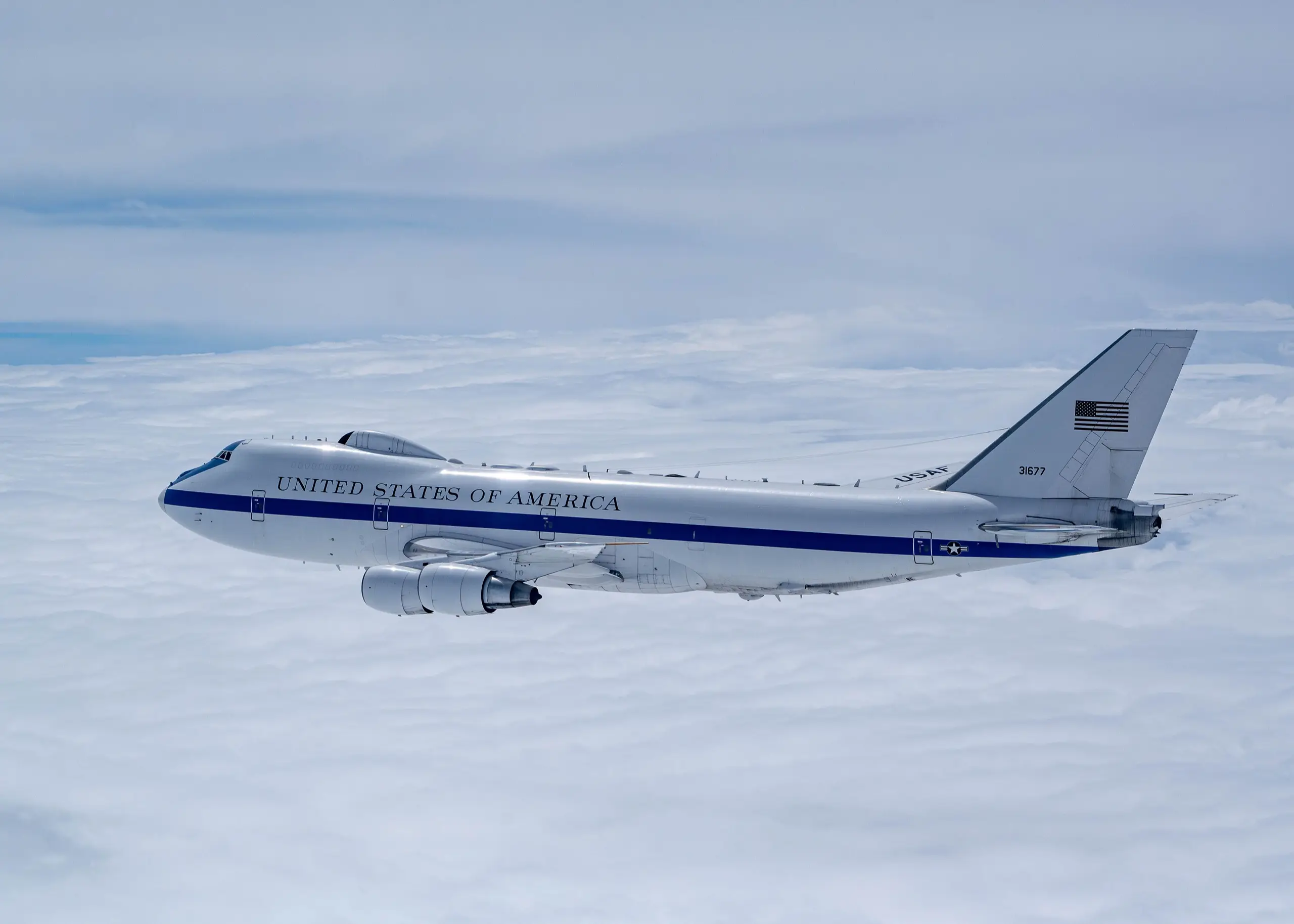
A white E-4B Nightwatch with a blue cheatline and the words United States of America flying above a solid layer of white cloud

Transport · Cold War · In service

E-4 Nightwatch

The Pentagon's 747, always switched on

Boeing (747-200 airframe), modified for the US Air Force

Aircraft in the fleet, one always on alert
4
Of round-the-clock alert, since the 1970s
50+years
Communications systems on board
42
People it can carry
112

Four Boeing 747s at Offutt Air Force Base, Nebraska, carry the words “United States of America” down their sides and no presidential seal. They are the E-4B Nightwatch, and their job is to keep the American military under command if the command centres on the ground have been destroyed. One of them is always on alert, crewed and switched on, ready to take off with the President, the Secretary of Defense or the Joint Chiefs of Staff on board. The job also gave them their nickname, the “Doomsday plane”.

The mission is older than the aircraft. A flying command post had been keeping watch from modified KC-135 jets since February 1962 when, in June 1973, the first 747 converted into an E-4A took to the air, and it entered service in late 1974. The first E-4B was delivered in January 1980. By 1985 all four aircraft had been brought up to that standard, protected against the electromagnetic pulse of a nuclear burst.

Inside, it is closer to an office building than an airliner. It carries 42 communications systems, a secure conference room, a briefing room, private quarters and about 465 square metres of working space, enough for up to 112 people. The crew can reach any mobile phone or landline, pull in radio and television, and talk to forces on the ground or under the sea. Without a tanker it can stay up for about twelve hours; refuelled in mid-air, Air Force Times reports, it can stay aloft for up to three days.

On most days the work is quieter. Defence secretaries use it for their trips abroad because they can run the Pentagon from it while they fly: Donald Rumsfeld held secure video conferences with his staff from its conference table, and Robert Gates once used its spare seats to fly four soldiers home on leave. It can also stand in for communications knocked out by a disaster on the ground.

The airframes date from the 1970s. In 2024 the Air Force chose Sierra Nevada Corporation to build a successor, the Survivable Airborne Operations Center, with work expected to run into the 2030s. Until then, the four E-4Bs share an alert that has gone on, without a break, for more than fifty years.

Built for the worst day

The E-4B is built around a single scenario. In the Air Force's words, "in case of national emergency or destruction of ground command control centers," it becomes a command, control and communications centre that can survive, so the President, the Secretary of Defense and the Joint Chiefs can still direct US forces and coordinate with civil authorities. Nearly everything unusual about the aircraft follows from that one sentence.

A nuclear burst high in the atmosphere throws out an electromagnetic pulse that can wreck unprotected electronics far beyond the blast. The E-4B is protected against it, and against nuclear and thermal effects. In May 1979 an E-4 was parked beneath the wire antennas of an EMP simulator at Kirtland Air Force Base, New Mexico, to be tested against exactly that. The few windows in the cabin are covered with mesh. On the flight deck the pilots keep masks to protect their eyes from being blinded by a nuclear flash.

One E-4B is always on alert, with its communications systems switched on. Lt. Col. Mike Shirley, who commanded the 1st Airborne Command and Control Squadron, put it in four words to Air Force Times: the alert jet "does not shut down." Crews rotate through two weeks on alert and four weeks in office jobs. In January 2010, when the Air Force photographed a crew running to the aircraft for a practice launch at Offutt, the mission had been on constant alert for more than 35 years, and it has not stood down since.

The world the aircraft serves has changed around it. It was built to direct nuclear forces and connect national leaders during the Cold War. Satellites and the internet have widened the job: today the crew can reach any mobile phone or landline, pull in radio and television, broadcast video and talk to units on the ground or under the sea. After a natural disaster that knocks out communications, it can help state governors reach federal agencies and support first responders.

A fleet of four

When Air Force Times flew aboard in 2022, the jet it rode in was 42 years old, and the other three E-4Bs are no younger: all of them are 1970s airframes carrying a mission that never stops. The leaders of the 595th Command and Control Group, writing in 2024, called the E-4B "well into its fourth decade of service" and listed what they were doing to keep it flying.

One step was a partnership with NASA, which had retired a 747 test aircraft of its own and could supply thousands of spare parts. More depot workers were added, because, as the group's leaders put it, "every day saved in depot is an extra day available for mission execution." Studies had found the local maintenance unit roughly 35 per cent under-manned, and new posts were approved.

As recently as 2022, E-4B pilots learned their aircraft in a Boeing 747-200 simulator in Miami. The group has since fielded the first full-motion E-4B flight deck simulator, so crews can train without taking a jet off the alert rotation. In March 2023 a team of contractors spent days scanning an E-4B inside and out in a hangar at Offutt to build virtual-reality training modules, so new crew members can learn the aircraft without needing a real one free.

Boeing, which built the 747, dropped out of the competition for a replacement in December 2023. In April 2024 the Air Force awarded Sierra Nevada Corporation a contract worth about $13 billion to develop the Survivable Airborne Operations Center: a hardened, modified commercial aircraft, with work expected to run to 2036. Until it arrives, the four E-4Bs keep the watch.

Missions & Moments

Four empty seats: home for the holidays, 2010

In December 2010, Defense Secretary Robert Gates spent two days in Afghanistan visiting troops, on a trip that also took him to Oman and the United Arab Emirates. He travelled the way defence secretaries usually travel overseas: in an E-4B from Offutt Air Force Base, chosen above all for its communications. It is a 747 built for a nuclear war, and on a routine trip it often flies with empty seats.

For a soldier going home on leave from Afghanistan, the journey was rarely simple. According to Fox News, it could take two days or more, starting with a wait for a military flight to Kuwait, then a long charter flight back to the United States.

Before the trip, Gates asked his commanders in Afghanistan to find four soldiers whose leave fitted his schedule. Pentagon Press Secretary Geoff Morrell told reporters that the secretary had "long wanted" to give troops heading home a ride on his own plane.

Two of the four were a married couple, deployed together, on their way to Texas. While they served, their three sons, aged five, four and two, had been staying with relatives. The third soldier was going home to Hammond, Indiana, after his second deployment to Afghanistan in three years in the Army. The fourth had just finished his first tour and was flying back to his wife and child in Tennessee.

Gates still had one more stop to make in the United Arab Emirates, so the soldiers came too. They spent the night with the official party at the Emirates Palace Hotel in Abu Dhabi, then boarded the E-4B again for the long flight home, an aircraft that can take on fuel from a tanker in mid-air rather than stop on the way.

The seats they used are the same ones that would hold a battle staff on the day the E-4B was built for. For one flight in December 2010 they held four soldiers going home to their families for the holidays.

The crews

An E-4B can carry up to 112 people. The aircrew covers pilots, a flight engineer, a navigator, flight attendants and security forces. Behind them sits a joint battle staff drawn from every service, with communications operators and a Raven security detail. When the aircrew, mission systems operators and maintainers of the 595th Command and Control Group join that battle staff, the E-4B becomes the National Airborne Operations Center.

A month in Miami
E-4B pilots spend about 30 days training in a Boeing 747-200 simulator in Miami, then learn air refuelling and night operations on top of that.
Nine months to learn the radios
Communications operators can train for up to nine months before they are ready to run the systems on board. Some arrive straight from basic training.
Two weeks on, four weeks off
Crews rotate through two weeks on alert, ready to launch, and four weeks in office jobs on the ground.
Private quarters
The cabin includes private quarters, a secure conference room, a briefing room for the press, and a few cots. Flight attendants keep it ready even for practice alerts.

Did You Know?

The pilots of an E-4B keep masks in the cockpit to protect their eyes from flash blindness caused by a nuclear explosion, and the cabin's few windows are covered with mesh.
Inside there are about 465 square metres of mobile office space, including a secure conference room, a briefing room for the media and a handful of cots.
Only two presidents are publicly known to have flown on the E-4B: Jimmy Carter and Ronald Reagan.
To keep its 1970s jets flying, the E-4B group obtained thousands of spare parts from a 747 test aircraft that NASA had retired.
According to the 595th Command and Control Group's commander, Lloyd Austin's first flight on the E-4B as defence secretary included the video conference in which President Biden decided to withdraw US troops from Afghanistan.
In 2023 an E-4B was 3D-scanned inside and out in a hangar at Offutt so that crews could train on a virtual copy in virtual-reality headsets.

Timeline

  1. Feb 1962

    The National Emergency Airborne Command Post begins flying aboard modified KC-135A jets, starting the mission the E-4 would later inherit.

  2. Jun 1973

    The first Boeing 747 converted into an E-4A Advanced Airborne Command Post makes its first flight.

  3. Late 1974

    The E-4A enters service and takes over the alert from the EC-135J. An airborne command post has been on alert ever since.

  4. May 1979

    An E-4 is photographed under the antennas of an electromagnetic pulse simulator at Kirtland AFB, New Mexico, during testing against the effects of a nuclear burst.

  5. Jan 1980

    The first E-4B is delivered to the Air Force.

  6. 1985

    The last E-4A is converted, and all four aircraft are now E-4Bs.

  7. Sep 11, 2001

    According to the military historian Robert Hopkins, one E-4B launched from Andrews in Maryland and another was airborne over the Midwest.

  8. Dec 2010

    Defense Secretary Robert Gates flies four soldiers home on leave from Afghanistan aboard his E-4B.

  9. Oct 1, 2016

    The E-4B fleet moves under Eighth Air Force and Air Force Global Strike Command.

  10. 2022

    The National Airborne Operations Center marks 60 years of its mission with a gala in Omaha, hosted by the 595th Command and Control Group.

  11. Apr 26, 2024

    The Air Force awards Sierra Nevada Corporation a contract worth about $13 billion to build the E-4B's successor, the Survivable Airborne Operations Center.

Sources

Facts last reviewed October 2026

  1. 1. U.S. Air Force: E-4B fact sheet (March 2003, archived) and current E-4B fact sheet (mission, dimensions, engines, weight, ceiling, endurance, deliveries, fleet size)
  2. 2. 595th Command and Control Group via DVIDS: An overview of the NAOC and E-4B Nightwatch (March 2024)
  3. 3. Joshua Plueger, 55th Wing, via DVIDS: 'Doomsday plane' goes digital (2023)
  4. 4. Rachel S. Cohen, Does America need its 'Doomsday plane'?, Air Force Times, May 2022 (crew, alert posture, interior, communications, presidents on board, Robert Hopkins on 9/11)
  5. 5. Boeing: Historical Snapshot: E-4 Advanced Airborne Command Post (first flight, conversions, secondary roles)
  6. 6. Offutt AFB: E-4B NAOC team celebrates 60th anniversary with gala (2022) and E-4 commemorates 35 years on alert (2010)
  7. 7. Kevin Baron, SecDef's plane in a holding pattern, Stars and Stripes, May 2009 (nuclear and thermal effects shielding)
  8. 8. Justin Fishel, A sweet ride, Fox News, December 2010, and American Forces Press Service, Secretary Gates brings deployed soldiers home for leave
  9. 9. Sierra Nevada wins $13B contract to build Air Force 'doomsday plane', Defense News, April 2024
  10. 10. U.S. Air Force and DoD photo captions on Wikimedia Commons: EMP simulator at Kirtland AFB (May 1979); 1st Airborne Command and Control Squadron alert photos by Lance Cheung (January 2010); E-4B over the Midwest by Tech. Sgt. Codie Trimble (May 2024, realignment under Eighth Air Force)