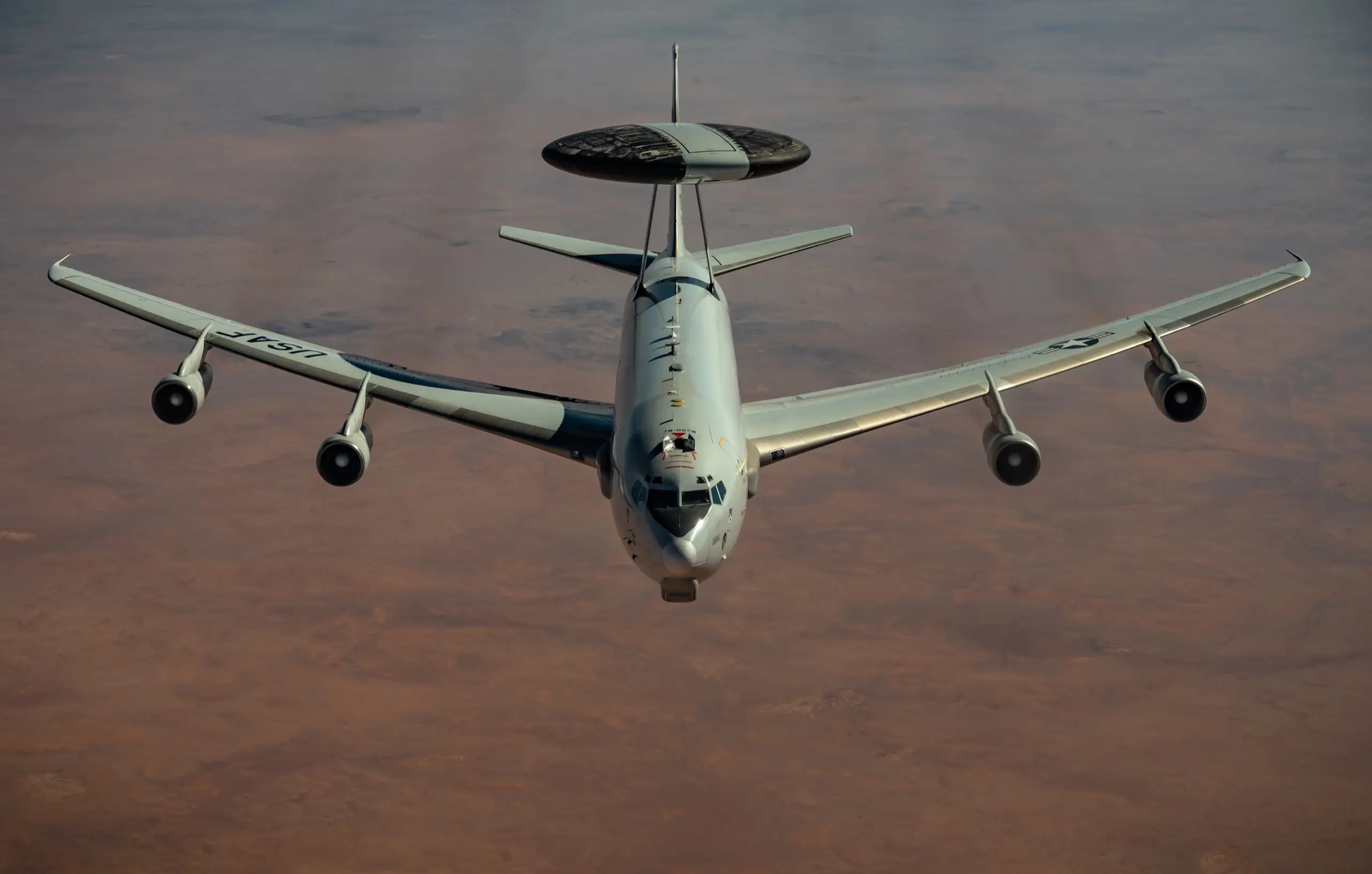
On two struts above the fuselage of an E-3 Sentry sits a disc 9.1 metres wide, and in flight it never stops turning. Every ten seconds the radar inside sweeps the whole horizon, from the sea surface up into the stratosphere, and on the consoles in the cabin below every aircraft within hundreds of kilometres shows up as a small moving symbol. The E-3 carries no weapons of its own. Its crews fight by talking to the pilots who carry them.
Underneath the dish is a Boeing 707, the airliner that took passengers into the jet age, stripped of its seats and filled with radar operators, controllers, radios and computers. The US Air Force took its first E-3s at Tinker AFB, Oklahoma, in March 1977, as the successor to a radar-carrying version of the Lockheed Constellation. Both aircraft existed for the same reason. A radar lifted high enough sees over the horizon, and low-flying aircraft can no longer slip in underneath it.
AWACS stands for Airborne Warning and Control System, and most of a Sentry crew’s work is in the second half of the name. Its controllers send fighters toward threats, bring thirsty aircraft to tankers, keep strike packages apart in crowded sky, and tell commanders on the ground what is moving. In Desert Storm, E-3 crews helped set up 38 of the 40 air-to-air kills the Air Force recorded, and one woman’s voice on the first night of that war became part of the story of how women got into combat cockpits.
The aircraft has spent much of its life far from home. E-3s watched the Gulf through the whole of the Iran–Iraq War, then stayed in the Middle East almost without a break from 1990 to 2003. NATO bought a fleet of its own, flown by mixed crews from across the Alliance, and after 9/11 those European-based jets crossed the Atlantic to guard American skies. They have also tracked drug smugglers for US Customs, coordinated hundreds of rescues after Hurricane Katrina, and flown long patrols over the Arctic for NORAD.
The Sentry is now an old aircraft. The RAF retired its E-3Ds in 2021, the US Air Force has sent more than a dozen to the boneyard, and the replacement, the 737-based E-7 Wedgetail, has been argued over in Washington ever since. NATO plans to keep its own fleet flying until 2035. For nearly half a century, wherever allied aircraft have gone to war, a grey 707 with a turning dish on its back has usually been circling somewhere behind them.