Skip to content
Early preview The vault is just opening. New files are added regularly, and some sections are still being built.
VLTARIS
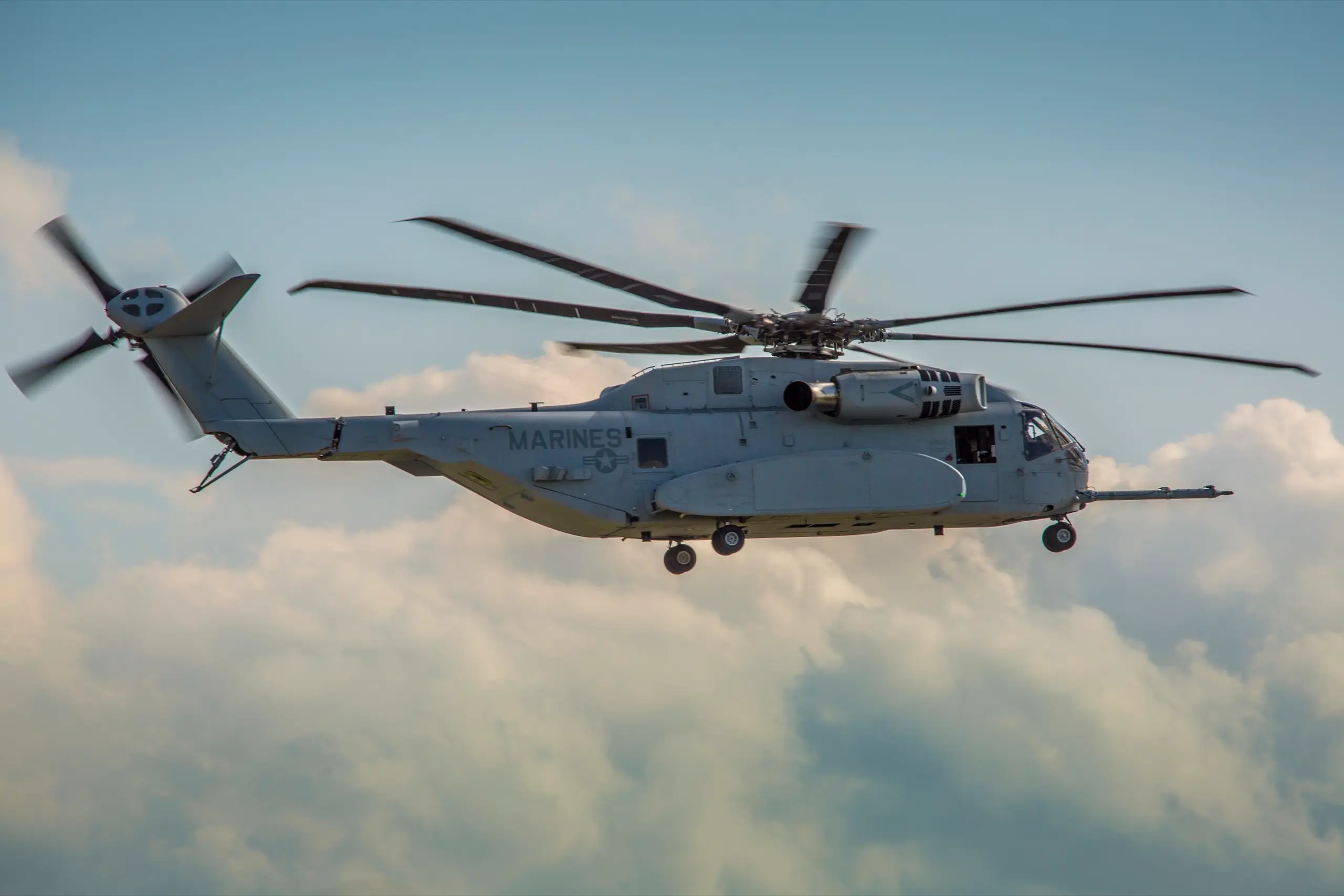
A grey CH-53K King Stallion flying side-on above a bank of white cloud, its seven rotor blades spread wide

Helicopter · Modern · In service

CH-53K King Stallion

A Super Stallion outline around a new helicopter

Sikorsky (a Lockheed Martin company)

Lifted on a single hook in testing (2018)
16,330kg
From three engines, the most powerful helicopter in the US military
16,800kW
Weight on the 2018 test lift, the heaviest helicopter Sikorsky had flown
41,000kg
Altitude of the ridge where it recovered a stranded Seahawk (2021)
3,660m

On a test pad in West Palm Beach in February 2018, a CH-53K lifted 16,330 kg on a single cargo hook, hovered, and flew away with it. With that load it weighed more than 41,000 kg, the heaviest helicopter Sikorsky had ever flown. From a distance it looked almost exactly like the CH-53E Super Stallion the Marines had been flying since 1978.

The resemblance was the point. The Marine Corps needed a lifter that could carry roughly three times as much as the Super Stallion on a hot day, and it had to fit the same amphibious ships: the same deck spots, the same hangars, the same elevators. So Sikorsky kept the outline and replaced almost everything inside it. Three new General Electric engines give it about 16,800 kW between them, the most power of any helicopter in the US military. The controls are fly-by-wire, the blades and much of the cabin are composite, and the aircraft keeps track of its own health and tells its mechanics what is about to fail.

The King Stallion belongs to a family that began with the twin-engined Sea Stallion of the 1960s and grew into the three-engined Super Stallion of the 1970s. For more than half a century the big Sikorskys have done the Marines’ heaviest lifting: artillery, vehicles, fuel, and wrecked aircraft that something has to carry home. The CH-53K was built to take over that work for the next half-century.

Its first real mission came before the Marine Corps had even declared it ready. In September 2021 two test aircraft recovered a Navy Seahawk that had been stranded for seven weeks on a ridge in the White Mountains of California, a job no other unit the Navy asked could do without taking the Seahawk apart. Since then a King Stallion has carried a stealth fighter under its belly, and another has lifted a stripped-down King Stallion.

The program began in December 2005, the first aircraft flew in 2015, and the first operational deployment with a Marine Expeditionary Unit, once promised for 2024, has slipped several times. The Marines plan to buy 200 of them.

Sea Stallion, Super Stallion, King Stallion

The family began at Sikorsky's plant in Stratford, Connecticut, on 14 October 1964, when the YCH-53A lifted off for the first time. The Marines wanted it for hauling troops and cargo from ship to shore, recovering downed aircraft and carrying casualties. In January 1965 a CH-53A reached 170 knots, which Sikorsky billed as the fastest production helicopter in the free world. A CH-53A crewed by Marine Lt. Col. Robert Guay and Sikorsky pilot Byron Graham later flew loops and rolls over Long Island Sound, which few people expected of a machine that size. There was even talk of it carrying the President, until trial landings at the White House showed that its rotor downwash was, in the company's own words, "not compatible with the White House shrubbery."

In the early 1970s the Marines asked for double the external lift. Sikorsky's answer was the CH-53E Super Stallion: a third engine, a seventh main rotor blade, a longer fuselage and a tail rotor canted 20 degrees to the left. The main rotor grew to 24.1 m, the same diameter the King Stallion uses today. The prototype first flew on 1 March 1974 and lifted about 16,800 kg, and Sikorsky called it the western world's most powerful helicopter.

The CH-53K keeps the Super Stallion's silhouette and almost nothing else. The Marines needed a heavy lifter that would still fit the hangars, decks and lifts of the same amphibious ships, so the outline stayed close to the old one while everything inside changed: new engines, a split-torque main gearbox, composite rotor blades and a mostly composite cabin, and triple-redundant fly-by-wire controls in place of mechanical linkages. It is the first heavy-lift helicopter to fly by wire. The requirement was to carry roughly three times what the CH-53E could carry under the same hot, high conditions.

Pilots moving across from the old aircraft have their own way of putting it. Lt. Col. Luke Frank, who led the first Marine test detachment, still wore a CH-53D patch and called the older helicopters his first love. "It's like an old Jeep, simple and reliable but unrefined, the ECHO is similar. However, most of the time I would prefer to drive the Denali, that is the KILO."

What hangs underneath

There are three cargo hooks under the King Stallion's belly. They can work together on a single big load, in pairs, or independently, so one sortie can carry three separate loads to three separate landing zones and drop each one off without going back to the ship. The design mission is specific: pick up about 12,250 kg at sea level on a hot day, carry it about 200 km to a landing zone at altitude, and fly back with fuel to spare, even with the engines at the end of their allowed wear.

The biggest test lift came at Sikorsky's flight centre in West Palm Beach, Florida, on 10 February 2018. The test aircraft lifted 16,330 kg, the maximum rated load for the single centre hook, hovered with it and then flew with it. With the load attached the helicopter weighed just over 41,000 kg, the heaviest helicopter Sikorsky had ever flown. "The payload capability of this helicopter is unmatched, triple that of its predecessor," said the Marine program manager, Col. Hank Vanderborght.

On 13 December 2022 a CH-53K from the Marines' test squadron, VMX-1, lifted CF-1, the first developmental F-35C, at Naval Air Station Patuxent River in Maryland. Stripped of its engine, mission systems and outer wings, the fighter and its rigging weighed about 10,000 kg. The aim was to see how the airframe behaved as a sling load and to inform future lifts.

In April 2026 the test squadron HX-21 had one King Stallion lift another. The team removed the passenger's three engines, most of its gearboxes and its tail pylon, bringing it down to about 12,700 kg, to work out how the fleet could recover its own aircraft. "This is a capability we hope will never be needed in the fleet," said the program manager, Col. Kate Fleeger.

Armament

GAU-21 machine guns
Three 12.7 mm (.50-calibre) GAU-21 machine guns, fired by the aircrew for self-defence. The King Stallion is a lifter, not a gunship.

Missions & Moments

Mount Hogue: the Seahawk nobody else could lift

On 16 July 2021 a Navy MH-60S Knighthawk was helping search for a lost hiker in the White Mountains of eastern California, near the Nevada line. It came down hard on a ridge near Mount Hogue. All four crew walked away uninjured and were rescued the next day. The helicopter stayed where it was, in a tight ravine at almost 3,660 m.

At that altitude the air is thin, and a helicopter's rotors and engines lose much of their lifting power. The Navy squadron and the Naval Safety Center asked for help from Army National Guard units, Navy squadrons and Marine squadrons. "They all lacked the capability to lift the aircraft without an extensive disassembly," said Lt. Col. Luke Frank. The alternative was to take the Seahawk apart on the mountain and carry it down in pieces.

Frank ran the CH-53K detachment of VMX-1, the Marines' operational test squadron, which at the time was putting its brand-new helicopters through their formal evaluation at Twentynine Palms. The request reached him from the Safety Center. His team looked at the conditions, ran the numbers and decided the King Stallion could do it. "After two weeks of exhaustive planning and assembling a team of more than 25 Marines and sailors from VMX-1 and 1st Landing Support Battalion from Camp Pendleton, Ca. we deployed two CH-53Ks to Bishop, Ca., and got to work," he said.

The Seahawk weighed about 6,900 kg. That is well inside what a King Stallion can carry at sea level, but this was a hover over a mountain ravine, with the ground crew rigging the load on a steep slope in thin air. "After six months of flight operations with the CH-53K, the detachment had every confidence in the aircraft's abilities to conduct the mission safely," Frank said. "Our main concern was the environmental factors ground support personnel would have to endure."

On Sunday 5 September the King Stallion lifted the Seahawk out of the ravine and carried it about 43 km down to the airport at Bishop, setting it down in the scrub near the field. The operation had taken two days.

It was the first official fleet mission the CH-53K ever flew, months before the Marine Corps had even declared it operational. "To be the first group of professionals to complete a real-world, heavy lift/high altitude mission in support of a unit who thought all options were off the table is extremely rewarding," Frank said. "This is exactly what the K is made to do."

The crews

A King Stallion flies with two pilots and between one and three aircrew in the back, depending on the job. The pilots sit in a glass cockpit with fly-by-wire controls; the crew chiefs and aerial observers in the back work the cargo and the guns. Pilots who came across from the CH-53E describe the change as moving from an aircraft that had to be flown every second to one that helps fly itself.

Hovering in the dust
In a brownout the crew can switch on position hold and let the aircraft keep its own hover. Lt. Col. Luke Frank described sitting in the dust cloud “just sitting there hovering and talking to each other with position hold on. And we’ve been debriefing the landing, and the aircraft’s just holding a hover perfectly.”
Knowing the power before the lift
The engines' digital controls log their health constantly, and a pilot can run a power check before a hot, high pickup. On the CH-53E, Frank said, crews learned what was failing from warning lights; the K warns its maintainers before a part fails.
A shorter conversion
The first conversion course for CH-53E pilots was written as a best guess. After the first co-pilots finished it, the test squadron found it could cut about a quarter of the events and flight hours.
Long flights
With air refuelling the King Stallion can fly a long way, and the automation changes how the crew feels at the end of it. “If you’re aerial refueling and flying 1,000 miles in the E, the air crew would be wet noodles getting out after the flight,” Frank said. “In the K you can relax a little, take a breath, allow the aircraft to help you fly.”

Names worth knowing

  • Stephen McCulley Sikorsky chief experimental test pilot

    Flew the first CH-53K, EDM-1, on its 30-minute maiden flight at West Palm Beach on 27 October 2015.

  • Lt. Col. Jonathan Morel First Marine to fly it

    Became the first Marine to fly the CH-53K, on a 1.5-hour test flight over West Palm Beach on 18 December 2015, the aircraft's sixth flight.

  • Lt. Col. Luke Frank Officer in charge, VMX-1 CH-53K detachment

    Led the operational test detachment and the Mount Hogue recovery. “Heavy lift is a unique and invaluable mission for the Marine Corps. Horsepower is our weapon system and the CH-53K is armed to the teeth.”

  • Col. Kate Fleeger Program manager, H-53 Heavy Lift Helicopters

    Oversaw the 2026 test in which one King Stallion lifted another, a procedure meant to go into the Navy's aircraft salvage manual.

Did You Know?

Before the first King Stallion flew, Sikorsky built a Ground Test Vehicle, a complete, working CH-53K bolted to a pedestal, so the engines, gearboxes and controls could be run hard and debugged on the ground.
The cabin is 30 cm wider than the CH-53E's, enough to take two standard Air Force 463L cargo pallets straight off a fixed-wing transport and lock them in place without reconfiguring anything.
The T408 engine gives about 57 per cent more power than the T64 it replaced, in the same size package, with 63 per cent fewer parts.
The King Stallion is certified to be carried by Air Force transports: one fits in a C-17, and a C-5 takes two.
In its first months at VMX-1, a single brand-new CH-53K flew more than 50 hours in one month, a figure the program manager called “a tremendous amount of work” for any helicopter.
Its family nearly carried the President. Trial landings by a CH-53A at the White House ended the idea, because the downwash proved “not compatible with the White House shrubbery.”

Myth vs. fact

Myth

The CH-53K is just an upgraded CH-53E with new engines.

Fact

It shares the old name, the outline and the footprint on deck, which is deliberate: it had to fit the same ships. But it is a new-build aircraft. It has new engines, a new gearbox, composite blades and cabin, fly-by-wire controls in place of mechanical ones, a wider cabin and built-in health monitoring. One defence writer suggested that if it had been called the CH-55, nobody would mistake it for a Super Stallion.

Timeline

  1. Oct 14, 1964

    The YCH-53A, first of the Sea Stallion family, flies at Stratford, Connecticut.

  2. Mar 1, 1974

    The three-engined YCH-53E Super Stallion flies for the first time.

  3. Dec 2005

    The CH-53K program passes Milestone B and enters full development.

  4. May 5, 2014

    Sikorsky rolls out the first aircraft at Jupiter, Florida, and the type is named King Stallion.

  5. Oct 27, 2015

    EDM-1 makes the first flight, a 30-minute hop at West Palm Beach with Sikorsky's chief experimental test pilot, Stephen McCulley, at the controls.

  6. Feb 10, 2018

    A test aircraft lifts 16,330 kg on its centre hook, the design maximum.

  7. May 2018

    The Marine Corps accepts delivery of its first CH-53K.

  8. Sep 5, 2021

    Two CH-53Ks recover a Navy MH-60S from Mount Hogue, California. It is the type's first official fleet mission.

  9. Apr 22, 2022

    The Marine Corps declares initial operational capability after more than 3,000 mishap-free test hours.

  10. Dec 13, 2022

    A CH-53K lifts the F-35C test airframe CF-1 at Patuxent River, Maryland.

  11. Apr 2026

    One CH-53K lifts another in an aircraft recovery test at Patuxent River.

Sources

Facts last reviewed October 2026

  1. 1. U.S. Marine Corps / NAVAIR: CH-53K King Stallion fact sheet (27 January 2016; performance, weights, dimensions, armament, crew, program milestones, Ground Test Vehicle)
  2. 2. NAVAIR: CH-53K King Stallion product page (external lift, maximum gross weight)
  3. 3. This Day in Aviation: 27 October 2015, CH-53K first flight (EDM-1, pilot, duration, cruise speed, rotor and fuselage dimensions)
  4. 4. Lockheed Martin: Sikorsky CH-53K completes critical flight envelope expansion with 36,000-pound external lift (7 March 2018)
  5. 5. NAVAIR, republished by Defense.info: VMX-1 squadron performs emergency lift of U.S. Navy helicopter with CH-53K (September 2021), with Robbin F. Laird's interviews with Lt. Col. Luke Frank and Col. Jack Perrin in the same collection
  6. 6. Robbin F. Laird, "What if it was called the CH-55? Transformation in the vertical heavy lift fleet", Defense.info, December 2020 (in the collection above)
  7. 7. U.S. Marine Corps: Marine Corps declares initial operational capability for CH-53K King Stallion (25 April 2022; also on DVIDS)
  8. 8. NAVAIR: CH-53K lifts F-35C in external load test (24 January 2023), republished by Seapower
  9. 9. NAVAIR via Seapower: CH-53K lifts CH-53K, expanding capabilities (April 2026)
  10. 10. USNI News: Marine Corps accepts delivery of first CH-53K (16 May 2018)
  11. 11. Breaking Defense: CH-53K gears up for first deployment with 26th Marine Expeditionary Unit (April 2026)
  12. 12. Igor I. Sikorsky Historical Archives: Sikorsky S-65 (CH-53A and CH-53E development, first flights, White House trials)
  13. 13. Wikimedia Commons: Sikorsky CH-53K King Stallion (public-domain U.S. Marine Corps and U.S. Navy photographs, including the caption for Lt. Col. Jonathan Morel's first flight)