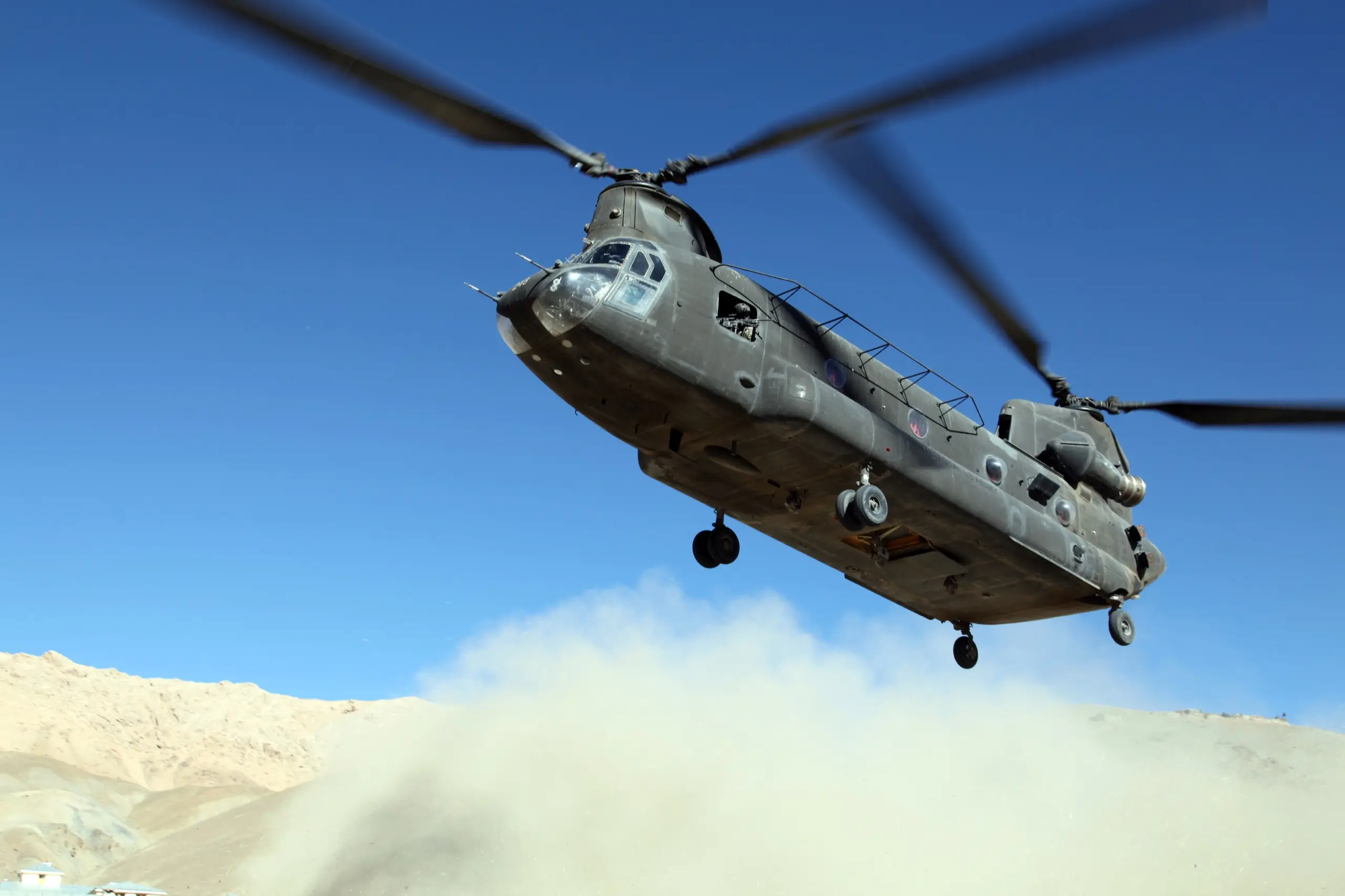
In Vietnam, when a helicopter went down in a clearing, the aircraft sent to fetch it was usually a Chinook. Crews flew out, rigged the wreck under the belly and lifted it away before the enemy or the jungle could claim it, and by the end of the war they had recovered 11,500 disabled aircraft that way, worth more than $3 billion. Recovery was the second job. The first, the one it was built for in 1962, was moving the Army’s guns, trucks and soldiers to places with no roads, and it has been doing both ever since.
There is no tail rotor. The two big rotors at either end of the cabin turn in opposite directions and cancel each other’s torque, so every kilowatt from the two engines goes into lifting, which is why a Chinook can carry a howitzer slung under its belly into mountains where a single-rotor helicopter would struggle to hover, and why the Army uses it to hoist people off Afghanistan’s high ground. Behind the pilots the cabin is a long box with a ramp at the back: roughly three dozen seats, or cargo, or whatever the crew can persuade up the ramp.
The prototype flew in 1961 on a pair of Lycoming T55 turboshafts, and every Chinook since has used descendants of the same engine, now built by Honeywell and giving almost three times the power. The airframes have had the same treatment. More than 500 A models were rebuilt as CH-47Ds in the 1980s and 90s, 300 of those became CH-47Fs in the 2000s, and the newest Block II version is only now coming off the line. One airframe accepted by the Army in January 1963 was still flying combat missions in Afghanistan in 2011.
Twenty countries fly it besides the United States, from Japan and Singapore to the Royal Air Force, whose Chinook ZA718 survived the sinking of the Atlantic Conveyor in the Falklands and went on to earn four Distinguished Flying Crosses for four different pilots over 40 years. Germany has ordered 60 to replace its old Sea Stallions. In August 2021, Chinooks of the 82nd Airborne flew about 10,000 people out of Kabul to the airport in three days, and then were loaded into C-17s and flown out themselves.
Passengers remember particular things: the ramp settling onto a ridge with the front wheels still in the air, the brown-out it makes landing in a dry valley, the rings of light its blades throw off when dust hits them at night. Nobody calls it graceful. It is the helicopter that turns up when something heavy has to go somewhere difficult, and 64 years after it entered service the production line is still running.