Skip to content
Early preview The vault is just opening. New files are added regularly, and some sections are still being built.
VLTARIS
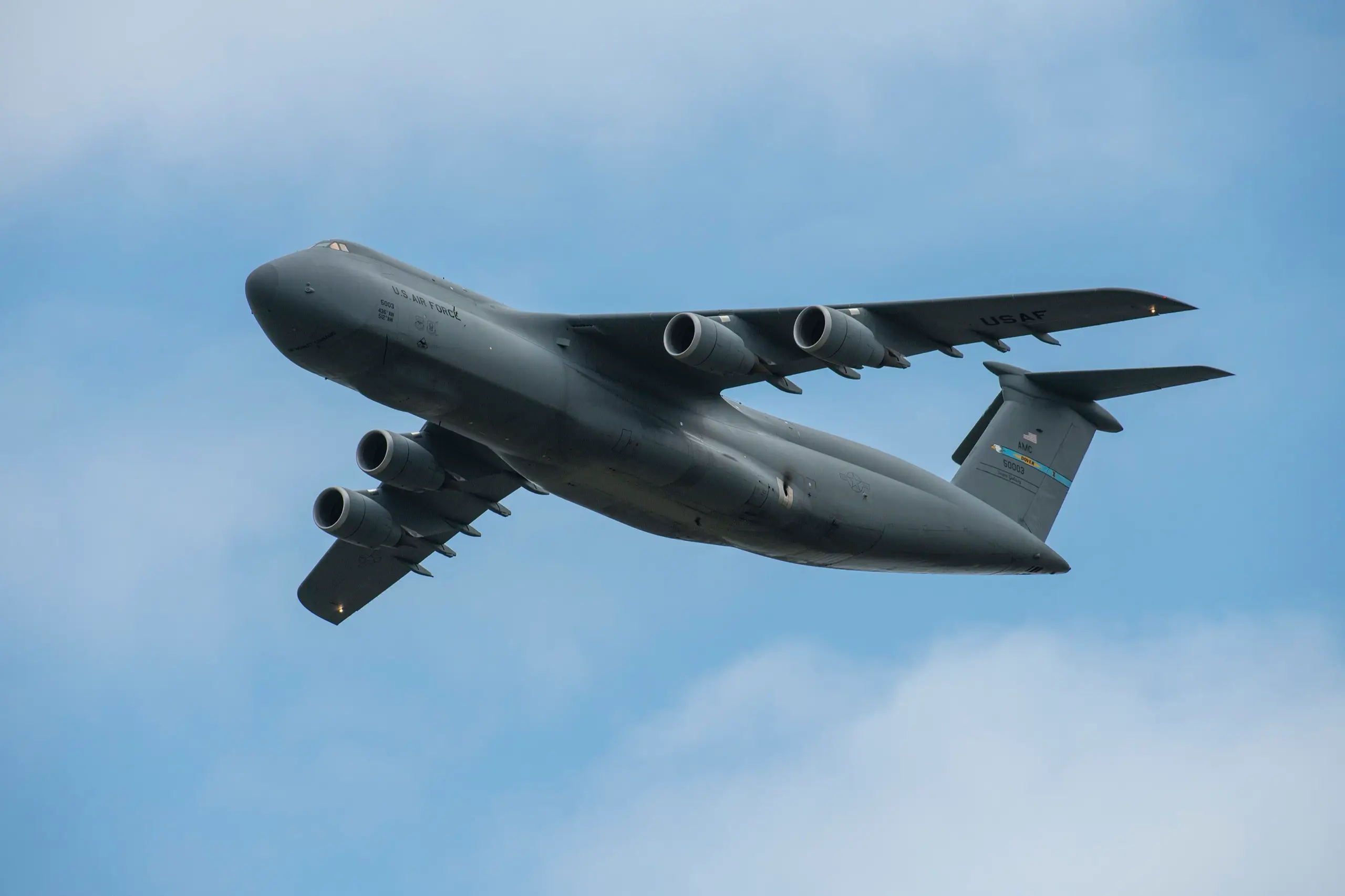
A grey C-5M Super Galaxy banking overhead against a blue sky with soft clouds, its four engines and T-tail seen from below

Transport · Cold War · In service

C-5 Galaxy

Built around a 43.8-metre hold

Lockheed-Georgia (now Lockheed Martin)

Length of the cargo hold, longer than the Wright brothers' first flight
43.8m
Wheels on its landing gear
28
Intercontinental ballistic missile fired from its hold (1974)
1
From first flight (1968) to today
58years

A C-5 opens at both ends. The nose swings up like a visor on a helmet, the tail parts into doors and a ramp, and the landing gear kneels until the cargo floor is level with the back of a truck. Vehicles can drive in at the front and out at the back without turning round. All of that weight rests on 28 wheels, spread across five sets of landing gear.

The aircraft was designed around its hold, for cargo that fits in nothing else. The hold is 43.8 metres long, longer than the Wright brothers’ entire first flight, and wide and tall enough for two M1 Abrams tanks, or six Apache helicopters, or 36 standard pallets. Upstairs, behind the wing, there are 75 seats for troops, a galley and a lavatory, and the passengers ride above the cargo like people on the top deck of a bus.

Lockheed-Georgia built the Galaxy at Marietta, and within months of the first flight in June 1968 an Air Force cost analyst had told Congress the programme was billions over budget, a confession that cost him his job. Then the wing proved defective and the C-5As had to be re-winged. For years the Galaxy was better known in Washington for its bills than for anything it carried.

The flying record reads differently. A C-5A reached Vietnam in July 1970, and five years later one of them flew the first mission of Operation Babylift, a flight that ended in a rice paddy outside Saigon. In 1974 one dropped an intercontinental ballistic missile out of its tail over the Pacific. In 1989 one delivered the Hubble Space Telescope to Florida. Between 2006 and 2018, 52 of them were rebuilt with modern engines and cockpits as the C-5M Super Galaxy.

Those 52 are still flying from Dover, Travis, Westover and Lackland. Keeping them flying is hard: the fleet’s mission-capable rate has dipped below 46 per cent, and the Air Force says more spare parts are the key to raising it. When they are ready, they do a job the newer C-17 was never meant to do. The C-17 can land on a short dirt strip near the fighting. The Galaxy carries the biggest loads the longest distances to a proper runway, which is what it has been doing for most of the 58 years since it first flew.

A Minuteman in the cargo hold

In the early 1970s American strategists worried about their missile silos. A silo cannot move, and an enemy who knew where every one of them was could, in theory, destroy them in a first strike. One answer that was studied was to put an intercontinental ballistic missile in an aircraft, keep it moving, and launch it from the sky.

The Air Force tried it for real on 24 October 1974. C-5A 69-0014, then assigned to Hill AFB in Utah, flew out over the Pacific test range with a crew from the 6512th Test Squadron and a Minuteman missile in its hold, about 17 metres long and close to 39,000 kg, strapped into a purpose-built cradle. At about 6,100 metres, parachutes pulled the cradle out of the open tail. The cradle fell away, more parachutes swung the missile upright beneath the aircraft, and then its rocket motor lit. The unarmed missile climbed roughly 9,000 metres above the water before it fell back into the ocean.

As a demonstration, it showed that a nuclear missile could be fired from an aircraft rather than only from a hole in the ground. As a weapon, it went no further. Accounts of how well the test went differ, and a later proposal to carry ICBMs in a Boeing 747 never materialised.

The aircraft itself kept working for nearly four more decades. It ended its career with the Tennessee Air National Guard in Memphis, flying cargo for the wars in Afghanistan and Iraq, and on 7 August 2013 it made its last flight, to the Air Mobility Command Museum in Dover, Delaware, as the first C-5A put on public display. Earlier that year an inert Minuteman had been trucked to the museum to stand beside it.

The price tag

The Galaxy's first fight was in Washington. In 1968, months after the first aircraft flew, a civilian cost analyst in the Air Force named Ernest Fitzgerald appeared before Senator William Proxmire's Joint Economic Committee and told it that the C-5 programme was heading for an overrun of about $2.3 billion. He had been advised beforehand to "play dumb". He didn't.

The reaction inside the Air Force was harsh. Fitzgerald was shut out of meetings, his mail was opened, his private life was investigated, and he was handed trivial audits, among them a bowling alley in Thailand. After Richard Nixon took office, the president was reported to have told his aides to "get rid of that son of a bitch", and Fitzgerald was fired. He went to court with help from the ACLU, wrote a book called The High Priests of Waste, and after years of legal fighting got his job back. When he finally retired in 2006, Senator Charles Grassley said that for Fitzgerald, "saving the taxpayers' money was never just a goal".

The wing was a costly problem of its own. The original C-5A wing had a defect, and fixing it became a long argument between the Air Force and Lockheed over who should pay. In 1983 the Government Accountability Office found that Lockheed had been legally obliged to correct a substantial part of the defect at its own expense, and that the Air Force had not held it to that. The C-5As were rebuilt with new wings, and the 50 C-5Bs built in the 1980s came off the line with the stronger design and more than a hundred other improvements.

Missions & Moments

Babylift: flying a Galaxy with no tail controls

In early April 1975 Saigon was days from falling. On 3 April President Gerald Ford announced that military transports returning from Vietnam would carry orphans out with them, and a C-5A, tail number 68-0218, was diverted to Tan Son Nhut Air Base to fly the first mission of what became Operation Babylift. Its aircraft commander was Capt. Dennis "Bud" Traynor, with Capt. Tilford Harp as co-pilot. The crew had planned to put the children upstairs, but around 250 orphans and a number of sick adults came aboard, along with escorts, and many of them were settled in the lower cargo compartment, where the flight nurse, Lt. Regina Aune, stationed herself and her medical team.

The Galaxy took off late in the afternoon of 4 April, bound for Clark Air Base in the Philippines. About twelve minutes later, the lower rear fuselage burst open. The pressure door, most of the rear ramp and a cargo door were torn away, and with them went the cables to the rudder and elevators. Two of the four hydraulic systems failed. What was left for steering was one aileron and the wing spoilers. The Air Force's own magazine later described it as "a critical flight situation not covered in any flight manual."

With no elevators, the nose dropped and the speed climbed to 300 knots, then the aircraft began to rear up towards a stall. A pilot's instinct is to take power off. Traynor did the opposite. "Instead he added power and as airspeed increased the nose slowly came up." From then on the two pilots split the job: Traynor flew pitch with the four throttles, and Harp rolled the aircraft with the aileron and spoilers. Every throttle movement took time to show, and the giant aircraft wallowed down towards the airport in a long, lagging descent.

They lined up for runway 25L at Tan Son Nhut, but partway through the final turn the descent suddenly steepened to about 1,200 metres a minute. They were not going to reach the runway. Traynor had Harp level the wings, pushed the power up to raise the nose, and at about 15 metres above the ground pulled the throttles back to idle. The C-5 touched down in a rice paddy, slid about 300 metres, bounced back into the air for roughly 800 metres, struck a dike and broke into four pieces. The lower cargo compartment, where so many of the children had been, was destroyed.

Aune had been thrown the length of the compartment. Her right foot was broken and she was bleeding from deep cuts to her arm and leg. She got up, checked on her passengers, opened an emergency exit and began carrying children out through waist-deep, fuel-soaked mud to rescue helicopters that could only hover over the paddy. She does not remember how long she kept going before she lost consciousness. In a Saigon hospital the doctors found that she had also fractured a leg and a bone in her back.

Well over a hundred people died, most of them small children. About 175 survived, most of them passengers in the upper troop compartment. The Accident Investigation Board credited their survival to Traynor's unorthodox use of power and his decision to put the aircraft down while he still had some control over it. Traynor and Harp received the Air Force Cross, and 37 medals went to the crew or their families. In 1976 Aune became the first woman to receive the Cheney Award, given for valour in a humanitarian cause. She accepted it on behalf of the whole crew, including the eleven who had died.

The crews

A C-5 flies with seven people: two pilots, two flight engineers and three loadmasters. The flight deck sits on an upper deck above the cargo hold, with its own galley and a rest area for the crew, which matters on flights that, with air refuelling, are limited only by how long the crew can stay awake.

Flight engineers still aboard
Two flight engineers sit behind the pilots and watch the engines and systems, and the job survived the rebuild into the C-5M Super Galaxy.
Passengers upstairs
Behind the wing, the upper deck holds a troop compartment with 75 seats, a second galley and a lavatory, so passengers ride above the cargo rather than beside it.
Three loadmasters
Ground crews can load and unload through the raised nose and the open tail at the same time, and the three loadmasters run the hold.

Did You Know?

The C-5 has 12 fuel tanks in its wings holding about 194,000 litres, enough, by the Air Force's count, to fill six and a half railway tank cars.
Its landing gear can kneel, lowering the parked aircraft until the cargo floor sits at the height of a truck bed, so vehicles can drive on at the front and off at the back.
The Hubble Space Telescope reached Kennedy Space Center in October 1989 inside an Air Force C-5.
On 13 September 2009 a single C-5M flight out of Dover claimed 41 world records, including lifting a payload of about 80 tonnes to more than 12,000 metres. The FAI certified them the following January.
Re-engining turned the Galaxy into the Super Galaxy: 22 per cent more thrust, a 30 per cent shorter take-off roll and a 58 per cent faster climb.
Two C-5As were modified to carry outsize space cargo for NASA. Re-engined, they still fly today as the only two C-5M-SCMs.

Timeline

  1. Jun 30, 1968

    The first C-5A Galaxy flies.

  2. Late 1968

    A civilian Air Force cost analyst, Ernest Fitzgerald, tells a congressional committee the C-5 programme is heading for an overrun of about $2.3 billion.

  3. Jun 1970

    Lockheed-Georgia delivers the first operational Galaxy to the 437th Airlift Wing at Charleston AFB, South Carolina.

  4. Jul 1970

    A C-5A lands at Cam Ranh Bay, the first Galaxy to reach Vietnam.

  5. Oct 24, 1974

    C-5A 69-0014 drops a Minuteman ICBM over the Pacific, and the missile's motor fires in mid-air.

  6. Apr 4, 1975

    The first flight of Operation Babylift, C-5A 68-0218, loses its rear doors after take-off from Saigon and crash-lands in a rice paddy.

  7. Mar 1989

    The last of 50 new-build C-5Bs joins the fleet, completing the second production run.

  8. Oct 1989

    The Hubble Space Telescope arrives at Kennedy Space Center aboard an Air Force C-5.

  9. Jun 6, 2006

    The re-engined C-5M Super Galaxy flies for the first time.

  10. Sep 13, 2009

    A C-5M crew from Dover claims 41 world records in a single flight.

  11. Aug 2, 2018

    The last C-5M conversion is delivered. The fleet settles at 52 Super Galaxies.

Where to see one today

Few Galaxies have been kept for display. Two retired C-5As stand in museums on Air Force bases, and one of them once launched a Minuteman missile.

United States· 2

  • Travis AFB Aviation Museum (Travis Heritage Center)

    Travis AFB, California

    Flew from Travis from 1973 to 1992 and returned on its final flight in July 2017. The museum is on the base: visitors without a military ID must clear entry at the Visitor Center and ride a shuttle in.

    70-0451C-5A Galaxy · outdoors
  • Air Mobility Command Museum

    Dover AFB, Delaware

    The aircraft that air-launched a Minuteman ICBM in 1974. It retired from the Tennessee Air National Guard in 2013 as the first C-5A on public display.

    69-0014C-5A Galaxy · outdoors

The Air Mobility Command Museum also displays an inert Minuteman missile beside its C-5A, a reminder of the day that aircraft fired one.

Locations last checked October 2026. Airframes occasionally move, so check with the museum before you travel.

Sources

Facts last reviewed October 2026

  1. 1. U.S. Air Force: C-5 A/B/C Galaxy and C-5M Super Galaxy fact sheet, as reproduced by the Travis AFB Aviation Museum (dimensions, cargo hold, fuel, kneeling gear, crew, deliveries, C-5M engine gains)
  2. 2. Air & Space Forces Magazine: C-5 Galaxy weapons file (dates, production, current inventory, payload, upper deck, readiness)
  3. 3. Air & Space Forces Magazine: Valor: A Galaxy of Heroes and Valor: The Lady Was a Tiger
  4. 4. Air Force Historical Support Division: 1975: Operation Babylift and Frequent Wind
  5. 5. Air Force Test Center: October 24, 1974: Air-launched modified Minuteman I ICBM from C-5A
  6. 6. DVIDS: The legacy of Tennessee Air National Guard's historic C-5 aircraft No. 69-0014 (2013)
  7. 7. Robert F. Dorr, air-launched Minuteman article, Flight Journal, and C-5A Galaxy missile launcher coming to Air Mobility Museum, Defense Media Network
  8. 8. Government Executive: Maverick Moves On (2006), on Ernest Fitzgerald
  9. 9. U.S. Government Accountability Office: C-5A Wing Modification Program, B-201347 (1983)
  10. 10. NASA: Kennedy Space Center celebrates Hubble's 25th anniversary
  11. 11. Air Force Reserve Command: C-5M crew claims 41 world records and C-5M Super Galaxy officially sets 41 world records
  12. 12. National Archives via Wikimedia Commons: The first C-5A Galaxy to arrive in Vietnam (NARA 111-CCV-80-CC72840)
  13. 13. Smithsonian National Air and Space Museum: 1903 Wright Flyer (first flight of 120 ft, 36.6 m)
  14. 14. Travis AFB Aviation Museum: Visiting