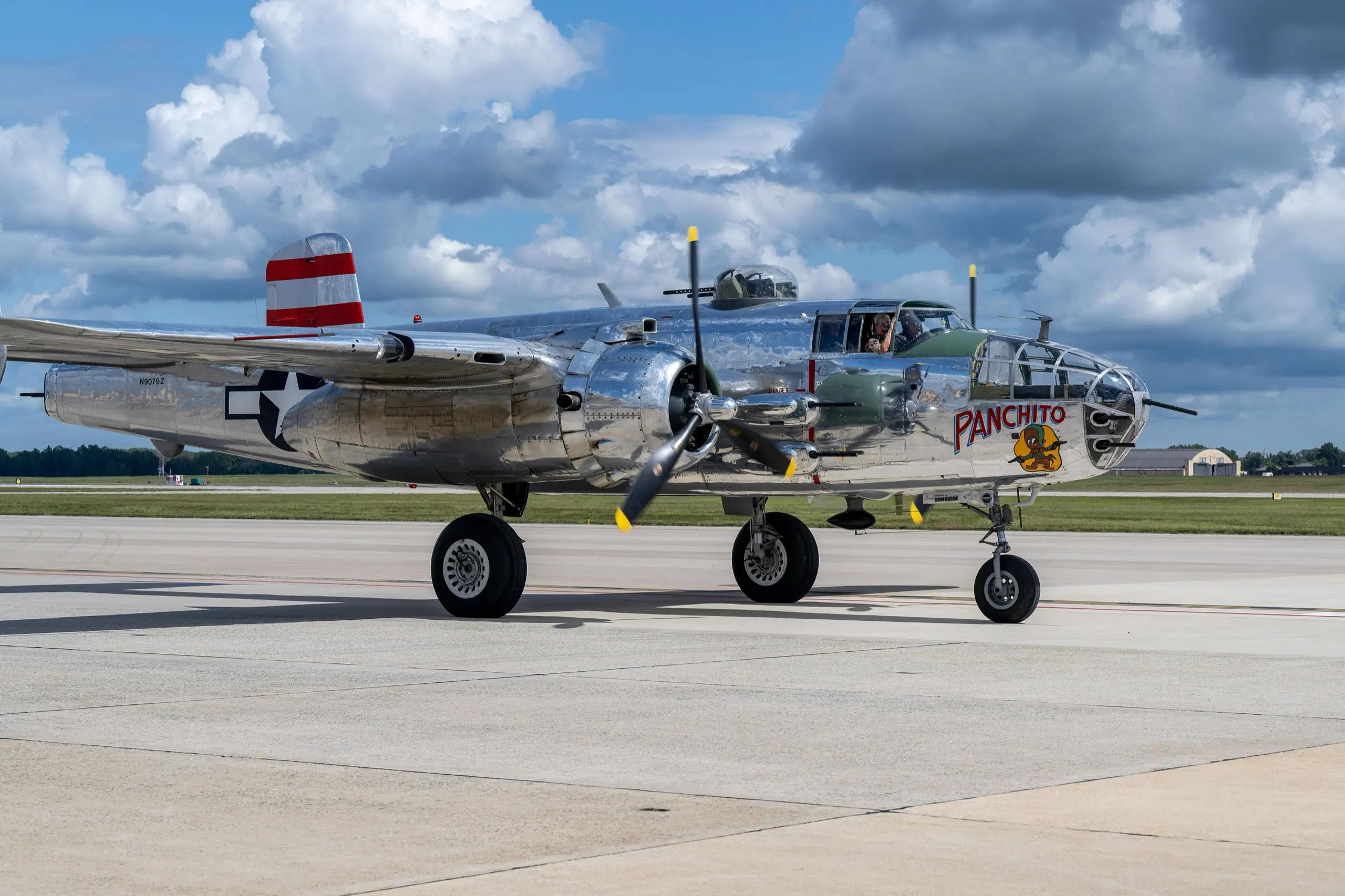
The training field was Eglin, in the Florida Panhandle, and the instructor was a Navy man. Lt. Henry L. Miller, a flight instructor sent over from Pensacola, spent March 1942 teaching Army bomber crews to drag a loaded B-25 into the air in a fraction of its usual run. Bad weather and work on the aircraft cut the planned training in half. In his report afterwards, Lt. Col. James Doolittle judged his crews "safely operational", and claimed no more than that.
The bombers changed too. A collapsible tank and extra fuel cells doubled the normal fuel load, and the belly turret and a heavy radio came out to make room and save weight. Doolittle had the secret Norden bombsights removed in case one fell into enemy hands. Capt. Charles Greening designed a replacement, nicknamed the "Mark Twain", which Eglin's sheet-metal shop built for about 20 cents apiece. In the tail, where a B-25B had no guns, mechanics fitted mock barrels.
At Alameda, across the bay from San Francisco, sixteen B-25s were loaded onto the carrier USS Hornet, and on April 1 she sailed under Capt. Marc Mitscher to join Vice Adm. William Halsey's task force. A B-25 could take off from a carrier but could not land on one, so the plan was to bomb Japan and fly on to airfields in China. On the morning of April 18 a Japanese picket boat found the ships. The cruiser Nashville sank it, but it had already radioed a sighting. Doolittle and Mitscher decided to launch at once, about 10 hours early and some 650 nautical miles (about 1,200 km) from Japan, much farther out than planned.
Doolittle went first, with about 142 metres of deck ahead of him as Hornet pitched and rolled in the Pacific swell. Takeoffs began at about 8:20 in the morning, and by 9:20 all sixteen bombers were in the air. Around noon they arrived over Tokyo, Yokohama, Yokosuka, Nagoya, Kobe and Osaka, climbing to about 450 metres to drop their bombs. Not one was brought down by anti-aircraft fire or fighters.
Fifteen bombers then flew south-west towards China into the night, fuel running out, and every crew either bailed out or ditched along the coast. The sixteenth, Capt. Edward York's, had carburettors set wrongly back in California and was burning fuel too fast, so York turned for Vladivostok. The Soviet Union was not at war with Japan; it interned the crew and kept the aircraft, and 13 months later Soviet secret police smuggled the five men across the border into Iran.
Doolittle came down in China and landed in a dung heap. Beside the wreck of his bomber, he believed the raid had done little damage and had cost him every aircraft. "I was very depressed," he said later. His engineer-gunner, SSgt. Paul Leonard, took his photograph and tried to cheer him up, and asked what would happen when they got home. "Well, I guess they'll send me to Leavenworth," Doolittle replied. Leonard predicted the opposite, and he was right: President Roosevelt promoted Doolittle to brigadier general and gave him the Medal of Honor.
The bombs did little damage, and the raid still cost a great deal. The Japanese captured eight Raiders, executed three of them and held the rest as prisoners; one died in captivity. Chinese soldiers, guerrillas and villagers helped 69 Raiders to safety, and in reprisal the Japanese army destroyed villages and killed up to 250,000 Chinese. But American newspapers ran "Tokyo Bombed" after four months of defeats, Japan pulled fighter squadrons home to defend its cities, and its planners turned their attention to Midway, where in June they lost four carriers.