Skip to content
Early preview The vault is just opening. New files are added regularly, and some sections are still being built.
VLTARIS
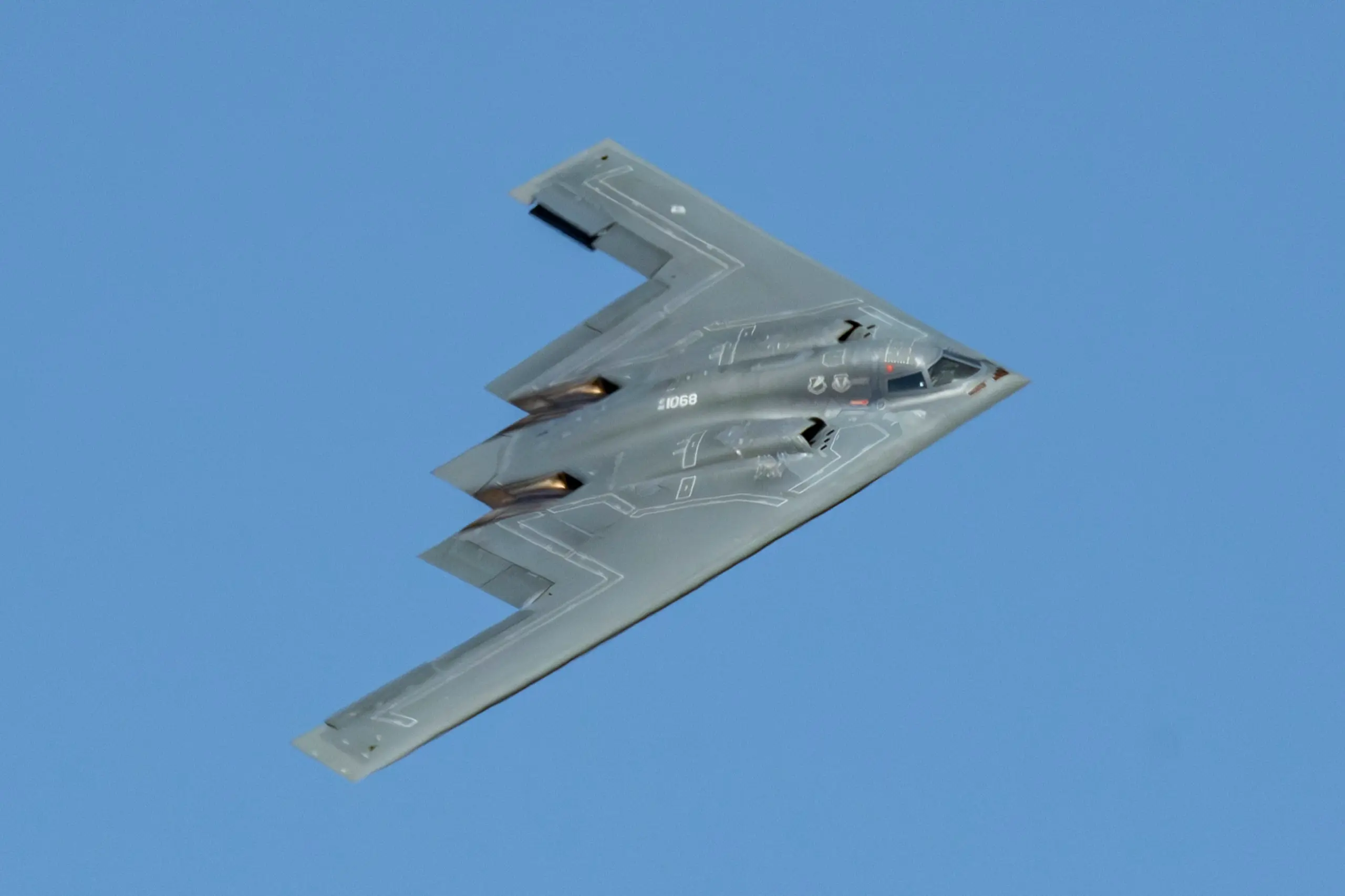
A grey B-2 Spirit flying wing banking across a clear blue sky, seen from below

Bomber · Modern · In service

B-2 Spirit

Two pilots, one wing, anywhere on Earth

Northrop (now Northrop Grumman)

Ever built (132 were once planned)
21
Longest combat mission, Afghanistan 2001
44.3hrs
Bombs dropped in one 22-second pass
80
Pilots qualified in its first 33 years
550

On 22 November 1988 a hangar at Air Force Plant 42 in Palmdale, California, opened on a shape the Air Force had kept secret for years: a single grey wing, 52 metres from tip to tip, with no tail, no fuselage and nothing sticking out. Two people fly it. It was built to pass through the best air defences on Earth, hit the targets they were guarding, and be gone before anyone worked out where it had come from.

The shape was not new. Jack Northrop had been building flying wings since the 1940s, and his jet-powered YB-49 spanned 52.4 m, the same figure as the B-2’s. The Air Force cancelled it. Decades later, engineers realised that a flat wing with no tail gives radar very little to bounce off, and the idea came back. In April 1980 his old company showed Northrop, by then in his eighties, a model of the secret new bomber. “Now I know why God has kept me alive for the last 25 years,” he said.

The Air Force once planned to buy 132. In the early 1990s, with the Cold War over, the order was cut to 21, and the Air Force put the unit cost at about $1.157 billion in 1998 dollars. At that price each jet became a national treasure with its own name: Spirit of Missouri, Spirit of Ohio, Spirit of Kansas. One crashed in 2008 and another was retired after a 2022 accident, which leaves a fleet of 19 under the Air Force’s 2024 plans, all of them at one base, Whiteman, in Missouri.

What the B-2 does with that shape is go a very long way. Its first war, Kosovo in 1999, was flown from Missouri and back in over 30 hours. In 2001 one crew stayed airborne for 44.3 hours to bomb Afghanistan. In June 2025 seven B-2s flew to Iran and back in about 37 hours, carrying 13.6-tonne bunker busters that had never been used in combat. No other Air Force jet can carry them.

Its replacement, the B-21 Raider, is already flying, with the first operational jets due in 2027. Nobody is in a hurry to say goodbye. In September 2026 the Air Force said the B-2 will keep flying until the Raider is fully ready, so for now Jack Northrop’s wing is still on call.

Armament

GBU-57 Massive Ordnance Penetrator
Two of these 13.6-tonne bunker busters, one in each weapons bay. Each carries about 2,400 kg of explosive and was designed to dig deep underground before going off. The B-2 is the only Air Force aircraft that carries it, and in June 2025 it dropped 14 of them in combat for the first time.
Satellite-guided bombs (JDAM)
Up to 80 independently aimed 227 kg bombs, or a smaller number of 907 kg ones. On its very first combat mission in 1999, each B-2 carried 16 of the big ones.
Nuclear weapons
A dual-role bomber: the same jet that drops precision conventional bombs is part of America's nuclear deterrent.
No guns, no turrets
Nothing hangs under the wing. Every weapon rides inside the two weapons bays in the belly, out of sight.

Missions & Moments

Midnight Hammer

Around midnight, Friday into Saturday, June 21, 2025, a large package of B-2s takes off into the dark from Whiteman Air Force Base in Missouri. Some of them turn west, out over the Pacific. They are decoys, part of a deception known only to a handful of planners in Washington and Tampa.

The real strike force heads east: seven B-2s, two pilots in each, saying as little as possible on the radio. Ahead of them is an 18-hour flight to Iran, with several air-to-air refuelings along the way. In the bomb bays ride fourteen GBU-57 Massive Ordnance Penetrators, 13.6-tonne bunker busters that have never been used in combat. Their targets are the nuclear sites at Fordow and Natanz, buried deep underground.

Near the target area the bombers link up with escort fighters and support aircraft, in what the Chairman of the Joint Chiefs, Gen. Dan Caine, later called "a complex, tightly timed maneuver requiring exact synchronization across multiple platforms in a narrow piece of airspace." Fighters sweep ahead at high altitude and high speed, hunting for enemy jets and missile sites. A US submarine fires more than two dozen Tomahawk cruise missiles at a third site, Isfahan.

At about 2:10 in the morning, Iran time, the lead B-2 releases two GBU-57s on the first aim point at Fordow. The other bombers follow. Within about 25 minutes all three sites have been hit. According to Caine, "Iran's fighters did not fly, and it appears that Iran's surface-to-air missile systems did not see us."

Then the long way home. By the time the bombers land back at Whiteman the crews have been flying for about 37 hours, napping in turns on the floor space behind their seats. More than 125 aircraft took part. Caine called it "the largest B2 operational strike in U.S. history and the second longest B-2 mission ever flown, exceeded only by those in the days following 9/11."

A design from the 1980s had carried two pilots per jet halfway around the world and back without landing. Forty-five years after Jack Northrop held that first model, his flying wing had flown the mission it was built for.

The crews

Two people fly a B-2, even on missions that last a day and a half: the pilot in the left seat and the mission commander in the right. A B-1B carries four, a B-52 five. Getting one of those two seats takes about six months at Whiteman: 266 hours of classroom work, 30 exams, 46 simulator missions and 10 flights in the real jet, and only around 16 new B-2 pilots graduate each year.

Your Spirit Number
After their first flight, every B-2 pilot gets a Spirit Number, a sequential number that is never reused. Number 1 went to test pilot Bruce Hinds in 1989. After 33 years only 550 pilots had one, and fewer than 800 people of any kind had ever flown in a B-2.
Picky about pilots
Pilots apply with their full flying record. In one 2020 cycle nearly 60 applied, 12 were interviewed and 6 were selected.
A cot behind the seats
On marathon missions the pilots take turns napping on a modified Army cot behind the ejection seats. Sleep is rare and bad, or as Col. Mel Deaile put it, “any sleep is good sleep.” There is a tiny chemical toilet, and for the rest there are "piddle packs".
Desert-dry air
The cabin air is so dry on long sorties that crews must keep drinking and still end up with dry, cracking skin. Each pilot packs their own food for the trip.

Names worth knowing

  • Bruce Hinds & Col. Rick Couch Spirit Numbers 1 and 2

    The test pilots who took the B-2 up for the first time on July 17, 1989, from Palmdale to Edwards.

  • Lt. Col. Eric Single First into combat

    Led the two-ship B-2 strike on the opening night of Operation Allied Force in March 1999, flying Spirit of Mississippi on a round trip of just over 31 hours.

  • Col. Mel Deaile & Brian Neal 44.3 hours

    Flew the longest B-2 sortie ever, from Missouri to Afghanistan and back, starting October 7, 2001.

  • Lt. Col. Justin Meyer 2,000 hours

    A Missouri Air National Guard pilot who, on June 6, 2024, became the first Air Force pilot to pass 2,000 flight hours in the B-2.

Did You Know?

The B-2's wingspan is 52.4 m, exactly the same as Jack Northrop's YB-49 flying wing of 1947.
In April 1980 Northrop's company showed the elderly Jack Northrop a model of the secret new bomber. “Now I know why God has kept me alive for the last 25 years,” he said. He died in February 1981.
In a 2003 test over Utah, one B-2 dropped 80 satellite-guided bombs in a single 22-second pass, each one aimed at its own target.
The museum B-2 in Dayton was a test airframe. Engineers bent its wing to more than 161 percent of its design load before it cracked.
The first B-2 ever lost, Spirit of Kansas in 2008, was brought down by moisture in its air-data sensors, which fooled the flight computers into a 30-degree pitch-up on takeoff. The bill came to about $1.4 billion.
In 1993 Spirit of Ohio spent more than 1,000 hours in a climate lab, from −54 °C to 49 °C plus rain and humidity, then went to Alaska to do it for real.

Myth vs. fact

Myth

The B-2 is invisible to radar.

Fact

Not quite. The Air Force calls it low observable: shape, composite materials and special coatings shrink its radar, infrared, acoustic and visual signatures so that it is difficult to detect, track and engage. Difficult, not impossible, and much of how it works is still classified.

Myth

The flying wing was invented for the B-2.

Fact

Jack Northrop flew his first flying wing in 1940, and his jet-powered YB-49 flew in 1947 with a 52.4 m wingspan, the same as the B-2's. The idea was old. What was new was using the shape to hide from radar.

Timeline

  1. Oct 21, 1947

    Jack Northrop's jet-powered YB-49 flying wing makes its first flight, on a wingspan of 52.4 m, exactly what the B-2's would be.

  2. Nov 22, 1988

    After years of secrecy, the B-2 is rolled out in public at Air Force Plant 42, Palmdale, California.

  3. Jul 17, 1989

    First flight, from Palmdale to Edwards Air Force Base. Test pilots Bruce Hinds and Col. Rick Couch receive Spirit Numbers 1 and 2.

  4. Dec 17, 1993

    The first operational B-2, Spirit of Missouri, is delivered to Whiteman Air Force Base, Missouri, still the type's only operational home.

  5. Apr 1997

    The B-2 reaches initial operating capability.

  6. Mar 1999

    First combat. Two B-2s fly non-stop from Missouri to Yugoslavia and back in just over 31 hours, opening Operation Allied Force.

  7. Oct 7, 2001

    A B-2 crew flies a 44.3-hour mission from Whiteman to Afghanistan, the longest in the type's history.

  8. Feb 23, 2008

    Spirit of Kansas crashes on takeoff at Andersen Air Force Base, Guam. Both pilots eject. It is the first B-2 ever lost.

  9. Nov 10, 2023

    Its successor, the Northrop Grumman B-21 Raider, flies for the first time.

  10. Jun 21–22, 2025

    Operation Midnight Hammer: seven B-2s strike Iranian nuclear sites, the largest B-2 operational strike in history.

  11. Sep 2026

    The Air Force says the B-2's service life will be extended until the B-21 is fully operational.

Where to see one today

Every B-2 that can fly is still on active duty, so the one you can stand next to is a jet that was never meant to fly at all.

United States· 1

  • National Museum of the U.S. Air Force

    Dayton, Ohio

    Built without engines, for fatigue testing: engineers bent its wing to over 161 percent of the design load before it finally cracked. It arrived in seven C-5 Galaxy loads and took three years to restore. Look for the "Fire and Ice" nose gear panel from Spirit of Ohio.

    B-2 test airframe “Spirit of Freedom” · indoors

Your best chance to see a real one fly is an air show or a flyover: B-2s from Whiteman regularly appear at events across the US.

Locations last checked October 2026 (museum fact sheet). Airframes occasionally move, so check with the museum before you travel.

On screen

Where the B-2 Spirit became a star outside the hangar.

  • Film · 1996

    Independence Day

    When the alien ship parks over Houston, the President sends B-2s from Whiteman. One fires a nuclear cruise missile straight at it, and the city is flattened while the ship's shield shrugs it off. The rare film moment where the B-2 doesn't win.

Find it in

Sources

Facts last reviewed October 2026

  1. 1. John A. Tirpak, Air Force Will Retire, Not Repair, Damaged B-2, Air & Space Forces Magazine, May 13, 2024 (fleet of 19)
  2. 2. U.S. Air Force: B-2 Spirit fact sheet (specifications, crew, range, history; current as of May 2026)
  3. 3. National Museum of the U.S. Air Force: Northrop B-2 Spirit (test airframe, fatigue and climate testing)
  4. 4. U.S. Air Force: ‘Spirit of Freedom’ dedicated at AF museum (2003)
  5. 5. Gen. Dan Caine, Pentagon press briefing on Operation Midnight Hammer, June 22, 2025 (transcript via American Rhetoric; original on defense.gov and DVIDS)
  6. 6. RFE/RL: Dry Skin, Hot Food: Life Inside The B-2 Bombers That Struck Iran's Nuclear Sites (2025; 37-hour duration confirmed by Whiteman AFB)
  7. 7. David Roza, “15 Tons of Bombs and One Tiny Toilet”, Air & Space Forces Magazine, June 25, 2025 (44.3-hour mission, crew life)
  8. 8. Air & Space Forces Magazine: First B-2 Combat Aviator Retires (2010)
  9. 9. Cristina Stassis, US Air Force to extend service of B-1, B-2 bombers, Air Force Times, September 17, 2026
  10. 10. U.S. Air Force: Second B-21 test aircraft arrives at Edwards AFB (2025)
  11. 11. Air & Space Forces Magazine: New B-21 Bomber Takes First Flight (2023)
  12. 12. U.S. Air Force: B-2 accident report released (2008)
  13. 13. Boeing: U.S. Air Force B-2 Bomber Drops 80 JDAMs in Historic Test (2003)
  14. 14. Whiteman AFB: What's in a number: how the Air Force catalogs its B-2 Spirit pilots (2022)
  15. 15. DVIDS: Joining the select few: 500th pilot qualifies for B-2 Spirit (2020)
  16. 16. Air National Guard: Lt. Col. Justin Meyer becomes first pilot to pass 2,000 B-2 flight hours (July 2024)
  17. 17. Walter J. Boyne, “The Low-Drag World of Jack Northrop”, Air Force Magazine, October 2005
  18. 18. John T. Correll, “Jack Northrop and the Flying Wing”, Air Force Magazine, December 2016
  19. 19. Air & Space Forces Magazine: GBU-57 Massive Ordnance Penetrator (weapons guide)
  20. 20. U.S. General Accounting Office: B-2 Bomber: Cost and Operational Issues (GAO/NSIAD-97-181, 1997)
  21. 21. Air Combat Command: B-2 accident report released, June 6, 2008 (Spirit of Kansas crash cause, injuries, pitot heat technique)
  22. 22. Independence Day (20th Century Fox, 1996), and the Internet Movie Plane Database: Independence Day