Skip to content
Early preview The vault is just opening. New files are added regularly, and some sections are still being built.
VLTARIS
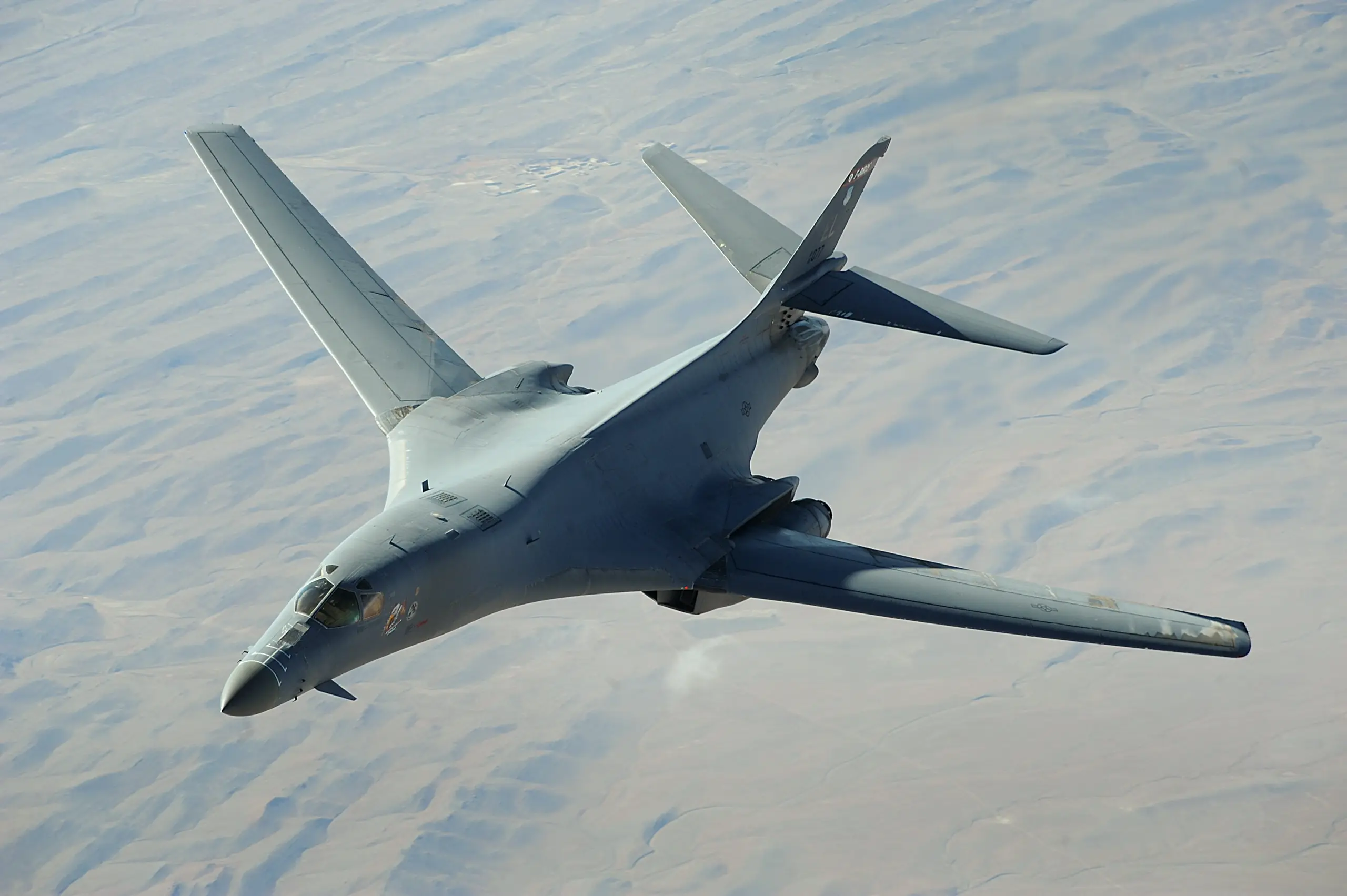
B-1B Lancer with wings fully swept flying a combat patrol over the brown hills of Afghanistan

Bomber · Cold War · In service

B-1B Lancer

Cancelled in 1977, still flying in 2026

Rockwell International (now Boeing)

Top speed, the fastest bomber in the US Air Force
Mach 1.2
Internal bomb load, the largest in the fleet
34,000kg
Of the bombs dropped on Afghanistan in the first six months, from 5% of the strike sorties
40%
Still in service, of 100 built
45

Crews call it the Bone. By historian Dennis Jenkins’s account the name began with a newspaper that printed the designation as “B-ONE”, and it had stuck long before the Air Force got round to christening the aircraft Lancer in 1990. Nobody who flies it says Lancer. The Bone is Rockwell’s swing-wing bomber, 41.8 metres across with the wings spread for take-off and 24 metres with them swept back to 67.5 degrees, and in that shape it will do Mach 1.2, faster than any other bomber the US Air Force has. Four people fly it. Three internal bays hold up to 34,000 kg of weapons, the largest internal load of any bomber in the fleet, the B-52 included.

The aircraft flying today is the second attempt. Rockwell’s B-1A first flew in December 1974 as the Mach 2 bomber that was going to replace the B-52, and on 30 June 1977 President Carter cancelled it before production could start, with three prototypes flying and a fourth on the way. The test flights went on quietly. On 2 October 1981 President Reagan brought it back as the B-1B: slower, with its sweep limited and the inlets simplified to shrink its radar echo, strengthened to take off at 216 tonnes, and fitted with new radar and computers. The first production aircraft flew in October 1984, The Star of Abilene was handed to Dyess in June 1985, and the bomber went on nuclear alert on 1 October 1986. The hundredth and last was delivered in May 1988. Those three years of production are the whole fleet.

The job it was built for, running in low under Soviet radar with nuclear missiles, never came. The job it ended up doing, it was never designed for. It dropped its first bombs in anger over Iraq in December 1998, flew over Kosovo the following spring, and then in Afghanistan in 2001 became the aircraft that carried the war: nearly 40 per cent of the ordnance from 5 per cent of the strike sorties, by the Air Force’s own count, because its three bays could hold 24 satellite-guided bombs and it could stay overhead for hours. The service’s news arm took to calling it the “monster truck” of the bomber fleet. Over Iraq it set up round-the-clock orbits, waiting for calls from the ground, and in 2011 it flew its first combat mission straight from South Dakota to Libya.

Twenty years of that wore the fleet down. In 2021 the Air Force retired 17 of the most tired airframes, leaving 45 split between Dyess and Ellsworth Air Force Base in South Dakota, and the B-21 Raider is due at Ellsworth in 2027 to begin replacing it. The published plan had the last B-1 gone no later than 2036. In September 2026 the head of Air Force Global Strike Command said both the B-1 and the B-2 would be kept flying beyond their planned retirements until the new bomber is ready in numbers. Only one air force ever flew the Bone, and it is not finished with it yet.

The bomber that gave up its bombs

The B-1B went on nuclear alert in October 1986. Among the weapons it was meant to carry was the AGM-69 SRAM, a short-range nuclear missile that the 96th Munitions Maintenance Squadron at Dyess practised loading into its bays, and the plan was the one Strategic Air Command had rehearsed for decades: cross the ocean, drop down to low level with the terrain-following radar, and run in under Soviet radar faster than anything had done it before. The Air Force never had to find out whether that would have worked.

By the mid-1990s the Cold War was over and the Air Force had decided the Bone's future was conventional. The first B-1Bs handed to Air National Guard units in Kansas and Georgia in the mid-1990s were set up for conventional bombs only, and the money went into smart-weapon interfaces instead of nuclear hardware. Then the arms-control treaties with Russia made the change permanent and physical. Technicians cut the wiring bundles in the weapons bays that would have armed a nuclear weapon, destroyed the nuclear pylons, and modified the external hardpoints so that a nuclear pylon could never be attached again. The last aircraft was converted in 2011.

Russia does not take that on trust. Under the treaty, Russian inspectors visit Ellsworth and Dyess to look over the aircraft and confirm that the United States has not quietly undone the work. Kenneth Vantiger, an arms-control analyst at Air Force Global Strike Command, put it plainly in 2017: they come to check "we haven't 'unconverted' them." So when a magazine calls the B-1 a nuclear bomber, it is three decades out of date. Of the B-52, the B-2 and the B-1, it is the only one that cannot carry a nuclear weapon at all.

Forty per cent of the bombs, five per cent of the sorties

On the night of 7 October 2001, the opening night of the war in Afghanistan, B-1Bs lifted off from the coral island of Diego Garcia in the Indian Ocean, more than 4,000 km from Kabul. For much of the 1990s the Bone had been a disappointment, with mission-capable rates that embarrassed its supporters. Afghanistan changed its reputation.

The weapon was the JDAM, a 900 kg bomb fitted with a GPS tail kit. A B-1 carries 24 of them, each with its own coordinates. Major General Daniel Leaf, the Pentagon's director of operational requirements, described the image that stayed with him: "the picture of an Afghan mountainside and a string of (GBU-31/32 joint direct attack munitions) marching down a trench line." By March 2002 the Air Force's own count had the B-1B dropping nearly 40 per cent of the ordnance in the campaign while flying only 5 per cent of the strike sorties, and the service press was calling it the "monster truck" of the bomber fleet.

None of this was in the plan. Leaf was candid about that: "If you offered the B-1 with JDAMs in direct support of ground forces as a solution 10 years ago, I would have laughed heartily because it's not what we envisioned." The aircraft designed to sneak into the Soviet Union at low level spent the next twenty years circling high over Afghanistan and Iraq for hours at a time, waiting for a call from troops on the ground, and dropping one bomb at a time. By 2025 the fleet had flown more than 12,000 combat missions since 2001.

Libya, from South Dakota

In the last week of March 2011 the 28th Bomb Wing at Ellsworth Air Force Base, South Dakota, was told to get ready to strike targets in Libya under the United Nations no-fly zone. No B-1 combat mission had ever been flown straight out of the continental United States. The wing had less than two days from first notice to take-off, and the weather on the ramp was snow, ice and fog.

Load crews moved 900 kg bombs from trailers onto jammers and into the bays on 26 March while other airmen de-iced the jets. On 27 March the Lancers launched, crossed the Atlantic, hit their targets in Libya, and flew two missions before coming home. The wing commander's objective was to destroy nearly a hundred military targets, and the wing reported that every intended target was struck. On 30 March the airmen of the 28th lined up to salute two B-1s as they taxied back to their parking spots at Ellsworth.

The B-52 had flown from Louisiana to Iraq and back on the first night of Desert Storm in 1991, and the B-2 does it as a matter of routine. For the Bone this was a first, and the point it made is the one the squadrons still make on their "bomber task force" deployments to Europe and the Pacific: a bomber parked at home in the Dakotas is already within reach of almost anywhere.

Armament

Three internal weapons bays
Up to 34,000 kg of ordnance inside the fuselage, the largest internal load of any bomber in the fleet. A movable bulkhead between the forward and middle bays lets the crew mix long and short weapons.
GPS-guided bombs
Up to 24 GBU-31 JDAMs of about 900 kg each, the load that did the damage over Afghanistan. Each bomb steers itself to its own set of coordinates, so one pass can hit 24 separate targets.
Unguided bombs
Up to 84 Mk 82 bombs of 227 kg, or 30 cluster bombs. The Mk 82s were the weapon of its first combat mission in 1998.
JASSM cruise missiles
Up to 24 AGM-158 JASSM stealthy cruise missiles. The B-1 was the lead aircraft for the extended-range version, which flies more than 800 km to its target.

Missions & Moments

Cease ejection

On 1 May 2018 a B-1B from the 7th Bomb Wing at Dyess Air Force Base was on a routine training flight over West Texas. The 28th Bomb Squadron is the B-1 schoolhouse, so the four seats held two instructors and two students: Major Christopher Duhon, instructor pilot and aircraft commander; First Lieutenant Joseph Welch, student pilot; Captain Matthew Sutton, instructor weapon systems officer; and First Lieutenant Thomas Ahearn, student weapon systems officer.

Fire warnings lit up for three separate areas of the aircraft. The crew worked the procedures and put out all but one. For a fire that will not go out, the B-1 technical orders end with leaving the aircraft. Duhon ordered a controlled manual ejection.

Each of the four seats in a B-1B sits under its own hatch. The hatches blow off first, then the seats fire. The first crew member pulled the handles. Air Force Secretary Heather Wilson later described what happened next: "The cover comes off, and nothing else happens. The seat doesn't fire." The crew now had an open hole in the roof and a fire still burning.

Another crew member called out that the seat had not gone. Within two seconds, Wilson said, Duhon gave the order: "Cease ejection, we'll try to land."

They flew the bomber on two engines to Midland International Air and Space Port with the cockpit open to the slipstream, depressurised, alarms sounding and the wind roaring through the missing hatch, and put it on the runway. The Air Force called it the first-ever successful landing of a B-1B with that combination of malfunctions.

The fleet stood down for about two weeks while every ejection seat was checked. On 19 June Air Force Global Strike Command cleared the B-1 to fly again, saying it had high confidence in the egress systems. On 13 July, at Dyess, General Robin Rand pinned the Distinguished Flying Cross on all four. The bomber itself sat at Midland through the investigation, was patched up, and on 26 October 2018 was flown to Tinker Air Force Base in Oklahoma for depot maintenance and its return to service.

The crews

Four people fly a B-1B, side by side in two rows: the aircraft commander and co-pilot up front, and behind them two weapon systems officers, one for the offensive systems (radar, navigation and weapons) and one for the defensive systems that jam and decoy enemy radar. The seats are a change from the B-1A, three of whose four prototypes had a capsule that ejected the whole cockpit as a unit.

The schoolhouse
New B-1 crews learn the aircraft with the 28th Bomb Squadron at Dyess Air Force Base, Texas, flying with an instructor pilot and an instructor weapon systems officer. The crew of the 2018 Midland landing was two instructors and two students.
Name your jet
Every B-1B has a name, painted on the nose with its own artwork: Lucky 13, Boss Hog, Star of Abilene, Wild Ass Ride, Last Lancer. The name is chosen by the aircraft's crew chief, subject to the wing commander's approval, and some jets have been renamed more than once.
Inspectors from Moscow
Part of the job at Ellsworth and Dyess is hosting Russian arms-control inspectors, who come to confirm that the aircraft are still incapable of carrying nuclear weapons.

Names worth knowing

  • Robert Chamberlain Record setter

    Flew a B-1B to world speed records with heavy payloads on 4 July 1987 at Palmdale, including 1,078 km/h around a 2,000 km circuit carrying 20,000 kg. That record is still on the books.

  • Christopher Duhon, Joseph Welch, Matthew Sutton and Thomas Ahearn The Midland crew

    Instructor pilot, student pilot, instructor weapon systems officer and student weapon systems officer on 1 May 2018. After the first ejection seat failed, Duhon called off the ejection and landed the burning bomber on two engines. All four received the Distinguished Flying Cross.

Did You Know?

Nobody calls it the Lancer. The official name was only given in 1990, and by then crews had settled on "Bone", which started, according to historian Dennis Jenkins, with a newspaper article that printed the designation as "B-ONE" without the hyphen.
Three of the four B-1A prototypes had no ejection seats. The whole cockpit was an escape capsule that blew off the aircraft and came down under its own parachutes, the way the F-111's did. The B-1B went back to four ordinary seats.
On 4 July 1987 a B-1B flew a 2,000 km closed circuit at 1,078 km/h while carrying 20,000 kg of payload. The FAI still lists it as the current world record.
Of the B-52, B-2 and B-1, it is the only one that cannot carry a nuclear weapon. The wiring was cut and the pylons destroyed under treaty, and Russian inspectors visit the bases to check that it stays that way.
A B-1B named Lancelot retired to the Arizona boneyard in March 2021, then came back. After an engine exploded on a Dyess jet during maintenance in 2022, the Air Force pulled Lancelot out of storage, reinstalled nearly 500 parts of its ejection system, and flew it to Tinker in 2024 for a second career.
The first B-1B was delivered to Dyess in June 1985 and the hundredth in May 1988. Those three years of production are the whole fleet; every Bone flying today is pushing forty.

Timeline

  1. Dec 23, 1974

    The first B-1A prototype flies from Palmdale, California, two months after rolling out of the Rockwell plant.

  2. Jun 30, 1977

    President Jimmy Carter cancels B-1 production. Three B-1As are flying and a fourth will follow in 1979; the flight tests go on.

  3. Oct 2, 1981

    President Ronald Reagan brings the bomber back and approves 100 B-1Bs as part of his defence build-up.

  4. Oct 1984

    The first production B-1B flies.

  5. Jun 1985

    B-1B 83-0065, The Star of Abilene, is delivered to Dyess Air Force Base, Texas, the first of the fleet.

  6. Oct 1, 1986

    Initial operating capability. The B-1B goes on nuclear alert with Strategic Air Command.

  7. Jul 4, 1987

    A B-1B crew led by Robert Chamberlain sets world speed records with 20,000 kg and 25,000 kg payloads over closed circuits at Palmdale. One of them still stands.

  8. Dec 18, 1998

    Combat debut: B-1Bs from Ellsworth and Dyess bomb Republican Guard targets in Iraq during Operation Desert Fox.

  9. Oct 7, 2001

    B-1Bs take off from Diego Garcia on the first night of strikes over Afghanistan.

  10. Mar 27, 2011

    Ellsworth launches B-1Bs against targets in Libya, the first time the fleet has flown combat sorties straight from the continental United States.

  11. Sep 23, 2021

    B-1B 85-0074 flies from Edwards to the boneyard at Davis-Monthan, the last of 17 Lancers retired that year. 45 remain.

  12. Sep 2026

    Air Force Global Strike Command says the B-1 and B-2 will both fly on past their planned retirements while the B-21 Raider arrives.

Where to see one today

Eight B-1s you can visit: six B-1Bs and two of the four B-1A prototypes. Two of the B-1Bs sit on active bases, so check visitor access before you go.

United States· 8

  • Wings Over the Rockies Air & Space Museum

    Denver, Colorado

    The third B-1A built, which ended its days as a ground trainer for bomb loaders at Lowry Air Force Base. On loan from the National Museum of the US Air Force.

    B-1A · indoors
  • Museum of Aviation

    Warner Robins, Georgia

    Painted as 86-0098 of the Georgia Air National Guard's 116th Bomb Wing, which flew B-1Bs from Robins from 1996 to 2002.

    83-0069B-1B
  • Barksdale Global Power Museum

    Bossier City, Louisiana

    One of the 17 Lancers retired in 2021, towed across the base to the museum air park in February 2022.

    B-1B · outdoors
  • Strategic Air Command & Aerospace Museum

    Ashland, Nebraska

    The fourth and last B-1A, used as the avionics test bed for the B-1B. The only prototype with ejection seats instead of an escape capsule.

    76-0174B-1A · indoors
  • National Museum of the US Air Force

    Dayton, Ohio

    Boss Hog, delivered to Dyess in 1986 and retired to the museum in 2002.

    84-0051B-1B · indoors
  • South Dakota Air and Space Museum

    Ellsworth AFB, South Dakota

    Texas Raider, outside the gate of the Bone's northern home.

    83-0067B-1B · outdoors
  • Dyess Linear Air Park

    Dyess AFB, Abilene, Texas

    The Star of Abilene, the first B-1B delivered to the Air Force in 1985. Active base, so check visitor access first.

    83-0065B-1B · outdoors
  • Hill Aerospace Museum

    Roy, Utah

    7 Wishes, a Dyess training jet with almost 4,000 flying hours. At the museum since May 2005.

    83-0070B-1B

Locations last checked October 2026. Airframes occasionally move, so check with the museum before you travel.

Sources

Facts last reviewed October 2026

  1. 1. U.S. Air Force: B-1B Lancer fact sheet
  2. 2. Boeing: B-1 Lancer (specifications, combat record)
  3. 3. Hill Aerospace Museum: B-1B "Lancer" (83-0070)
  4. 4. Museum of Aviation, Robins AFB: B-1B Lancer
  5. 5. Strategic Air Command & Aerospace Museum: B-1A "Lancer" (programme dates, 76-0174)
  6. 6. Wings Over the Rockies Air & Space Museum: B-1A Lancer
  7. 7. National Museum of the U.S. Air Force: Boeing B-1B Lancer fact sheet; U.S. Air Force, “B-1B finds home at Air Force museum” (2002)
  8. 8. Tech. Sgt. Tim Dougherty, “B-1 is tailor-made for Operation Enduring Freedom”, Air Force Print News, 29 March 2002
  9. 9. Adam J. Hebert, “Long-Range Strike in a Hurry”, Air & Space Forces Magazine, November 2004
  10. 10. Lt. Col. Ross Hobbs, “Risking America's Long-Range Strike Capability”, Air & Space Forces Magazine, 4 April 2025
  11. 11. Oriana Pawlyk, “START Lanced the B-1's Nukes, But the Bomber Will Still Get New Bombs”, Military.com, 12 July 2017
  12. 12. GlobalSecurity.org: B-1B Lancer, B-1B deployments (delivery dates, Air National Guard, aircraft names) and Operation Desert Fox
  13. 13. Air Force Global Strike Command, 25th anniversary of the B-1's combat debut (December 2023)
  14. 14. FAI world records 3825 and 3831 (Robert Chamberlain, 4 July 1987)
  15. 15. Task & Purpose, “Meet the heroic aircrew behind that fiery B-1B Lancer emergency landing”, 14 July 2018 (Secretary Wilson's account)
  16. 16. The Aviationist, “USAF identifies heroic B-1B bomber crew, awards Distinguished Flying Crosses”, 16 July 2018
  17. 17. Aerotech News, “B-1B Lancer arrives for overhaul and upgrade”, November 2018; Air Force Times, “B-1 that blew hatch in emergency landing flown to Tinker”, 26 October 2018
  18. 18. Rachel S. Cohen, “Farewell, Bones”, Air Force Times, 24 September 2021; John A. Tirpak, “First of 17 B-1Bs Heads to the Boneyard”, Air & Space Forces Magazine, 17 February 2021
  19. 19. Courtney Mabeus-Brown and Zamone Perez, “B-1 bomber rises from the Boneyard”, Military Times, 26 April 2024
  20. 20. Cristina Stassis, “US Air Force to extend service of B-1, B-2 bombers”, Air Force Times, 17 September 2026
  21. 21. Unshin Lee Harpley, “USAF Plans to Relocate B-1 Bombers from Ellsworth to Grand Forks in 2025”, Air & Space Forces Magazine, 19 August 2024
  22. 22. DVIDS / 2nd Bomb Wing, “2 BW adds B-1B Lancer to museum static displays”, March 2022
  23. 23. Dennis R. Jenkins, B-1 Lancer: The Most Complicated Warplane Ever Developed (McGraw-Hill, 1999)
  24. 24. U.S. Air Force photo captions for the Libya mission (26–30 March 2011) and the Diego Garcia launch (7 October 2001), via Wikimedia Commons
  25. 25. Museum websites linked in “Where to see one today” (checked October 2026)