On the morning of 30 October 1935 the only Flying Fortress in the world lifted off from Wright Field in Ohio with its control surfaces still locked for parking. It climbed steeply, stalled and fell back onto the airfield. Both pilots died. The Army cancelled its order and bought cheaper twin-engined Douglas bombers instead, and Boeing, which had bet the company on a four-engined aircraft nobody had asked for, was left with a wreck and a trademark. The inquiry found nothing wrong with the aircraft. It had become too complicated to fly from memory, so the pilots wrote out a list to read aloud before take-off. Every pilot alive today runs a checklist because of that crash.
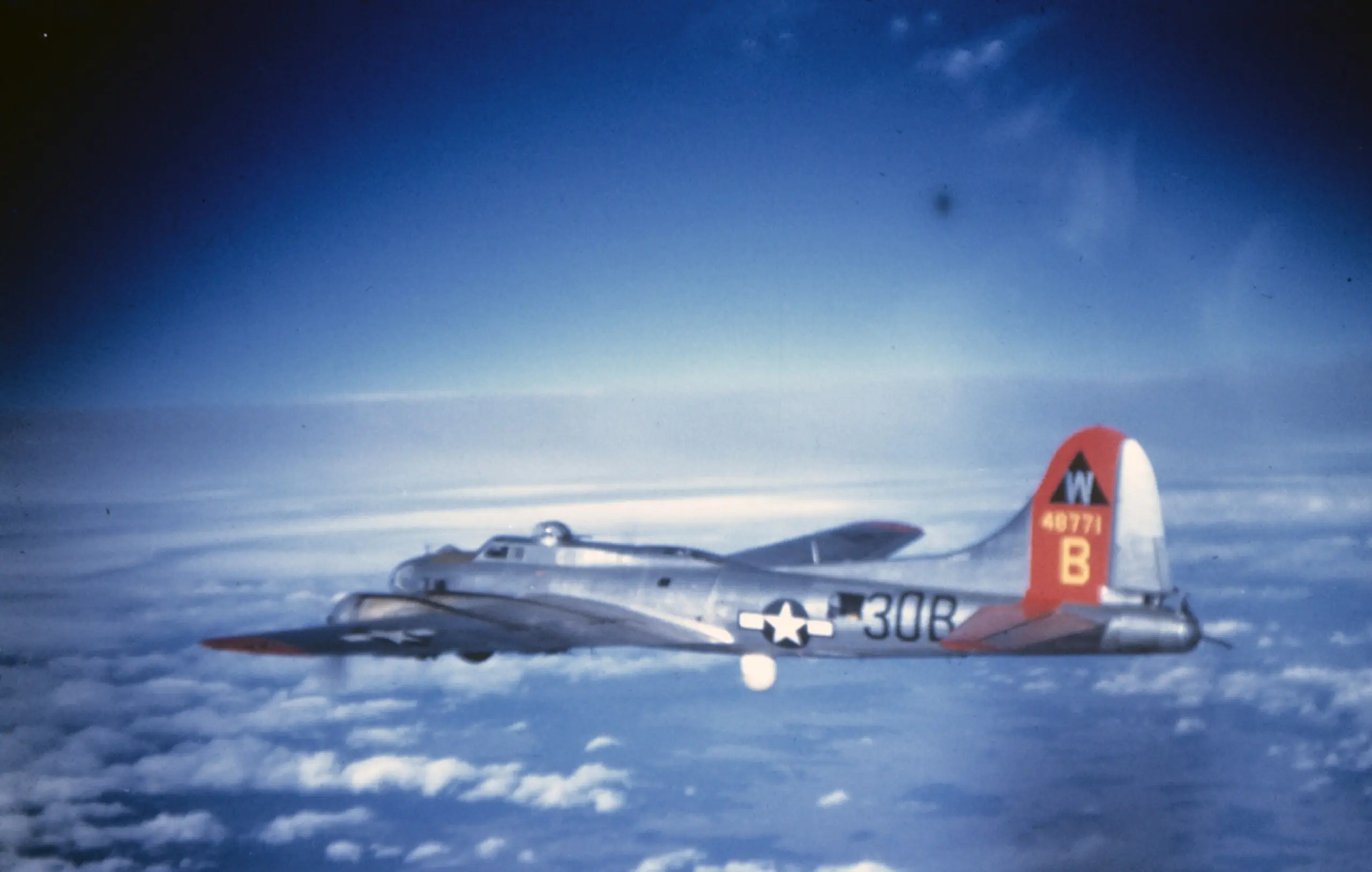
The Army came back for thirteen test aircraft, and then for thousands. By the end of the war Boeing, Douglas and Lockheed-Vega had built 12,731 of them, the fuselages queued nose to tail in Seattle like silver fish. The aircraft that reached England in 1942 was a different animal from the prototype, with a bigger tail, a gun position at the back, a top turret, a ball turret under the belly and, eventually, thirteen machine guns. German fighter pilots called the tight formations flying porcupines, which was the intent. The whole design rested on a bomber armed well enough to fight its way to any target in daylight without an escort.
Over Germany in 1943 that idea was tested to destruction. The escorts turned back at the border, the Luftwaffe waited on the far side of it, and on the worst days one bomber in five did not come home. A crew owed the Eighth Air Force 25 missions, and in that year only about one man in four finished them. What kept the campaign alive was partly stubbornness and partly the aircraft. The B-17 came back with an engine out, with the nose shot away, with the fuselage holed like a colander, with half the tail missing, and there are photographs of each. Pilots who had flown anything else said they would rather be hit in a Fortress, and the men who kept them flying patched the holes overnight.
Then the fighters that could go all the way arrived, the bombers went back to Schweinfurt and on to Berlin, and the B-17 dropped roughly 580,000 tonnes of bombs on Europe, more than any other American type. Carl Spaatz, who ran the air war there, said afterwards that without it the war might have been lost. The price is on the wall of the Air Force’s museum in Dayton: more than 30,000 heavy bomber crewmen killed, as many captured, 8,000 bombers gone.
Most of the survivors were melted down within a few years, and the last Air Force B-17s spent the 1950s shepherding target drones before they were retired in 1959. About 45 remain intact, and a handful still fly. The most famous of them never flew again. The Memphis Belle sat outdoors in Tennessee for half a century before the Air Force took it back, spent thirteen years putting it right, and set it down in Dayton, where you can walk around it today.


