Skip to content
Early preview The vault is just opening. New files are added regularly, and some sections are still being built.
VLTARIS
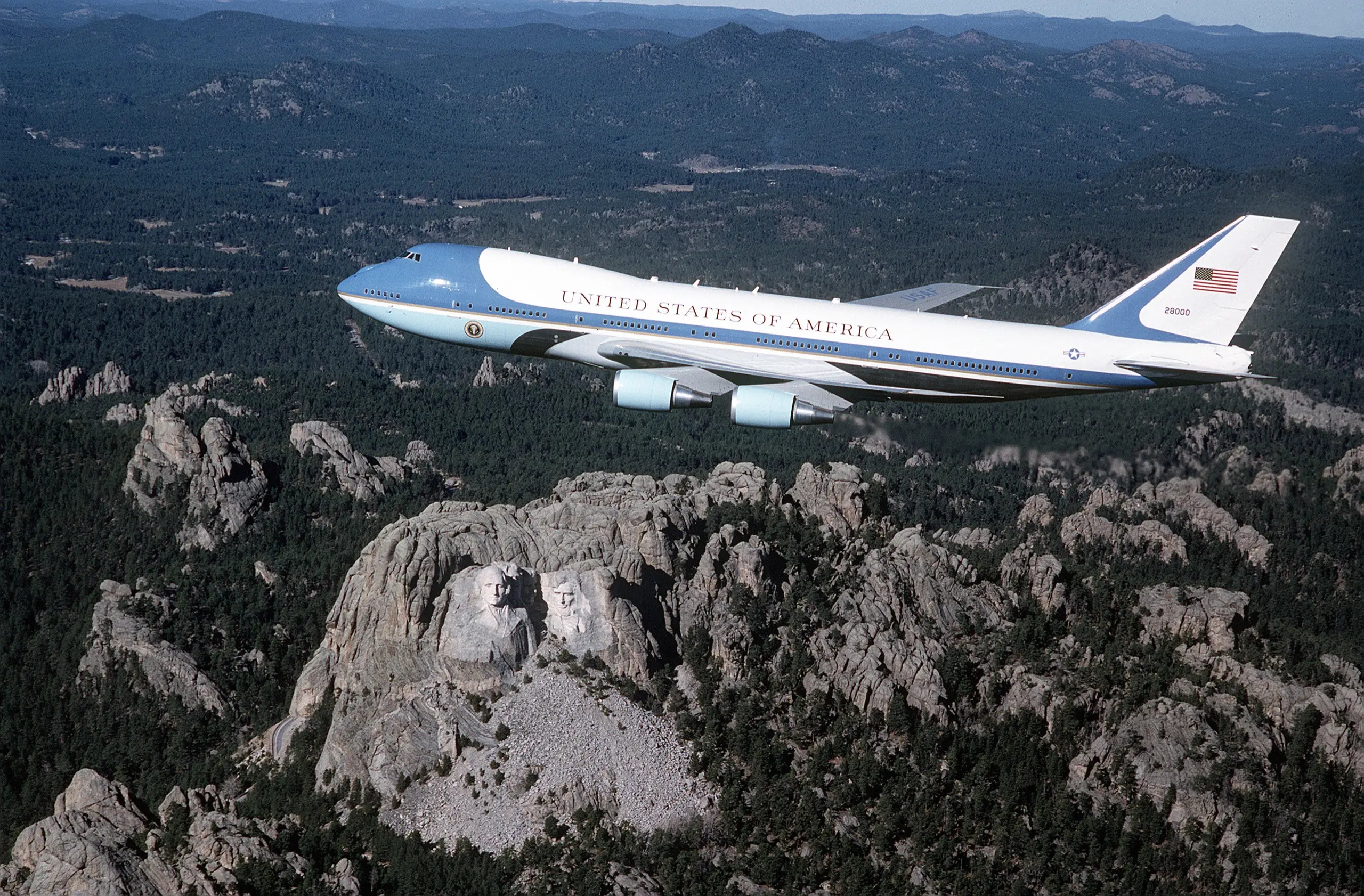
A blue and white VC-25A Air Force One flying past the granite faces of Mount Rushmore, above forested hills

Transport · Cold War · In service

Air Force One

The call sign that follows the president

Boeing (VC-137C from the 707, VC-25A from the 747-200B), flown by the US Air Force

Presidents carried by SAM 26000
8
Flying hours on SAM 26000 before it retired
13,000+
VC-25A 747s, flying presidents since 1990
2
Meals the VC-25A's two galleys serve at one sitting
100

When the president of the United States boards an Air Force aircraft, its radio call sign changes to “Air Force One”. It might be a small executive jet or a four-engined 747; the name belongs to the radio, not to the aeroplane. Most people still picture one particular aeroplane, a blue and white airliner with “United States of America” along its side and the flag on its tail. This page is about that aircraft, and the jets that have carried the name since 1962.

Today the call sign usually goes to one of two Boeing 747-200Bs, tail numbers 28000 and 29000, known to the Air Force as the VC-25A. On the outside they look much like airliners of their generation. Inside they carry their own airstairs and baggage loader, a communications suite, an air-refuelling receptacle, a stateroom and office for the president, a conference room, a small medical bay, and seats for staff, guests, the Secret Service and the press. The first flew as Air Force One in September 1990. The figures on this page are the VC-25A’s.

The aircraft that made the name famous was a Boeing 707. SAM 26000, delivered in 1962, was the first jet built specifically for a president, and the Air Force says it was the first aircraft popularly known as Air Force One. It wore the livery that Jacqueline Kennedy and Raymond Loewy designed, carried eight presidents in 36 years, and was the aircraft on which Lyndon B. Johnson took the oath of office at Love Field in Dallas on 22 November 1963, a little over two hours after President Kennedy was shot.

The 747s that followed it have had their own such days. On 11 September 2001, VC-25A 29000 took off from Sarasota, Florida, with the president aboard and no fixed destination, and spent the day moving across the country, from Louisiana to Nebraska, before flying back to Washington that evening.

The VC-25As have now flown presidents for more than three decades. Boeing is building two new 747s to replace them, the VC-25B, and the Air Force expects the first to enter service in mid-2028. When it does, the call sign will move across, as it has moved from aircraft to aircraft since the 1950s.

11 September 2001: tail number 29000

On the morning of 11 September 2001, VC-25A 29000 was parked at Sarasota, Florida, while President George W. Bush visited the Emma E. Booker Elementary School. The pilot and commander of the Presidential Airlift Group, Col. Mark Tillman, was walking through the cabin checking each room when the radio operator called him upstairs to watch the news. The first pictures from New York looked like an accident. When the second aircraft struck, as Tillman later told an audience at the National Museum of the US Air Force, "all the phone lines are coming alive."

With reports of hijacked airliners still coming in, Tillman wanted to move the 747 off the ramp, where it was an obvious target. The Secret Service told him to stay put: "Negative, we are coming at you as fast as we can come at you. Do not, repeat, do not move." When the motorcade arrived, the right-hand engines were already running so the passengers could board on the left. As he taxied out, he was warned of an unknown man at the end of the runway, so he took off in the other direction, with a tailwind, and climbed hard: "Pullback, went up at about 8000 feet per minute, and just put the plane on its tail." The man turned out to be a father who had brought his children to watch Air Force One leave.

The 9/11 Commission records that the aircraft departed at about 9:54 with no fixed destination. The plan at the school had been to fly straight back to Washington, but the Secret Service, the president's advisers and the vice president argued against it, and at about 10:10 the 747 turned west. Word reached the crew of a threat against the aircraft itself, one that used its classified code name. The Commission later traced it to "a misunderstood communication in the hectic White House Situation Room that morning." Fighters joined up as escort, among them, Tillman recalled, F-16s of the Texas Air National Guard from Ellington Field.

The aircraft landed at Barksdale Air Force Base in Louisiana at about 11:45, where the president recorded a statement and the crew took on as much fuel as they could. At 2:50 p.m. it reached Offutt Air Force Base in Nebraska, chosen for its command and control facilities, and the president held a secure video conference with his advisers. Tillman expected to stay there for many hours. Then a young airman ran in to tell him the president was already heading back to the aeroplane. Tillman found him at the top of the stairs: "Tillman, it's time to get home. Let's get home."

In the late afternoon 29000 flew east, with fighters on its wings, and landed at Andrews. From there the president flew by helicopter to the White House, over the Pentagon, which was still smouldering, and spoke to the nation that evening. When he made his last flight on the aircraft in 2009, the crew gave him the cabin window he had looked out of that day, etched with the Manhattan skyline and the Twin Towers, for his presidential library.

Before the 747s: a cow, a hometown and a state flower

The first aircraft bought for a president was a four-engined Douglas VC-54C that entered service in 1944 for Franklin D. Roosevelt. Its nickname was the Sacred Cow. Harry Truman inherited it, and on 26 July 1947 he signed the National Security Act on board, which created the US Air Force as a service of its own. The Air Force still calls the Sacred Cow its birthplace.

Truman then moved to a Douglas VC-118 that he named Independence, after his hometown in Missouri. Dwight D. Eisenhower flew in two Lockheed Constellations, Columbine II and Columbine III, named after the state flower of Colorado as a compliment to his wife's home state. It was in his time, in 1953, that the call sign "Air Force One" was established, to avoid confusion with other aircraft in flight.

Eisenhower was also the first president to travel by jet. On 26 August 1959 he flew in SAM 970, a Boeing 707-120 that went on to carry Kennedy, Johnson and Nixon and foreign leaders such as Nikita Khrushchev. According to the Museum of Flight, which displays it in Seattle, early in its career the aircraft was secretly fitted out by the CIA as a spy plane, in a programme code-named Operation Lida Rose. It kept ferrying VIPs and vice presidents until 1996.

The next presidential jet, delivered in 1962, is the one that made "Air Force One" a household name.

Missions & Moments

Love Field, 22 November 1963

SAM 26000 was just over a year old when it brought President John F. Kennedy to Dallas on 22 November 1963. It was a Boeing 707 built for the job, the first jet ordered specifically for a president, and it wore a new livery of blue and white that Jacqueline Kennedy had worked out with the industrial designer Raymond Loewy, with "United States of America" in tall letters along the fuselage. By the evening it had been put to a use nobody had planned for.

Kennedy was shot in the motorcade through downtown Dallas at half past twelve. At Parkland Hospital, according to the Warren Commission, Vice President Lyndon B. Johnson "decided to board the Presidential airplane, Air Force One," but would not take off without the president's widow: "the Vice President said that he would not leave Dallas without her."

The casket was taken to the airport shortly after two. At about 2:15 it was carried aboard, "with some difficulty because of the narrow airplane door," and placed at the rear of the cabin. Meanwhile Federal Judge Sarah T. Hughes hurried to Love Field to give the oath of office.

Members of both parties crowded into the central compartment. At 2:38 p.m., Dallas time, Johnson raised his right hand and became the 36th President of the United States, with his wife on one side and Jacqueline Kennedy, still in the clothes she had worn in the motorcade, on the other. The White House photographer, Cecil Stoughton, took the picture. Squeezed in among the men on the right is Sid Davis, the Westinghouse radio pool reporter, face turned down to his notebook. Years later Davis said the photograph showed that "the Constitution still lives, the Constitution works, and it showed the world the United States was not imperiled here."

Nine minutes later the aircraft took off for Washington, with James B. Swindal at the controls, the new president in the cabin, and the coffin of the old one in the back. It landed at Andrews at 5:58 p.m. Washington time. Swindal kept the light blue blanket, embroidered with the presidential seal, that Kennedy had used on board, and it is now in the museum's collection.

SAM 26000 flew on for another 35 years. It took Johnson to visit the troops in South Vietnam, took Nixon to China and the Soviet Union in 1972, and carried Henry Kissinger on 13 trips to secret peace talks in Paris. In May 1998 it made its last flight, to Dayton. Today visitors walk through its cabin, past the spot where Johnson stood.

The crews

Air Force One is flown and looked after by the Presidential Airlift Group, part of the 89th Airlift Wing at Joint Base Andrews, Maryland. The Air Force fact sheet lists a crew of 30 for the VC-25A, and room for 71 passengers: the president's staff, guests, the Secret Service and a group of journalists, each in their own section of the aircraft.

Room inspection
Before every flight, Mark Tillman went through each room on the aircraft with the flight attendants. The president, he said, liked to tease him about anything that was not perfect, so he made sure nothing was.
White phones and beige phones
In Tillman's time the VC-25A carried 82 telephones. White phones were for ordinary calls and beige phones for secure ones.
Three minutes to taxi
With its own auxiliary power units, the VC-25A can start all four engines at once. Tillman said the aircraft could be ready to taxi in about three minutes.
A small hospital
The VC-25A has a compartment fitted out with medical equipment and supplies for minor emergencies, alongside the president's stateroom, office and a conference room that doubles as a dining room.

Names worth knowing

  • James B. Swindal Kennedy's pilot

    Flew SAM 26000 on 22 November 1963, including the flight that brought President Kennedy's body back to Washington. He kept the blue blanket with the presidential seal that Kennedy had used on board; his family later gave it to the National Museum of the US Air Force.

  • Col. Mark Tillman 12th presidential pilot, 2001–2009

    Commanded the Presidential Airlift Group and flew VC-25A 29000 on 11 September 2001. He went on to fly the president into Baghdad and Afghanistan in secret.

Did You Know?

The Sacred Cow, Roosevelt's and Truman's VC-54C, is the aircraft on which the act creating the US Air Force was signed, so the Air Force calls it its birthplace.
The blue and white livery was worked out by First Lady Jacqueline Kennedy and the industrial designer Raymond Loewy, at President Kennedy's request.
In 1970 Henry Kissinger flew aboard SAM 26000 on 13 separate trips to secret peace talks with the North Vietnamese in Paris.
In March 1983 Queen Elizabeth II flew on SAM 26000 during her visit to the United States.
The first presidential jet, SAM 970, was secretly fitted out as a spy plane by the CIA early in its career, under the code name Operation Lida Rose.
The VC-25A carries its own baggage loader and its own front and rear airstairs.

Timeline

  1. 1944

    A Douglas VC-54C nicknamed the Sacred Cow enters service for President Franklin D. Roosevelt. Presidential air transport begins.

  2. Jul 26, 1947

    President Truman signs the National Security Act aboard the Sacred Cow. The act creates the US Air Force as an independent service.

  3. 1953

    The call sign "Air Force One" is established for any aircraft carrying the president, to avoid confusion with other aircraft in flight.

  4. Aug 26, 1959

    Eisenhower becomes the first US president to fly by jet, aboard the Boeing 707 SAM 970.

  5. Oct 10, 1962

    Boeing delivers a highly modified 707, serial 62-6000. As SAM 26000, it is the first jet built specifically for the president.

  6. Nov 22, 1963

    After President Kennedy is assassinated in Dallas, Lyndon B. Johnson takes the oath of office aboard SAM 26000 at Love Field. The aircraft carries Kennedy's body and the new president back to Washington.

  7. Feb 1972

    SAM 26000 flies President Nixon to the People's Republic of China, the first visit by an American president. Three months later it takes him to the Soviet Union.

  8. Dec 1972

    A second VC-137C, 27000, joins the fleet. SAM 26000 becomes the backup aircraft but keeps flying presidents and officials.

  9. Sep 6, 1990

    VC-25A 28000 flies as Air Force One for the first time, taking President George H. W. Bush to Kansas and Florida. Its twin, 29000, follows in March 1991.

  10. May 1998

    SAM 26000 makes its last flight, to the National Museum of the US Air Force in Dayton, after 36 years and more than 13,000 flying hours.

  11. Sep 11, 2001

    VC-25A 29000 takes President George W. Bush from Sarasota, Florida, via Barksdale and Offutt, back to Andrews by evening.

Where to see one today

Several presidential aircraft have retired to museums, and you can walk through some of them. The National Museum of the US Air Force in Dayton has a whole Presidential Gallery, so most of the family line can be seen under one roof.

United States· 5

  • Ronald Reagan Presidential Library

    Simi Valley, California

    Flew seven presidents, from Nixon to George W. Bush, and served from 1973 to 2001. Visitors can step aboard.

    72-7000VC-137C SAM 27000 · indoors
  • National Museum of the US Air Force

    Dayton, Ohio

    Kennedy's Air Force One, in the Presidential Gallery. Visitors can walk through the cabin where Johnson took the oath of office.

    62-6000VC-137C SAM 26000 · indoors
  • National Museum of the US Air Force

    Dayton, Ohio

    Roosevelt's and Truman's aircraft, where the act creating the US Air Force was signed.

    VC-54C Sacred Cow · indoors
  • National Museum of the US Air Force

    Dayton, Ohio

    Truman's and Eisenhower's piston-engined aircraft, side by side in the same gallery.

    VC-118 Independence and VC-121E Columbine III · indoors
  • The Museum of Flight

    Seattle, Washington

    The first presidential jet, in the covered Aviation Pavilion, on loan from the National Museum of the US Air Force.

    58-6970VC-137B SAM 970

The two VC-25As are still in service at Joint Base Andrews and are not open to visitors.

Locations last checked October 2026. Airframes occasionally move, so check with the museum before you travel.

Sources

Facts last reviewed October 2026

  1. 1. U.S. Air Force: VC-25 Air Force One fact sheet (current as of February 2021; specifications, history, presidential aircraft lineage)
  2. 2. National Museum of the US Air Force: Boeing VC-137C SAM 26000, President Kennedy's Air Force One blanket and Presidential Gallery
  3. 3. Report of the President's Commission on the Assassination of President Kennedy (Warren Commission), chapter 2
  4. 4. LBJ Presidential Library: Swearing in of Lyndon B. Johnson as President (Cecil Stoughton photograph, 1A-1-WH63)
  5. 5. Texas Public Radio: Inside Parkland Hospital, aboard Air Force One the day JFK was killed (2013; Sid Davis)
  6. 6. Col. (Ret.) Mark W. Tillman, Air Force One: Zero Failure, Wings & Things lecture transcript, National Museum of the US Air Force
  7. 7. The 9/11 Commission Report, chapters 1 and 10
  8. 8. The Museum of Flight: Boeing VC-137B "Air Force One" (SAM 970)
  9. 9. Ronald Reagan Presidential Foundation & Institute: Air Force One Pavilion
  10. 10. Defense One: Next presidential jet will arrive a bit earlier than projected, Air Force says (December 2025)