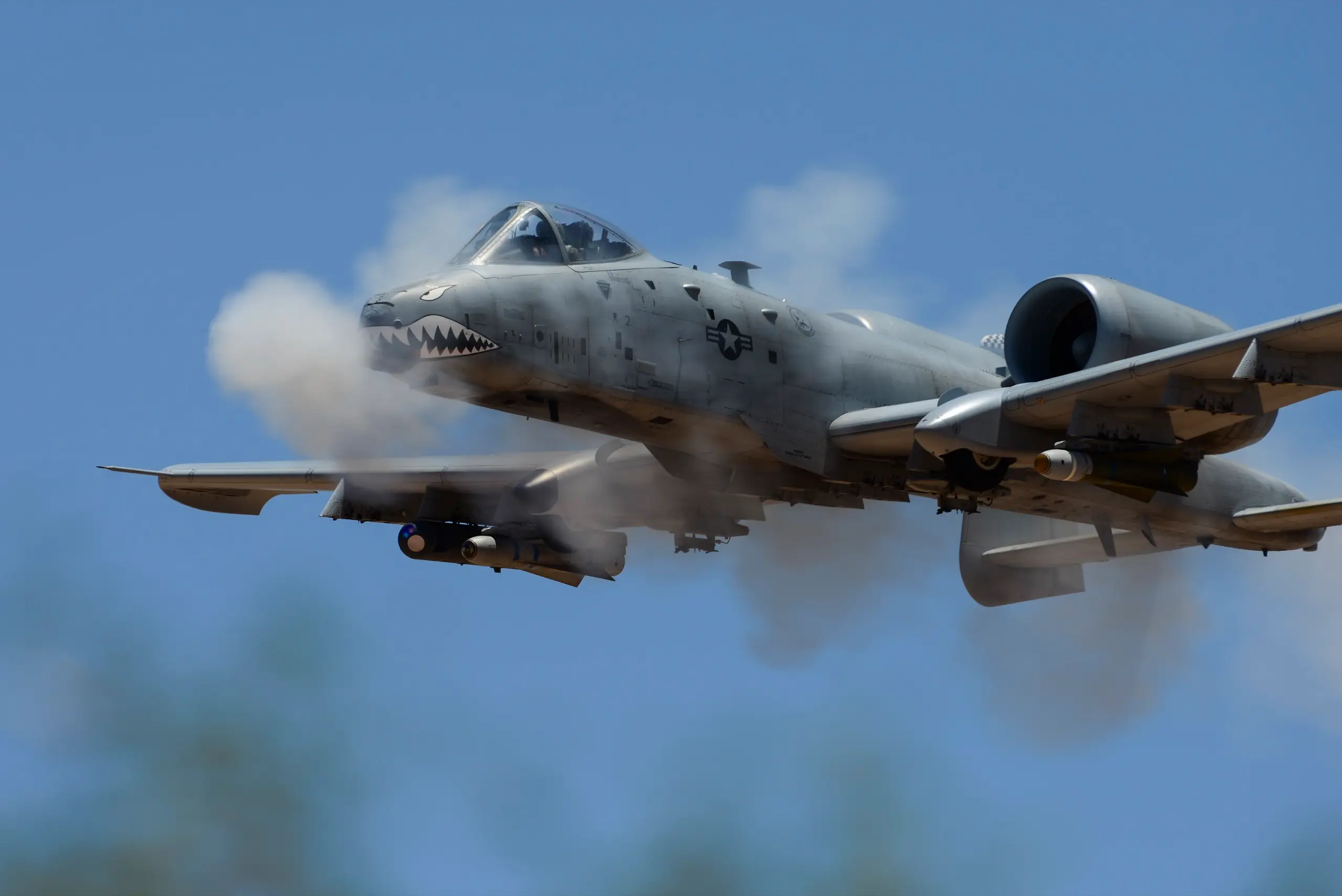
The people who first worked on the A-10 named it after a wild pig, and the name stuck. The jet is slow, straight-winged and stubby, with two engines bolted high on its back like an afterthought. Soldiers on the ground love it more than almost any aircraft ever built, because when an A-10 arrives overhead it does not drop a bomb from far away and leave. It stays, circling low, and then it opens fire with the cannon in its nose.
That cannon is the reason the rest of the aircraft exists. In the early 1970s the Air Force designed the A-10 around the GAU-8 Avenger, a seven-barrel 30 mm cannon longer than a Volkswagen Beetle, for one scenario: thousands of Soviet tanks pouring into Western Europe. Fairchild Republic, the company that had built the P-47 Thunderbolt in the Second World War, wrapped a simple, tough airframe around the gun and called it the Thunderbolt II. Everybody else called it the Warthog.
The whole airframe assumes it will be hit. The pilot sits in a titanium bathtub of armour. The fuel tanks are packed with foam and seal themselves. The flight controls are doubled, and if every hydraulic system fails the pilot can still fly the jet through cables. The engines ride high on the rear fuselage, where ground fire is least likely to reach them. A-10s have come home with holes the size of a football in them.
The Soviet tanks never came. The wars did. In the 1991 Gulf War A-10s flew more than 8,000 sorties, and since then they have fought over the Balkans, Afghanistan, Iraq and Syria. They have also circled over downed airmen while the rescue helicopter came in, a job their crews call Sandy.
It has outlived almost everyone’s plans for it, too. The Air Force has tried to retire the A-10 again and again since 2014, and Congress has said no every time. In April 2026 the Air Force announced it would keep flying until 2030. Fifty years after it entered service the Warthog is still ugly, still loud, and still turning up when it is called.